
Verification Checklist: Centralized Exchange PoR Audit Essentials
- ✓ Mathematical Non-Negativity Verification: Verify whether the Merkle tree architecture enforces zero-knowledge range constraints (e.g., Bulletproofs) ensuring
0 ≤ balance < 2^64to prevent liability offset attacks. - ✓ Time-Weighted Balance Velocity Analysis: Reject static single-block snapshots. Audit cold wallet UTXO and ERC-20 inflows across at least 72 hours before and after the snapshot block to detect temporary bridge loans.
- ✓ Off-Chain Encumbrance & Rehypothecation Check: Confirm whether reserve addresses have approved token transfers to external lending vaults (EigenLayer, Aave, Lido) that generate subordinated unbacked debt.
- ✓ Comprehensive Multi-Asset Liability Closure: Ensure that the published audit scope accounts for margin deposits, yield programs (Earn), and collateral loans across all platform services rather than cherry-picked pairs.
1. The Mathematical Illusion of Merkle Sum Trees: Why Leaf Inclusion Fails Solvency
In standard Merkle Sum Tree implementations, each leaf node represents an anonymized user account commitment h = H(uid, nonce) paired with an asset balance b. Parent nodes are computed recursively by summing child balances and hashing concatenated digests:
parent.hash = H(left.hash || left.balance || right.hash || right.balance)
parent.balance = left.balance + right.balance
When an individual user downloads their personal authentication path, their local script recomputes hashes and balances up to the Merkle Root. If the computed root matches the operator's published root, the user receives apparent cryptographic confirmation.
However, information theory reveals a foundational blind spot: Proof of Inclusion does not imply Proof of Completeness or Solvency. An individual audit path covers merely 20 to 30 adjacent siblings along a single branch. The user remains entirely blind to the contents of millions of other leaves across parallel subtrees. If a fraudulent operator constructs anomalous values within uninspected branches, the root liability sum can be forged arbitrarily.
2. Negative Balance Smuggling: Mathematical Mechanics of Offset Fraud
Negative balance smuggling occurs when an insolvent platform intentionally modifies leaf generation logic to offset customer deposits against phantom negative entries. The underlying arithmetic is alarmingly straightforward:
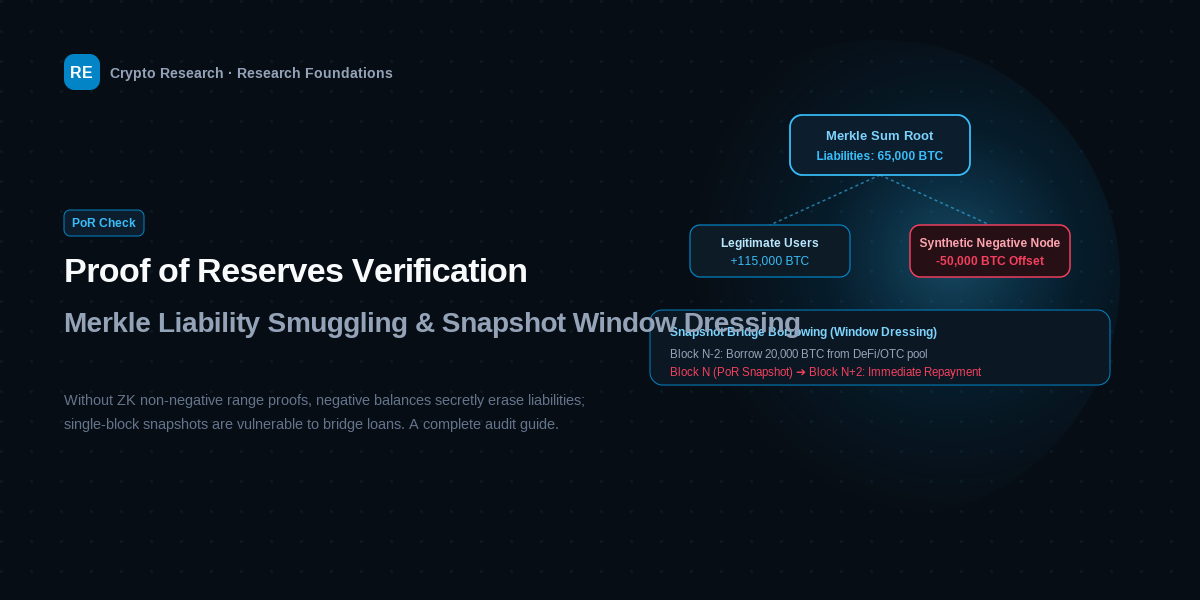
Suppose an exchange genuinely owes users 115,000 BTC, but holds merely 65,000 BTC in its on-chain vaults, suffering an uncollateralized deficit of 50,000 BTC. In a naive Merkle Sum Tree devoid of non-negative range proofs:
- The exchange packages all legitimate customer balances honestly (aggregating to
+115,000 BTC); - The exchange inserts an internal dummy leaf into an isolated branch carrying an artificial balance of
-50,000 BTC; - When the parent nodes aggregate across subtrees:
root.balance = legitimate_subtree.balance (+115,000) + dummy_node.balance (-50,000) = 65,000 BTC - The resulting Merkle Root indicates a total liability of exactly
65,000 BTC, matching on-chain reserves precisely to boast a fraudulent 100% reserve ratio.
Under this attack vector, every genuine user verifies their personal path with 100% success. Because no individual user path intersects with the isolated negative leaf, traditional audits blindly confirming Root.balance == OnChain.reserves will report pristine solvency.
3. Snapshot Window Dressing: Detecting Ephemeral Bridge Borrowing
Beyond liability manipulation, the asset side of PoR is frequently compromised by single-block snapshot window dressing. Solvency attestations conventionally record balances at a predetermined block height (e.g., Ethereum block 21,240,000).
Because decentralized lending pools and institutional OTC desks provide multi-million-dollar flash liquidity:
- Ten blocks prior to the audit target (approximately 2 minutes prior), the platform borrows
20,000 ETHusing off-chain collateral or protocol credit; - The borrowed capital is swept into the platform's public cold storage address;
- The snapshot block is minted, and the custodian cryptographically signs the balance assertion;
- Merely 5 blocks later, the platform executes reverse transfers, returning the 20,000 ETH to the lender.
To penetrate this deception, researchers must discard static snapshot balances in favor of a Time-Weighted Balance Velocity Model. By analyzing UTXO residency and ERC-20 inflows across a 72-hour window before and after the snapshot block, any large-scale deposit representing more than 5% of reserves that persists for less than 48 hours and subsequently flows back to lending facilities must be flagged as fictitious temporary liquidity.
4. Zero-Knowledge Proofs (zk-PoR): Enforcing Non-Negativity with Bulletproofs
To eliminate negative-balance exploits algorithmically, advanced custody infrastructures transition to zk-SNARKs and Bulletproofs-based Proof of Reserves (zk-PoR). The core innovation lies in cryptographic range proofs:
Within a zero-knowledge circuit, individual user balances are represented as homomorphic Pedersen commitments: C = g^v * h^r (where v is the balance and r is a blinding factor). The circuit mathematically proves that:
0 ≤ v < 2^64Under discrete logarithm assumptions, attempting to insert a negative value (which wraps around to an astronomically large number modulo the prime field exceeding 2^64) causes proof generation to fail irrevocably. Independent verifiers run lightweight verification scripts locally to guarantee that every leaf across tens of millions of accounts is strictly non-negative without compromising personal account privacy.
5. Independent Verification Protocols: An Audit Checklist for Researchers
Professional analysts, market makers, and institutional depositors evaluating any centralized solvency report must execute the following four-step verification framework:
- Local Open-Source Script Verification: Never rely on web-based verification widgets hosted by the exchange itself. Always download open-source verification CLI binaries (Python or Rust) and independently compute Merkle path hashes inside an isolated sandbox.
- Cryptographic Ownership Signatures: Verify that the custodian generated valid digital signatures (ECDSA / Ed25519) utilizing the private keys of disclosed cold storage addresses over the exact snapshot block hash, preventing third-party address spoofing.
- On-Chain Collateral & Allowance Tracking: Audit disclosed cold storage addresses using on-chain explorers to ensure that tokens are not encumbered by infinite ERC-20 approvals to decentralized lending protocols (such as Aave, Compound, or Morpho) where assets may serve as pledged collateral for unrevealed liabilities.
- Holistic Multi-Product Balance Reconciliation: Confirm that the solvency audit accounts for open futures margins, Earn yield programs, and lending obligations rather than restricting transparency to spot balances while concealing derivative exposures.
References & Standards
- Vitalik Buterin's Solvency Framework: Having a safe CEX: proof of solvency and beyond (Vitalik Buterin)
- Cryptographic Range Proof Standards: Bulletproofs: Short Proofs for Confidential Transactions and More
- Exchange Solvency Research: Provisions: Complete Privacy-Preserving Proofs of Solvency for Bitcoin Exchanges
- Ethereum Signature Verification: EIP-1271: Standard Signature Validation Method for Contracts