
Verification checklist
- Read the protocol instant-redeem cap or buffer balance at one block; do not use UI copy.
- Run a read-only quote on the main pair and measure executable secondary size inside 50 basis points.
- Map consensus exit and withdrawal rules, and write queue wait in days, not “fairly soon”.
- If research size exceeds the buffer and half of near-tick depth, do not call the exit liquid; list three paths.
1. A transferable receipt is not an instant redemption right
Liquid staking turns principal locked in consensus into a receipt that can move on the execution layer. Transfer is fast; principal exit is not. Ethereum’s staking-withdrawal note splits a full exit into a validator exit queue and a later sweep onto the execution layer; EIP-4895 specifies beacon-chain push withdrawals, not a DEX pool willing to take the other side. Product copy that folds both into one “liquid” lets a research note treat someone else’s liquidity as the holder’s redemption right.
My rule is: any sentence that calls an LST instantly exitable must carry three numbers — protocol buffer, secondary capacity at a stated slippage, and queue wait in days. Missing one, “liquid” is an adjective.
2. A worked example: one “unstake anytime”, three paths an order of magnitude apart
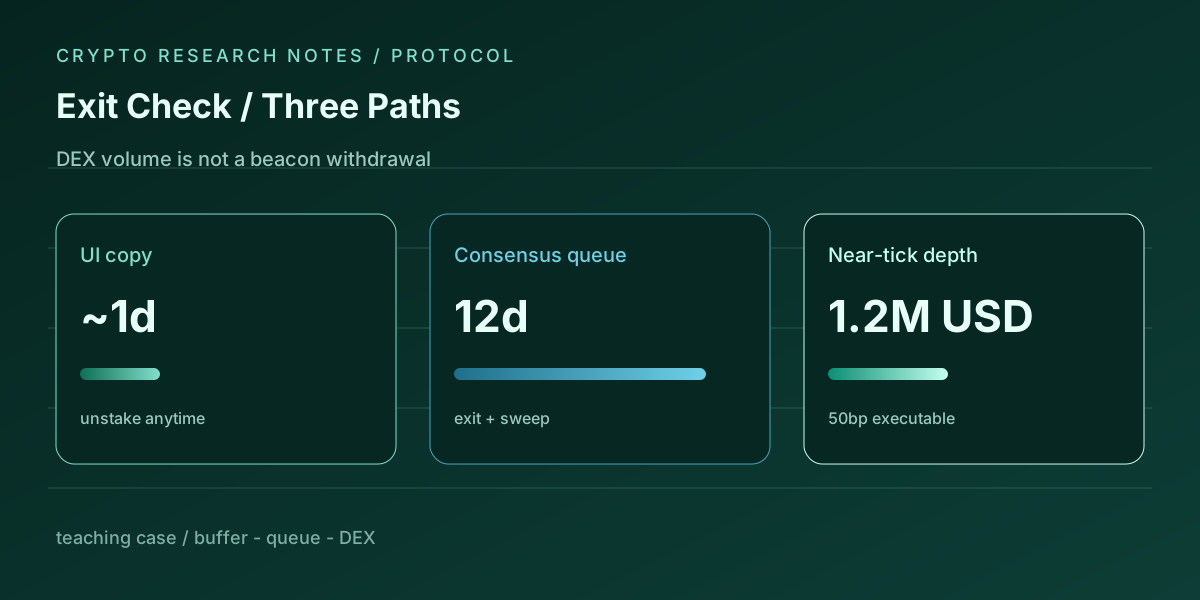
Suppose an LST UI says “about one day to exit” and protocol TVL is $800 million. The same block’s instant buffer is $4 million. A read-only quote on the main pool shows about $1.2 million executable inside 50 basis points. Using public exit and sweep rules, a full redemption queue is about 12 days. A researcher who wants to call a $20 million position “liquid, instantly realisable” has no path that holds. The table is hypothetical.
| Path | What is read | Capacity or wait | Versus $20m |
|---|---|---|---|
| Protocol buffer | instant-redeem cap | $4.0m | covers 20% |
| Secondary market | 50bp near-tick depth | $1.2m | covers 6% |
| Consensus queue | exit plus sweep | ~12 days | size is notionally enough; time is not “anytime” |
The gap between $1.2 million and $800 million TVL is not “a temporary discount”. Most of the capital sits in validators, not in ticks around the current price. Treating TVL as exit size treats the market value of a locked receipt as cash in the till. The correct sentence is: at most $4 million instant; about $1.2 million secondary inside 50bp; the rest enters the queue, a teaching wait of 12 days. The $20 million clip is not a liquid exit.
3. Read three paths so volume is not mistaken for redemption
Layer one is the protocol’s own instant door: buffer balance, a maxRedeem-style cap, pause flags. Same block, raw return values. Layer two is the secondary market: a router or Quoter read, in the spirit of Uniswap v3 single-hop quoting, to find the notional that pushes price 50 basis points; on a CEX, the resting size 50bp either side of mid, with the screenshot time. Layer three is consensus: write the validator exit queue and sweep delay as a range from the proof-of-stake exit and finality docs, not the UI’s “about a day”.
The three paths use different units. The buffer is ETH the protocol has not restaked; secondary depth is the receipt counterparties will buy inside slippage; the queue is the rate the beacon state machine allows exits. Summing 24-hour DEX volume and calling it “daily redeem capacity” treats other people’s completed turnover as an exit you have not yet sent.
4. A screen: size must not exceed the buffer, nor half of near-tick depth
The teaching screen allows a position S to be called instantly realisable only if both hold: S ≤ buffer; S ≤ 0.5 × (50bp secondary depth). The half is slack for other sells in the same block and for quote decay, not a regulatory standard. In the example S = $20 million, buffer $4 million, half of near-tick $0.6 million; both fail. The write-up can only say: that size would move secondary price hard, and the protocol path is the queue; do not use the word liquid.
The screen does not cover depeg, slashing, credential rotation or pauses. Those are a separate check. Passing clock and depth also does not prove the token price equals underlying principal — that is an exchange-rate question. A long queue, conversely, does not prove default; it only proves “anytime” was the wrong word.
5. Keep a record another researcher can replay
A minimum record includes chain ID, block number and hash, LST and underlying addresses, raw buffer or maxRedeem, the quote call and return, 50bp depth, UI wait copy, queue days from the spec, research size S, and whether both inequalities hold. Store CEX ladder timestamps; store calldata or the query string for on-chain quotes; do not splice another refresh into the same row.
Reconcile in a fixed order: buffer, then near-tick depth, then queue. Any gap between “about a day” and the spec estimate belongs in unexplained wait. Unexplained is not an accusation of fabrication; it is a ban on writing the gap into verified instant liquidity. If a paid node is required to read the beacon queue stably, record that source grade.
6. Liquidity is three paths, not one adjective
The weak sentence is “this LST is very liquid; TVL is large”. A useful one is “buffer B; 50bp depth D; queue about T days; coverage of size S versus B and D/2”. Until those four quantities are written, using volume to narrate “we can get out in a run” turns other people’s prints into your exit.
This is a research framework with hypothetical calculations, not a quality opinion on any liquid staking protocol, and not investment advice.