
Verification checklist
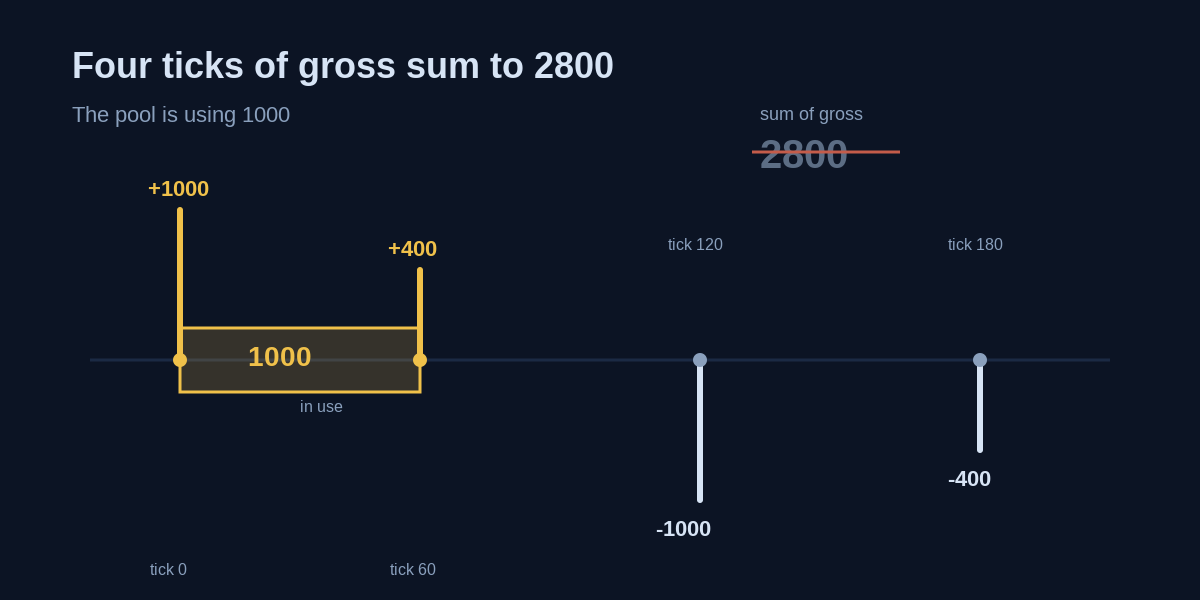
- Read pool liquidity(). Do not sum liquidityGross across ticks and call that the same number. After the teaching mint, gross sums to 2800 and the pool is using 1000.
- liquidityNet is positive on a lower tick and negative on an upper tick. A left-to-right cross adds that net. A right-to-left cross negates a local copy only. The stored net is not rewritten.
- A mint updates pool liquidity immediately only when the current tick is inside the range. At tick 0 the position bounded by 60 and 180 already has gross written, and pool liquidity does not gain 400.
- At tick 90, ticks(90) gross is 0. After crossing 60 upward and before crossing 120, pool liquidity is 1400. From tick 0 to tick 59, liquidity stays 1000 and the price ratio is 1.005917142554.
1. Gross counts positions that reference the tick, and one position is written twice
IUniswapV3PoolState v1.0.0 describes the first return of ticks(tick), liquidityGross, as the total position liquidity that uses the tick as tick lower or tick upper. It is not the amount the pool can trade against right now. The same interface describes liquidity() as the currently in-range liquidity available to the pool, and its comment says this value has no relationship to the total liquidity across all ticks. Those two comments are already the split between 2800 and 1000.
Tick.update in v1.0.0 runs once for the lower tick and once for the upper tick. When upper is false, liquidityNet gains liquidityDelta. When upper is true, liquidityNet loses liquidityDelta. liquidityGross uses LiquidityMath.addDelta both times, so a position of 1000 leaves gross 1000 on each boundary. Adding those two gross values produces 2000. The position's own liquidity is still 1000. The extra 1000 is the same position counted twice, not a second position.
This is not the question in Position Check: Liquidity on a Position Is Not a Token Balance. That note asks whether one position's liquidity can be read as token0 and token1. This note assumes that liquidity figure is already read correctly, and asks whether gross on many ticks can be added up into the liquidity the pool is using.
2. Two teaching positions, minted while the tick is 0
The integers are small so the additions stay visible. The pool uses fee 3000 from the v1.0.0 constructor, so tick spacing is 60 and every boundary has to sit on a multiple of 60. Spacing Check: Fee 3000 Stores Tick Spacing 60, and -887272 Is Outside the Grid already checks that. The four ticks here are 0, 60, 120, and 180.
Position A has liquidity 1000, from tick 0 to tick 120. Position B has liquidity 400, from tick 60 to tick 180. Both are minted while slot0.tick is 0. Tick.update then stores: tick 0, gross 1000 and net +1000; tick 60, gross 400 and net +400; tick 120, gross 1000 and net -1000; tick 180, gross 400 and net -400. The four gross values sum to 2800. No single tick has gross 2800, and no single tick has net 2800.
For spacing 60, Tick.tickSpacingToMaxLiquidityPerTick compresses MIN_TICK -887272 and MAX_TICK 887272 onto the grid, which lands on -887220 and 887220. That is 29575 ticks, and the per-tick gross cap is 11505743598341114571880798222544994. The teaching values 1000 and 400 are far under that cap, so update does not revert with LO. The gap between 2800 and 1000 is not the per-tick ceiling.
| tick | whose boundary | liquidityGross | liquidityNet |
|---|---|---|---|
| 0 | A lower | 1000 | +1000 |
| 60 | B lower | 400 | +400 |
| 120 | A upper | 1000 | -1000 |
| 180 | B upper | 400 | -400 |
3. At the mint, only the in-range position enters the pool
UniswapV3Pool v1.0.0 splits _modifyPosition on the current tick. If the tick is below the lower bound, only token0 is due and pool liquidity is unchanged. If the tick is below the upper bound, the price is inside the range, and only this branch calls LiquidityMath.addDelta on the pool's liquidity. Otherwise only token1 is due. A tick equal to the lower bound fails the first test and takes the inside branch. A tick equal to the upper bound takes the last branch, and pool liquidity does not increase.
The mint happens at tick 0. Position A has 0 below 120, and 0 is not below its lower tick, so it takes the inside branch and pool liquidity moves from 0 to 1000. Position B has lower tick 60. Because 0 is below 60, B takes the first branch and pool liquidity stays 1000. B's gross and net are already stored on tick 60 and tick 180. That liquidity is not yet part of the number the pool is using. Writing 2800 by summing gross counts the 400 that is not active yet, and it counts every boundary a second time.
The net is written at mint, but the mint does not call Tick.cross. The inside branch updates pool liquidity directly and does not add the lower tick's net again. Adding 1000 for the inside branch and then adding the +1000 stored at tick 0 would record A as 2000. The contract does not take that second step.
4. A cross adds the net. The leftward negation is not stored
Tick.cross subtracts the outside fee-growth accumulators from the global values and returns the stored liquidityNet. It does not flip the sign of liquidityNet. In swap, when price moves left and zeroForOne is true, that returned value is negated. The negation is local to the call. LiquidityMath.addDelta then applies it to state.liquidity. A rightward cross does not negate. The next cross in the other direction reads the original net and decides again whether to negate. Writing the negated value back into ticks(tick) flips the sign one extra time on the way back.
Moving right from tick 0: crossing tick 60 adds net +400, and pool liquidity goes from 1000 to 1400. Crossing tick 120 adds net -1000, and it becomes 400. Crossing tick 180 adds net -400, and it becomes 0. Gross on the four ticks does not change during these crosses, so the sum stays 2800. The liquidity the pool is using is 1000, then 1400, then 400, then 0. None of those four numbers is 2800.
From 1400, a leftward cross of tick 60 negates +400 into -400 because zeroForOne is true, and pool liquidity returns to 1000. The stored net is still +400. A note that says the net at tick 60 became -400 after the leftward pass will subtract 400 again on the next rightward cross, and pool liquidity will be short by 800.
| tick just crossed | net applied | liquidity afterward | sum of gross |
|---|---|---|---|
| none yet | A was already in range at mint | 1000 | 2800 |
| 60 | +400 | 1400 | 2800 |
| 120 | -1000 | 400 | 2800 |
| 180 | -400 | 0 | 2800 |
5. The current tick can have no gross. Price moves first, liquidity later
After the upward cross of tick 60, and before tick 120, pool liquidity stays 1400. Tick 90 sits in that stretch. It is not a multiple of 60 and it is not a boundary of either position, so ticks(90) is the zero struct: gross is 0 and initialized is false. Reading that gross as the liquidity in use writes 0. liquidity() is still 1400. The current tick and an initialized tick are different fields.
Price can move before liquidity does. Using the truncation from the square-root note on this site, an integer power of 1.0001 is cut at 12 decimal places, with no rounding. The ratio from tick 0 to tick 59 is 1.005917142554. No initialized tick lies between them, so swap does not call cross, and pool liquidity stays at the post-mint 1000. The ratio from tick 0 to tick 60 is 1.006017734268. Only that last step is where net +400 is added. Treating the move priced at 1.005917142554 as if depth had already gained 400 records a cross that has not happened.
The farther ratios are 1.012071681663 over 120 ticks and 1.018162060104 over 180 ticks. They describe price, not liquidity. Crossing tick 120 drops liquidity from 1400 to 400. The drop is the absolute net, 1000, not the price ratio 1.012071681663. Adding a price ratio to liquidity mixes two units.
6. Ask whether the reading is gross, net, or pool liquidity
The unreliable sentences are "sum liquidityGross on every tick and that is pool depth" and "gross on the current tick is the liquidity in use." The more reliable sentence names liquidity() as it stands, liquidityGross and liquidityNet on each tick, whether slot0.tick was inside or outside the range at mint, whether the next cross runs left or right, and whether a negation was written back to storage. In the teaching set the gross sum is 2800. After the mint the pool is using 1000. After tick 60 it is 1400. After tick 120 it is 400. After tick 180 it is 0. At tick 90, gross is 0. The price ratio from tick 0 to tick 59 is 1.005917142554, and that move does not change 1000.
This is an analytical frame. The comments on liquidity() and ticks() come from IUniswapV3PoolState at v1.0.0. Gross, net, and the value returned by cross come from Tick at the same tag. The three-way split at mint, and the negation of net when zeroForOne is true, come from UniswapV3Pool at the same tag. The per-tick cap 11505743598341114571880798222544994 is Tick.tickSpacingToMaxLiquidityPerTick for spacing 60. The ratios 1.005917142554, 1.006017734268, 1.012071681663, and 1.018162060104 are integer powers of 1.0001 truncated to 12 decimals. They are not a pool reading from 5 November 2026, and they are not investment advice.
7. Misreadings that keep coming back
If gross on four ticks sums to 2800, is pool liquidity 2800 too?
No. The v1.0.0 comment on liquidity() says it is the in-range liquidity available to the pool, and that it has no relationship to the total liquidity across all ticks. In the teaching mint at tick 0, gross of 1000, 400, 1000, and 400 sums to 2800, and pool liquidity is 1000.
If the current tick is 90, is ticks(90) gross the liquidity the pool is using?
No. Tick 90 is not a boundary of either position, so it is not initialized and its gross is 0. After an upward cross of tick 60 and before a cross of tick 120, pool liquidity is 1400.
Does active liquidity change as price moves from tick 0 to tick 59?
No. No initialized tick sits between them, so no cross runs. The price ratio, 1.0001 to the 59th power truncated to 12 decimals, is 1.005917142554, and pool liquidity stays 1000. Active liquidity changes only when price crosses tick 60 from left to right, adding net 400 and becoming 1400.