
Verification checklist
- Write the spot only as reserve over reserve. Do not multiply spot by size and call that the amount received.
- Price the fill with this pool's own fee coefficient and reserves. The V2 library's 997/1000 does not transfer to a pool on another fee.
- When a fee-only figure differs from the formula, record the gap as impact. Do not fold it back into the fee rate.
- Two pools with the same spot still need their own reserves. Different depth means the amounts received are not the same figure.
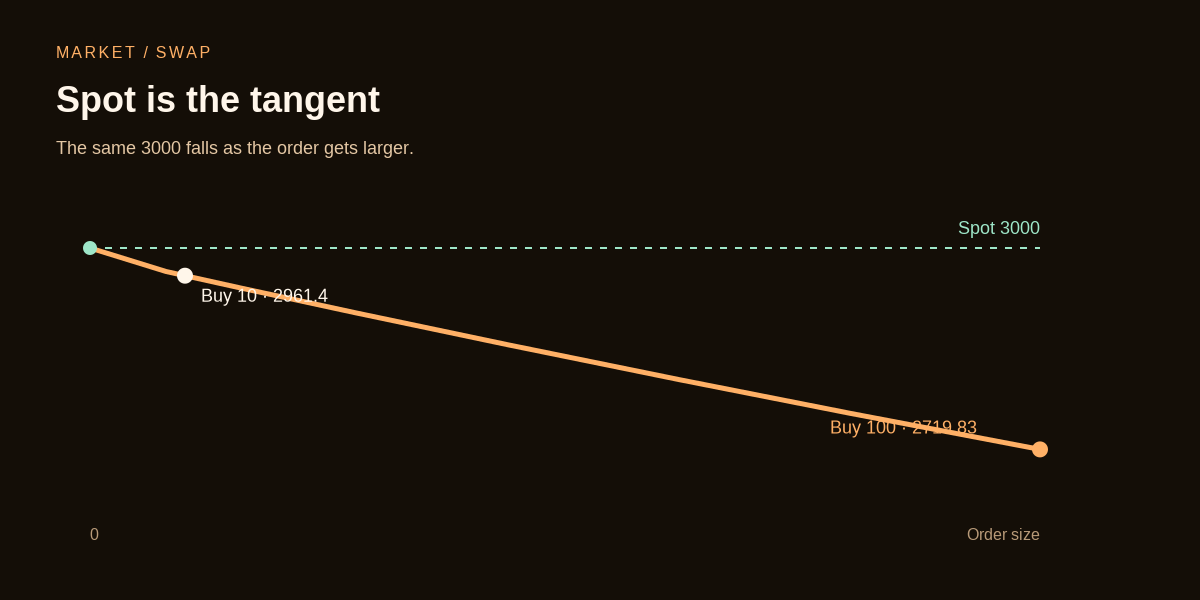
1. Spot is the tangent. The fill is the chord
A common sentence in a note is "the pool is at 3000, so buying 10 returns 30000." That sentence treats a marginal price as an average. Uniswap V2 getAmountOut does not multiply those two numbers. It multiplies the input by 997, then divides by the input reserve times 1000 plus that fee-adjusted input. The 997/1000 is the 0.3% fee hardcoded in that library, and the division floors. The spot y/x matches the fill only as the input approaches zero. Once the input is a visible fraction of the reserve, the curve bends and the chord lies under the tangent.
The fee and the impact are not one gap. Taking 0.3% off 30000 still assumes the trade executed at the spot. The denominator also contains the input reserve. A shallower pool moves farther for the same input, the denominator grows, and the output shrinks. Calling the whole gap "the 0.3% fee" erases impact in a shallow pool and invents impact in a deep one.
This is not the site's other three execution notes. The cross-venue note asks how much of a quoted spread survives slippage and a transfer. The transfer-tax note asks whether the buy path and the sell path use the same tax. The routing note asks which costs sit outside a "best path" quote. This note assumes the path is already chosen and the token tax is recorded elsewhere. The question is whether this pool's spot can be multiplied into this trade's output.
2. Teaching case: writing 30000, the formula returns 29614
The teaching reserves are not a live pool on 23 October 2026. In the shallow pool the input reserve x is 1000 and the output reserve y is 3000000, so the spot y/x is 3000. These integers are already the units the formula divides. If the tokens also have a decimals field, align the scale first; a mixed scale makes the gap meaningless. The deep pool multiplies both reserves by 100. The spot is still 3000. It exists so depth can be compared.
Buying 10: the numerator is 10 × 997 × 3000000 = 29910000000, the denominator is 1000 × 1000 + 10 × 997 = 1009970, and the output is 29910000000 / 1009970 = 29614. The remainder is 748420, and the contract drops it. Spot times size is 30000. Fee only is 29910. The formula is 386 under the spot quote. The fee explains 90 of that, and the impact explains 296. The fill price is 29614/10 = 2961.4, not 3000.
| Reading | Shallow, buy 10 | Shallow, buy 100 | Deep, buy 100 |
|---|---|---|---|
| Spot times size | 30000 | 300000 | 300000 |
| Fee of 0.3% only | 29910 | 299100 | 299100 |
| getAmountOut | 29614 | 271983 | 298802 |
| Fill price | 2961.4 | 2719.83 | 2988.02 |
On a buy of 100 in the shallow pool, the gap is no longer the fee. 300000 minus 271983 is 28017. The 0.3% fee is 900 of that, and the impact is 27117. The fee explains about 3% of the miss. The rest is an input of 100 against a reserve of 1000. The same buy of 100 in the deep pool returns 298802. That is only 298 under the fee-only figure of 299100, so the fee is again the larger part of the gap. One sentence, "the price is 3000, buying 100," differs by 298802 − 271983 = 26819 across the two pools. The difference is the reserves, not the shared 3000 on the screen.
3. The spot after the trade is still not the fill
After the shallow pool buys 10, the input reserve is 1010 and the output reserve is 3000000 − 29614 = 2970386. The new spot is 2970386/1010 = 2940.98. The fill of 2961.4 sits between the old spot of 3000 and the new spot of 2940.98, and it equals neither. Reading the reserve ratio after the trade and writing that new spot as "the price I just paid" makes the trade look worse than it was. The fill is output divided by input. The spot is the tangent that remains.
The fee coefficient is not a global constant either. Uniswap's note on how fees evolved describes V2 as a single fee and V3 as separate pools at 0.05%, 0.30%, and 1.0%. The 997 in the V2 library belongs to pools that call that getAmountOut. Using 997 on a 0.05% pool multiplies the fee by about six. Concentrated liquidity also means the token balance is not the reserve. Uniswap's concentrated-liquidity note says V2 spreads liquidity from zero to infinity, and that about 0.50% of the DAI/USDC capital sits in the 0.99 to 1.01 range where trading actually happens. A V3 balance can sit outside the current price. Feeding the pool's token balance into the V2 formula counts inventory this trade never touches, and the impact comes out too small.
4. A screen: spot times size cannot be written as the amount received
The teaching screen is ordered. First, the fee coefficient comes from this pool, not from "AMMs charge 0.3%." Second, the reserves in the formula are the reserves this trade actually walks: getReserves in the right direction for V2, and the inventory offered inside the current range for concentrated liquidity, not the contract's whole token balance. Third, the amount received is the floored formula. Spot times size, and spot times size times one minus the fee, are comparison columns. They are not the fill. Fourth, two pools are subtracted only after each has passed the first three steps. Writing a spread of zero because the spots match fails the screen.
The screen does not say how much of a cross-venue spread a transfer fee consumes. That is the arbitrage note. It does not say what a token contract deducts on transfer. It does not say which extra layers an aggregator adds after it chains several pools. A formula that holds for one pool can still worsen on the next hop. Passing once does not keep the reserves at these figures. The next trade reads them again.
5. Keep a record another researcher can replay
The minimum fields are: venue, pool address, both tokens and their decimals, the reserves or in-range liquidity at the read, the fee coefficient (997/1000 or that pool's tier, written out), input size, numerator, denominator and remainder, floored output, spot, the fee-only comparison, fill price as output over input, and the new spot after the trade. A two-pool comparison adds the same fields for the other pool. If input and output are not in the same unit, the row stops at "scale not aligned."
Reconcile in a fixed order: whether the units match, whether the fee coefficient belongs to this pool, whether the reserves are the inventory this trade uses, and only then the spot-times-size column and the fee-only column. A note missing reserves or the fee stops at "formula incomplete." Holding a small amount of the token in order to compare a displayed spot with a wallet receipt belongs in a fee footnote. It does not belong in the judgment of whether the formula explains the fill.
6. Write the reserves and the fee before talking about the price
The weak sentence is "the pool is at 3000, so this trade fills at 3000." A useful one is "spot; fee coefficient; reserves this trade uses; formula output; fill price; new spot after the trade." The tangent, the chord, and the tangent after the trade are three numbers. In a shallow pool the impact can be an order of magnitude above 0.3%. In a deep pool the same order can shrink until the fee is what remains. An equal spot only says the two tangents have the same slope.
This is a research framework. The 997/1000 coefficient and the floor division come from the V2 library cited above. The V3 fee tiers, and the statement that about 0.50% of capital sits between 0.99 and 1.01, come from the Uniswap pages cited above. The figures 1000, 3000000, 29614, 271983, and 298802 are a teaching conversion. They were not measured on a live pool, and they are not investment advice.