
Verification Checklist
- ✓Confirm whether "proof of reserves" specifically means real-time on-chain data anyone can independently verify at every block, or a snapshot audit report issued periodically by a third party, and the report's publication cadence
- ✓Verify how the native asset is custodied: locked in a publicly inspectable on-chain smart contract, or held off-chain by one or more centralized institutions
- ✓Check the gap between a snapshot audit's issue date and the current date, and assess whether reserves could plausibly have changed during that window
- ✓Verify whether custodied assets have been redeployed elsewhere (e.g. as lending collateral or liquidity), and check the multisig threshold and signer diversity controlling custody
1. "Proof of Reserves" Hides One Crucial Question: How Often Is It Checked
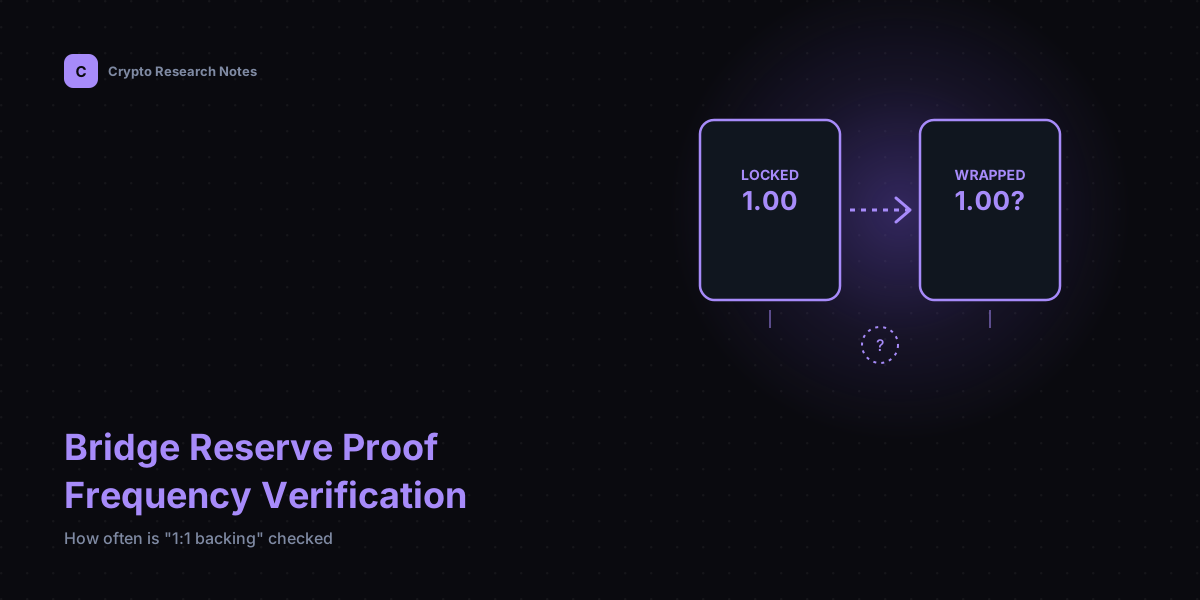
The term "proof of reserves" originally came from the centralized exchange context, referring to a published proof that an exchange's total held user assets aren't less than the sum of user account balances. The concept in a bridge context is similar but the mechanism differs: the "wrapped asset" a user holds on the destination chain (like wBTC or bridged USDT) is supposed to correspond to an equal amount of native asset locked on the source chain, and a proof of reserves is the mechanism used to demonstrate that correspondence holds. But the issue is that "proof exists" and "proof stays valid" are two different things — if a reserve proof is only a one-time snapshot at some point in time, it can only tell you "the backing relationship held at the moment the audit happened," with no guarantee it still holds at the moment you're reading the report. By contrast, if the reserve proof is maintained in real time via an on-chain smart contract, anyone can query at any moment the amount of asset locked in the contract versus the total amount of wrapped asset minted on the destination chain — the gap between the two is immediately visible, with no dependence on any third party's periodic report.
The first thing a verifier should do is reframe the question from "does a proof of reserves exist" to "what is the verification frequency of this proof of reserves" — is it real-time data updated every block, or a static snapshot updated weekly, monthly, or quarterly. This frequency gap directly determines how much reference value this "proof" still holds at the exact moment you're making a decision based on it.
- A proof of reserves demonstrates the correspondence between "wrapped asset on the destination chain" and "locked native asset on the source chain," but it only has ongoing meaning if verified continuously.
- A one-time snapshot audit only proves the backing relationship held at audit time — it cannot guarantee it still holds when you're reading the report.
- The verification focus should shift from "does a proof of reserves exist" to "what is the verification frequency of this proof of reserves."
2. Verification Method One: Distinguish Real-Time On-Chain Verifiable Reserves from Snapshot Audit Reports
To determine which type a given reserve proof falls into, a verifier should check the official documentation directly for a self-queryable on-chain contract address — if one exists, and the asset balance locked in that contract can be read at any time via a block explorer, while the total supply of wrapped asset on the destination chain is also public on-chain data, then anyone can independently calculate the ratio between the two at any moment. This is genuine real-time on-chain verifiable reserves, with no dependence on any third party's periodic report. If the official materials only offer a PDF audit report listing an asset balance verified by an auditing firm on a specific date, with no link to any real-time queryable on-chain address, this is essentially a snapshot proof, and its credibility rests entirely on the auditor's independence, the rigor of the audit methodology, and — most importantly — how much time has passed between the report's issue date and the present. A verifier should note that some protocols offer both mechanisms simultaneously: day-to-day operations rely on real-time on-chain data, while a third party is still periodically commissioned to issue an audit report as supplementary endorsement — this combined model is generally more trustworthy than relying on either mechanism alone.
- Genuine real-time on-chain verifiable reserves require a self-queryable on-chain contract address, with both locked assets and wrapped-asset total supply as public on-chain data.
- Providing only a PDF audit report with no queryable on-chain address is essentially a snapshot proof, whose credibility depends on the auditor's independence and the report's timeliness.
- A combined model — real-time on-chain data plus periodic third-party audit reports — is generally more trustworthy than relying on either mechanism alone.
3. Verification Method Two: Check the Specific Custody Structure of the Native Asset
Even after confirming verification frequency, the underlying custody structure a reserve proof depends on needs separate scrutiny, because different custody structures carry entirely different risk exposures. Under an on-chain lock-contract model, the native asset is locked in a publicly deployed smart contract, and anyone can inspect the contract code and verify the locking logic — the main risk is whether the contract itself has bugs, and who holds the authority to unlock it (this can be cross-checked against this site's earlier pieces on upgradeable contract proxy patterns and multisig verification). Under a centralized custody model, the native asset is held off-chain by one or more institutions, meaning users must additionally trust that these institutions won't misappropriate assets, won't be hacked, and won't have assets frozen by regulators — and the identity, geographic jurisdiction, and regulatory status of the custodian are all concrete details a verifier should check, rather than settling for a vague claim like "assets are held by a reputable institution." Another situation worth watching for: some protocols redeploy custodied assets elsewhere to earn additional yield (e.g., depositing them into a lending protocol for interest, or using them as liquidity for another protocol). This "reserve redeployment" practice means that even if the reserve total looks "sufficient" on paper, the actual assets are now exposed to the risks of the lending protocol or liquidity pool itself — if anything goes wrong with that secondary use, the reserve's actual redeemability takes a real hit.
- An on-chain lock contract's risk mainly centers on contract bugs and who holds unlock authority — cross-check against proxy-upgrade-authority and multisig verification methods.
- Centralized custody requires additional checks on the custodian's identity, geographic jurisdiction, and regulatory status — not just a vague claim of "held by a reputable institution."
- If reserve assets are redeployed into lending or liquidity pools for yield, a sufficient balance on paper doesn't mean actual redeemability is unaffected.
4. Hidden Risk Checklist: The Time Gap Between an Audit Snapshot and the Present
Beyond custody structure, reserve proofs carry several easily overlooked time-dimension risks. First, audit publication lag: most third-party audits take weeks to complete verification and write up a report, meaning there's an inherent gap between the "audit date" on a report's cover and the date the report is actually made public — a verifier should use the actual audit date (not the publication date) as the baseline for evaluating how current the backing relationship is. Second, the window-period risk after publication: even if the backing relationship held perfectly on audit day, the entire window until the next audit (potentially months long) is completely unconstrained by any external verification — any operational change the bridge operator makes during that window won't be caught by an audit report unless the reserve proof itself has already switched to real-time on-chain verification. Third, multisig control concentration: whether it's an on-chain lock contract or a centralized custody account, the actual authority to unlock or transfer funds is usually held by a multisig wallet, and its signing threshold (e.g., 3-of-5 vs. 6-of-9) and whether signers are genuinely distributed and include third parties independent of the operating team directly determine whether "the reserve proof shows the assets are still there" is even credible — if the threshold is too low or signers are highly concentrated, the operator in theory could still quietly move assets between audits.
- Use the actual audit date, not the publication date, as the baseline for evaluating currency, since audit write-up itself introduces a lag.
- The window between snapshot audits (potentially months long) is completely unconstrained by external verification unless the proof has switched to real-time on-chain data.
- Multisig threshold and signer distribution determine the real credibility of a reserve proof — a low threshold or concentrated signers still allows quiet asset movement between audits.
5. Cross-Protocol Comparison Framework: Verification Frequency, Custody Transparency, Independent Audit
When facing multiple bridges or wrapped-asset issuers, a verifier can score them across three dimensions. First, verification frequency: protocols with self-verifiable real-time on-chain data should rank above snapshot audit reports; among snapshot audits, a shorter publication cycle (monthly beats quarterly, quarterly beats annually) is more trustworthy. Second, custody transparency: an on-chain lock contract is inherently more transparent than centralized custody; among centralized custody arrangements, protocols that publicly disclose the specific custodian's identity, jurisdiction, and regulatory credentials should rank above those vague about custody details. Third, independent third-party audit: even if a protocol already provides real-time on-chain data, whether an independent audit or security assessment — not issued by the protocol itself — exists as cross-verification is a plus, because on-chain data itself could reflect a manipulated contract state (for instance, temporarily topping up reserves via a flash loan and immediately withdrawing them afterward). Scoring across these three dimensions together produces a genuine cross-protocol picture of reserve credibility — rather than assuming a protocol's wrapped asset is safe simply because the phrase "proof of reserves" appeared somewhere on its marketing page.
- Verification-frequency dimension: real-time on-chain verifiable beats snapshot audits; among snapshot audits, shorter publication cycles are more trustworthy.
- Custody-transparency dimension: an on-chain lock contract beats centralized custody; centralized custody requires checking the institution's identity, jurisdiction, and regulatory credentials.
- Independent third-party audit as cross-verification guards against on-chain data itself being temporarily manipulated (e.g., topping up reserves via flash loan then immediately withdrawing).
6. Verification Checklist and Conclusion
Distilling the sections above into a reusable checklist: first, has it been determined whether "proof of reserves" specifically means real-time on-chain data or a snapshot audit report, and if the latter, what its publication cycle is? Second, has the native asset's custody structure been verified — on-chain lock contract or centralized custody account — and are the custodian's identity and regulatory status publicly transparent? Third, has the gap between a snapshot audit's publication date and the current date been calculated, with an understanding that this window is completely unconstrained by external verification? Fourth, has it been checked whether custodied assets have been redeployed elsewhere, and what the multisig control's signing threshold and signer distribution look like? Fifth, has the candidate protocol been scored across verification frequency, custody transparency, and independent third-party audit — rather than assumed safe simply because a marketing page mentions "proof of reserves"? Working through these five questions gives a well-grounded judgment of a wrapped asset's true backing credibility. The entire piece discusses abstract mechanism categories and verification methods only, names no real protocol, and is for learning and research purposes only, not investment advice.
- Five-question checklist: is the verification method and frequency identified, is the custody structure verified, is the audit window calculated, is asset redeployment and multisig concentration checked, has a three-dimension comparison score been completed.
- The phrase "proof of reserves" alone is not a safety guarantee — verification frequency and custody transparency are the real sources of ongoing backing credibility.
- The entire piece is a discussion of verification methodology, names no real protocol, and is not investment advice.