
Verification Checklist
- ✓Verify exactly which proxy standard the contract uses (Transparent/UUPS/Beacon) and which specific address holds the authority to call the upgrade function
- ✓Check whether upgrades are protected by a timelock, and whether the delay is on the order of tens of hours or more — long enough for the community to spot an anomalous upgrade before it takes effect
- ✓Check the historical record of upgrade-authority changes — has it moved from a single EOA to a multisig, and further to DAO governance voting?
- ✓Confirm whether each new logic contract version gets an independent audit or at least a public code-diff disclosure after every upgrade, rather than relying solely on the audit from initial deployment
1. "The Address Didn't Change" Doesn't Mean "The Code Didn't Change": The Trust Shift Behind Proxy Patterns
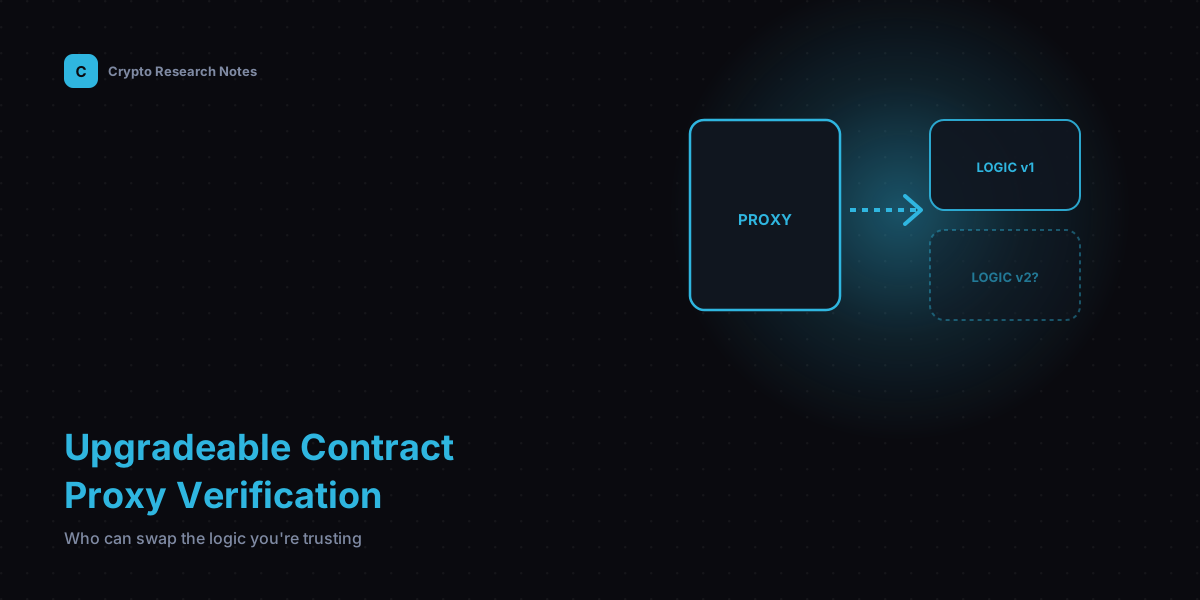
Once an ordinary smart contract is deployed, its bytecode is permanently fixed at that address, and anyone can confidently assume "the code the audit report covers is the code I'm interacting with." A proxy pattern breaks that assumption: the address a user actually sends a transaction to (the proxy contract) contains almost no business logic itself — its core job is to forward every call via `delegatecall` to another address (the logic/implementation contract) for execution, while keeping state in the proxy's own storage. The value of this design is that a team can deploy a new logic contract and have the proxy switch its forwarding target from the old address to the new one, with no user asset migration and no change to any contract address configured in a frontend — nearly invisible to users. But it also means the trust a user previously built based on an "audit report" really only applied to one specific piece of logic code the proxy pointed to during a particular time window; once the pointer switches, that trust basis shifts too, potentially onto entirely unaudited new code.
A verifier must understand this isn't a theoretical flaw but the very intent behind the proxy pattern — most protocols adopt an upgradeable architecture precisely because they're worried about undiscovered bugs in early versions, or want to keep shipping features; without a proxy, every fix would require users to manually migrate to a new contract address, an enormously high-friction process. The core question was never "should a proxy pattern be used" — it's "who has the authority to decide when and where to switch, and does the community have any ability to review the switch before it takes effect."
- A proxy pattern separates "the address users interact with" from "the logic code that actually executes," letting whoever holds upgrade authority swap the logic contract at will without changing the address.
- This isn't a bug but the design intent: it lets a protocol keep patching bugs and shipping features post-deployment, avoiding the high friction of users manually migrating to a new contract address.
- The core verification question isn't "was a proxy pattern used" but "who holds upgrade authority, and can the switch be reviewed by the community."
2. Verification Method One: Determine the Proxy Standard and Who Actually Holds Upgrade Authority
Different proxy implementation standards vary significantly in authority management and risk exposure, and a verifier's first step should be confirming exactly which one is in use. Under a Transparent Proxy, the upgrade logic lives in the proxy contract itself, typically with a separate `ProxyAdmin` contract holding upgrade authority, and calls from regular users versus the admin are automatically routed differently to avoid function-selector collisions. Under UUPS (Universal Upgradeable Proxy Standard), the upgrade logic instead lives inside the logic contract itself, keeping the proxy extremely minimal — this means if an upgrade accidentally removes the upgrade function itself, the contract could be permanently locked at its current version, making this pattern more dependent on the audit quality of the logic contract's code. A Beacon Proxy uses a shared beacon contract so multiple proxy instances can all point to the same logic address at once; upgrading the beacon once switches all instances simultaneously, amplifying both the risk and the benefit to the scale of the entire proxy cluster. After confirming the standard, the next step is finding the actual address holding upgrade authority — typically by reading the proxy contract's admin storage slot via a block explorer (each standard has its own conventional slot location), and checking whether that address is currently a plain externally-owned account (EOA), a multisig wallet, or a DAO governance contract. This information tells you far more about the real degree of authority concentration than a protocol's homepage claim of being "decentralized."
- A Transparent Proxy has a separate ProxyAdmin holding upgrade authority with automatic admin/user call routing; UUPS builds upgrade logic into the implementation contract itself, relying more on its code quality.
- A Beacon Proxy lets multiple proxy instances share a single upgrade, amplifying both risk and benefit to the scale of the entire proxy cluster.
- Read the proxy contract's admin storage slot via a block explorer to check whether upgrade authority currently sits with an EOA, a multisig, or a DAO governance contract.
3. Verification Method Two: Is the Upgrade Protected by a Timelock, and Is the Delay Long Enough
Even if upgrade authority has already moved from a single EOA to a multisig or DAO governance, if an upgrade takes effect immediately after signatures or a vote pass, the community still has no real review window — a malicious or flawed upgrade could affect every user's funds before anyone notices. A timelock forces a waiting period between an upgrade proposal passing and it actually taking effect, giving researchers, auditors, and community members time to review the incoming logic code — and in theory, respond via public pressure, withdrawing funds, or coordinated action if a problem is found. Specific parameters a verifier should check include: how long the timelock delay actually is (a delay of a few hours is essentially no protection at all; a delay in the tens-of-hours-to-multi-day range is where it starts to matter); and whether this delay applies uniformly to all types of upgrades, or whether there's a special "emergency upgrade" channel that can bypass the timelock — if so, the trigger conditions and authority ownership of that emergency channel need separate scrutiny, because "emergency upgrade" paths are often exactly the high-risk entry point that gets abused.
- A timelock inserts a waiting period between an upgrade proposal passing and taking effect, giving the community a window to review incoming code.
- A timelock delay of a few hours is essentially no protection; tens of hours to multiple days is where it becomes meaningful for review.
- Check separately for an "emergency bypass" channel — its trigger conditions and authority ownership are often the high-risk entry point most prone to abuse.
4. Hidden Risk Checklist: Storage Slot Collisions and Initialization Re-entrancy
Beyond upgrade-authority ownership and timelock delay, proxy patterns carry several technical-layer hidden risks that fully decentralized upgrade authority alone cannot automatically avoid. Storage slot collisions: a proxy's and a logic contract's state variables are assigned to sequential storage slots in declaration order; if a new logic version's variable declaration order or types don't match the old version (for instance, inserting a new variable in the middle rather than appending it at the end), the new logic can end up reading misaligned old data — this kind of bug is often only discovered after an upgrade, and can cause serious consequences like incorrect fund calculations. Initialization re-entrancy and double-initialization: because a proxy's constructor doesn't execute correctly in a `delegatecall` context, most upgradeable contracts use an explicit `initialize` function to do what a constructor normally would; if that function lacks a proper "callable only once" guard, there's in theory a risk it could be called again to tamper with critical parameters like the admin address. Function selector collisions: if a function signature defined on the proxy itself happens to hash-collide with a function signature inside the logic contract, a call could be routed incorrectly — this class of bug usually needs specialized static-analysis tooling to catch and is hard for an ordinary verifier to spot by eye, but at minimum one should confirm whether the audit report explicitly mentions checking for these proxy-pattern-specific risk categories, rather than a generic audit report that gives no indication whether it specifically reviewed the proxy architecture at all.
- Storage slot collisions: mismatched variable declaration order or types between old and new logic versions cause misaligned data reads, often only discovered post-upgrade.
- An initialize function without a "callable only once" guard risks being called again to tamper with critical parameters like the admin address.
- Function selector collisions need specialized static-analysis tooling — check whether the audit report explicitly covers proxy-architecture-specific risk categories.
5. Cross-Protocol Comparison Framework: Verifying the Upgrade-Authority Evolution Path
When facing multiple candidate protocols, a verifier can use "upgrade-authority evolution stage" as a core comparison dimension. The first and highest-risk stage: upgrade authority is held entirely by a single EOA, meaning one leaked private key could replace the entire protocol's core logic. The second stage: upgrade authority moves to a multisig wallet, with risk varying by the multisig threshold (e.g., 3-of-5 vs. 5-of-9) and how distributed the signers' identities are — check whether signers include parties genuinely independent of the core team. The third stage: upgrade authority is further handed to a DAO governance contract, with token holders voting on whether to execute a given upgrade — this stage should be cross-checked against this site's earlier piece on governance vote snapshot manipulation risk, since "handing authority to a DAO" by itself is not a safety guarantee; it also depends on whether that DAO's own governance mechanism is robust. A verifier should check: which stage the protocol is currently at, whether it has published a clear roadmap and timeline for decentralizing authority further, and whether it has actually completed a real migration in the past — from EOA to multisig, or multisig to DAO — rather than being permanently stuck at "planned" on a roadmap. Combining this evolution stage with the proxy standard and timelock parameters from sections 2 and 3 produces a complete picture of a protocol's overall upgrade-mechanism risk level.
- Upgrade authority typically evolves through single EOA, multisig, and DAO governance stages, with risk decreasing at each stage but never automatically becoming safe.
- At the multisig stage, check the signature threshold and whether signers include parties independent of the core team; at the DAO stage, cross-check against governance-mechanism risks like snapshot manipulation.
- Key checks: which stage the protocol is currently at, whether it has a clear roadmap and timeline, and whether a real migration has actually happened rather than remaining "planned."
6. Verification Checklist and Conclusion
Distilling the sections above into a reusable checklist: first, has the specific proxy standard been identified, and is it known which address (EOA/multisig/DAO) currently holds upgrade authority? Second, is the upgrade protected by a timelock with a delay of tens of hours or more, and is there a bypass channel for emergencies? Third, has it been verified whether each new logic contract version after an upgrade gets an independent audit or a public code-diff disclosure, rather than relying solely on the initial deployment's audit? Fourth, is there an understanding of proxy-pattern-specific technical risks like storage slot collisions and initialization re-entrancy, and does the audit report specifically cover these checks? Fifth, has the protocol's upgrade-authority evolution stage (EOA/multisig/DAO) been combined with its timelock parameters and historical migration record into an overall judgment, rather than concluding from vague phrases like "audited" or "decentralized" alone? Working through these five questions gives a well-grounded judgment of an upgradeable contract's true risk level. The entire piece discusses abstract mechanism categories and verification methods only, names no real protocol, and is for learning and research purposes only, not investment advice.
- Five-question checklist: is the proxy standard and authority ownership identified, is the timelock adequate, is each upgrade independently audited, are proxy-specific technical risks checked, is the upgrade-authority evolution stage judged holistically.
- "Audited" only covers the current version of logic for an upgradeable contract — upgrade-authority ownership and timelock parameters are the ongoing sources of security assurance.
- The entire piece is a discussion of verification methodology, names no real protocol, and is not investment advice.