
Verification checklist
- At one timestamp, read this feed's own deviation threshold and heartbeat. Do not reuse 0.5% or 3600 seconds from another feed.
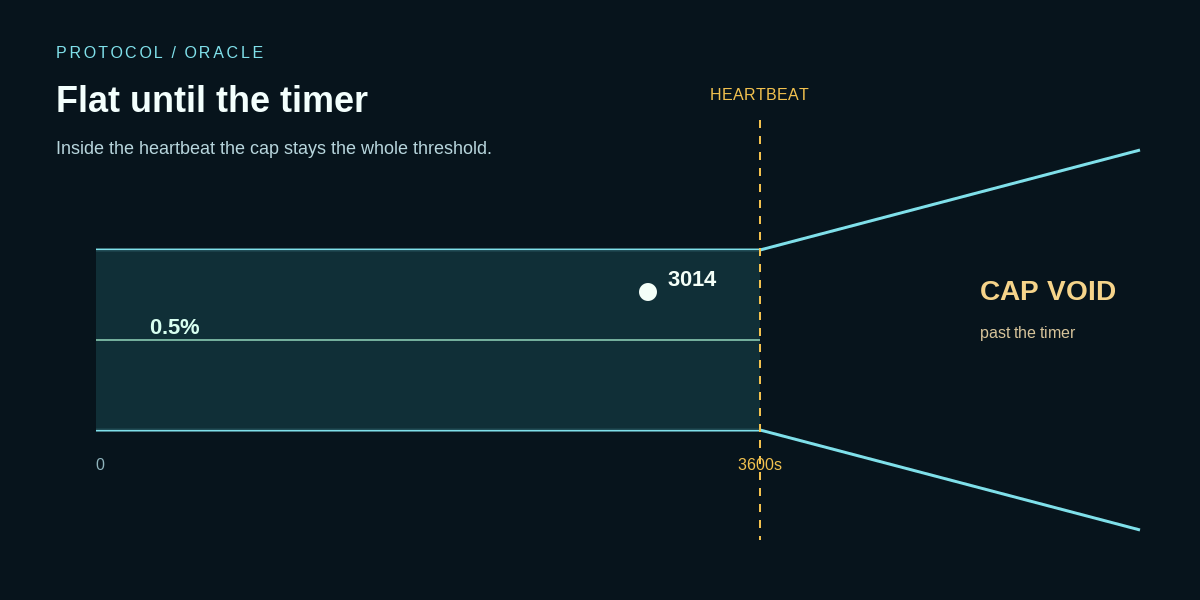
- While updatedAt is still inside the heartbeat, the allowed gap is the whole deviation threshold. Do not multiply the threshold by elapsed time over heartbeat.
- Once updatedAt is past the heartbeat and the answer has not moved, the threshold is no longer a price cap. Write that the cap is void.
- After a new answer lands, subtract the two answers. If the change is under the threshold, record a heartbeat update, not a deviation trigger.
1. The first condition to be met opens the round
A common sentence in a note is "updatedAt is 50 minutes old, the heartbeat is one hour, so the price is about five sixths of the threshold away." That sentence welds two different rulers together. Chainlink's decentralized data model says the aggregator receives a new round only when the deviation threshold or the heartbeat triggers one, and the first condition met starts the update. The deviation threshold is a node seeing off-chain values move by more than the configured percentage from the on-chain value. The heartbeat is a set amount of time since the last update. Both answer "when may a new answer be written." Neither says the current error equals a function of time.
The same page adds a gate that notes often drop. A round needs responses from at least the minimum number of oracles for that feed, or the latest answer is not updated. Off-chain price can be past the deviation threshold while updatedAt stays put. Writing "the market was quiet, so nothing updated" turns an unfinished aggregation into a claim that price did not move. The response count is a separate field. The data page shows the minimum for that feed.
This is not the site's other three feed notes. The decimals note asks which power of ten divides the answer. The circuit-breaker note asks whether a consumer pauses the feed when the price jumps. The sequencer-grace note asks whether a fresh updatedAt is usable in the window after an L2 sequencer returns. This note assumes the scale is already right and that the protocol has not added its own pause. The question is what "minutes elapsed" can be turned into, inside the heartbeat and past it.
2. Teaching case: the error band is a rectangle, not a wedge
The teaching parameters are not a live read of one feed on 22 October 2026. The last on-chain answer P is 3000. The deviation threshold D is 0.5%. The heartbeat H is 3600 seconds. The 0.5% figure is the ETH/USD example in Chainlink's own visualization note: the feed updates when the off-chain price deviates 0.5% from the on-chain trusted price. That note describes the heartbeat as a countdown backup when the deviation condition has not fired. It does not set every feed's heartbeat to 3600 seconds. The 3600 is here so the arithmetic can be checked. Before the numbers enter a research note, replace H and D with the values on that symbol's data page.
"More than 0.5%" is a distance of 3000 × 0.005 = 15. The upper edge is 3015 and the lower edge is 2985. An off-chain price of 3014 has moved 14/3000 = 0.4667%, which is not yet more than 0.5%, so the deviation condition does not open a round. At 10 seconds or at 3000 seconds, the allowed gap is still that full 15. It is not a slope that widens or narrows with the clock.
| Reading | Time-ratio reading | Trigger reading |
|---|---|---|
| 3000 seconds elapsed, off-chain price 3014 | 3000/3600 × 0.5% = 0.4167%, written as about 3012.5 | Still inside the heartbeat. 3014 need not update. |
| 3601 seconds elapsed, answer still 3000 | One second late, still about 0.5% | Cap void. Off-chain price can be 3300 (+10%). |
| New answer 3002 | Treated as a fresh 0.5% move | Change is 2/3000 = 0.0667%. Record a heartbeat update. |
The first row is not a rounding gap. The time-ratio price is 3012.5, which is 1.5 under a price that is still allowed. It also implies the error reaches 0.5% only after another 600 seconds. The specification has no such slope. The second row is what the heartbeat is for: when the timer finishes, a new round should have started. If the answer is still the old one, either too few oracles responded or the push did not land. The 0.5% figure was never a clamp after the timer. An off-chain price of 3300 is 10% from 3000, and that can be true in the same second the note calls "only one second late." The third row shows that an update does not carry the threshold inside it. A heartbeat writes a new answer even when price barely moved. 0.0667% and 0.5% differ by about 7.5 times. An advanced updatedAt is not a license to fill in the threshold.
3. The threshold lives on this feed, not in memory
A completed update resets the rectangle. It does not spend the error budget down to zero for the rest of the hour. From the new answer, the heartbeat starts again, and the deviation is again a full D measured from that new answer. Ten seconds after an update, off-chain price can travel the whole threshold without opening the next round. "It just updated, so the next hour is accurate" hears the reset as a shrink. What is fresh is that the stored answer matches the round that just aggregated. The next move that has not been written still has the whole D as its budget.
D is not one number across symbols. On the check date, Chainlink's feed list showed different deviation thresholds on Ethereum mainnet, including 0.5% for ETH/USD, 0.25% for USDT/USD, 2% for SOL/USD, and 2% for BTC/ETH. Copying ETH's 0.5% onto a feed whose row says 2% makes the rectangle four times too narrow. The heartbeat is read the same way, one feed at a time. The teaching value of 3600 seconds does not become a default because an older integration note once used it for ETH/USD. The list changes. A note's D and H need the time they were read.
4. A screen: a time ratio cannot be written as the price error
The teaching screen is ordered. First, D and H for that feed at that time come from its own data page, not from "major mainnet feeds are usually 0.5% and one hour." Second, subtract updatedAt from the block time. If the difference is under H, an off-chain price that has not been written may be described only as "within D of the current answer." Multiplying by (difference / H) fails the screen. Third, if the difference is at least H and no new round is stored, the price cap on that row is void, and the note records whether the minimum oracle count may have been missed. Fourth, if a new answer exists, compute (new answer − old answer) / old answer, compare it with D, and label the row as a deviation trigger or a heartbeat trigger. A time ratio in the first two steps is a failed note.
The screen does not say whether a consuming contract pauses on a large jump. That is the circuit-breaker note. It does not say whether a fresh updatedAt is usable during the grace period after a sequencer outage. It does not say which power of ten divides the answer. A wrong scale turns 3000 into another order of magnitude before 0.5% can matter. Passing once does not keep the next read on the same D. The parameter page changes, so the next read copies it again.
5. Keep a record another researcher can replay
The minimum fields are: network, feed symbol, proxy address, read time with the block time and the zone, answer, that feed's decimals, D, H, the page each came from, updatedAt, the age, whether the age is under H, the phrase "cap = D" when it is under H, the phrase "cap void" when it is not, the minimum oracle responses, and, when a previous answer exists, the answer change and the trigger label (deviation or heartbeat). Two reads that straddle a round are two rows. Do not explain the old gap with the new answer's D.
Reconcile in a fixed order: whether the scale already used the feed decimals, whether D and H belong to this feed, whether the age is inside or outside the heartbeat, and only then the answer change. A note missing D or H stops at "trigger missing." Moving a small amount of the quote asset in order to compare one off-chain print with the on-chain answer belongs in a fee footnote. It does not belong in the judgment of whether the band is still in force.
6. Draw the rectangle before talking about the clock
The weak sentence is "the heartbeat is a fraction elapsed, so the price error is that fraction of the threshold." A useful one is "current answer; D; H; age compared with H; if a new answer exists, the actual change." Inside the heartbeat the band does not change width. Past the heartbeat that width is no longer a promise. A landed update only says a new round was stored. How far the price moved is the difference of the answers.
This is a research framework. The rule that the first of the two conditions opens a round, and that too few oracle responses leave the answer unchanged, comes from the Chainlink page cited above. The ETH/USD 0.5% example comes from the visualization note. The figures 0.5%, 3600 seconds, 3000, 3014, 3012.5, 3002, and 3300 are a teaching conversion. They were not measured on a live feed, and they are not investment advice.