
1. Why DeFi and on-chain security deserve their own conversation
Let's be clear up front: on-chain security is not the same thing as traditional software security. When an ordinary program has a bug, you can still patch it, roll it back, notify users. But once a DeFi contract is deployed, the code is often the "law" — money flows by the rules the code was written with, no support desk, no undo button. A single logic slip can drain an entire pool within one block. Because the cost of a mistake is irreversible, real money, the bar for on-chain security verification has to be far higher than for ordinary software.
That is why "can AI help me review a contract" deserves a careful answer rather than a quick yes or no. AI genuinely changed the tempo of on-chain security research — it compresses code that used to take hours to read into a few seconds of scanning. But a faster tempo does not mean more reliable conclusions. What a researcher really needs to build is a clear sense of the division of labor: which step the machine saved me, and which step I must never skip.
- On-chain code takes effect on deployment and mistakes are irreversible, setting a far higher bar than ordinary software.
- AI changes the tempo of research, not reliability itself; faster does not mean fewer checks.
- The core of this piece is clarifying the human-machine boundary in on-chain security verification.
2. What AI is genuinely good at in on-chain security
Start with where it truly helps, because these strengths are real. First, pattern recognition. Many known bugs — reentrancy, integer overflow, missing permission modifiers, unchecked external-call returns — have relatively fixed code shapes, and a model that has seen thousands of samples flags such suspects fast and accurately. Second, "reading the doorstopper." For a protocol of several thousand lines across a dozen contracts, a human tires and misses things halfway through; a model can lay out call relationships, fund flows and permission dependencies into a single map, helping you build a quick overall picture.
Third, acting as a "question machine." You can tell it to assume the attacker's role and force it to list "if I wanted to drain this pool, where would I start" — adversarial questioning like this often surfaces angles a human did not think of. The value here is not the answer itself but that it steers your attention toward what deserves a deeper look. Put the three together and AI's role is clear: an extremely fast, tireless triage tool and sparring partner — not the one who makes the call.
- Pattern recognition: fast, accurate flagging of fixed-shape known bugs like reentrancy, overflow and missing permissions.
- Reading large protocols: quickly mapping cross-contract call relationships and fund flows.
- Adversarial questioning: an attacker's-eye view that steers attention rather than delivering a verdict.
3. Where AI will fool you
Now the more important part — its weaknesses are exactly where people get burned. The first is "confidently making things up." A model may insist a function "has reentrancy risk" with reasoning that sounds airtight, but you check on-chain and the function already has a nonReentrant modifier or a call ordering that guards against it. It gives you the most probable-sounding answer, not a verified fact. The second is "blindness to business intent." Many on-chain risks live not in syntax but in economic logic — a fee parameter governance can raise at will, a liquidation threshold that chains under extreme conditions. These require understanding what the protocol is trying to do, and a model's grasp of "intent" is very limited.
The third is "broken context." Real attacks are often composed across contracts, across protocols, even across chains — each contract looks fine alone, and only the combination breaks. Limited by how much it can read at once, a model struggles to connect these long-range composite risks. So a practical rule: when AI says "there's a problem," go on-chain to confirm whether there really is; when AI says "no problem," treat it even less as proof of safety — its silence likely just means it did not see that angle. It lowers the odds of "missing a known pattern" but cannot rule out the unknown, cross-context risks hidden in business logic.
- Hallucination: models "confidently make up" bugs that do not exist; plausible reasoning still needs on-chain confirmation.
- Business-intent blind spot: economic-logic risks (fees, liquidation thresholds) exceed the model's strengths.
- Broken context: cross-contract composite risks are hard for a model to connect; "no alert" is not "safe."
4. A four-step loop that splits the work between human and machine
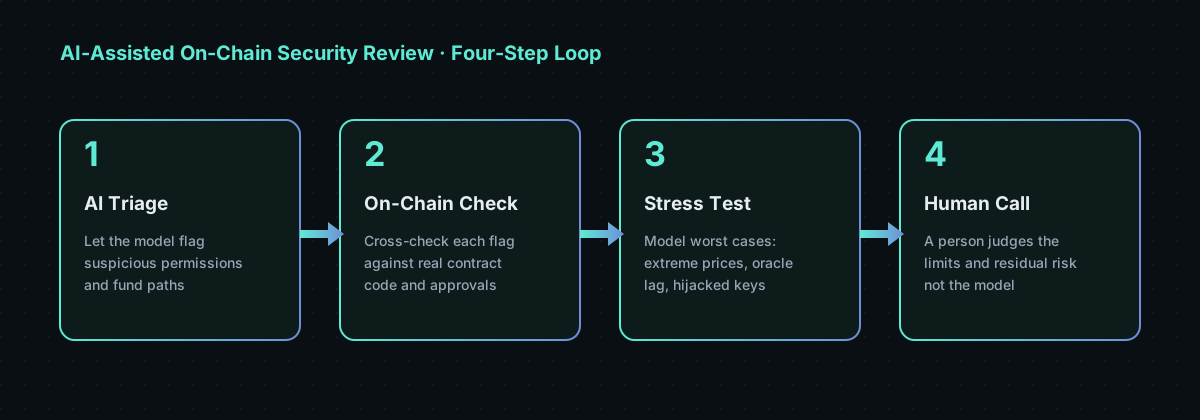
Turning the strengths and weaknesses into practice yields a simple loop — the four steps in the figure. Step one, AI triage: hand the contract to the model, let it quickly flag suspicious permissions, external calls and abnormal fund paths, producing a "suspect list." Step two, on-chain check: this is the step you must never skip — take the list to a block explorer and cross-check each item against the real, verified contract code and approval records to confirm whether each "suspect" holds. The model may have read a stale or rewritten version; the on-chain one is what is actually running.
Step three, stress test: don't only ask "is it safe now," ask "what's the worst case under extreme prices, oracle lag, or a hijacked permission." You can have AI help enumerate these scenarios, but reason through the conclusions yourself. Step four, the human call: a person makes the final judgment on permission boundaries and residual risk. Which risks are acceptable and which are red lines is a value judgment that cannot be outsourced to a model. The spirit of the whole loop is one line — AI makes things fast, the human makes things right.
- Four steps: AI triage → on-chain check → stress test → human call, each with a clear role.
- The on-chain check is the least skippable step: trust the verified real code on a block explorer.
- The final risk trade-off is a value judgment that must be made by a human, not the model.
5. A researcher's checklist and the cost of tools
To turn method into habit, follow a few rules. First, always cross-verify: when the AI's conclusion, the block explorer's raw data, and a formal audit report disagree, trust the on-chain data and the audit. Second, manage your own approvals: periodically review your wallet's approve records and revoke unlimited approvals you no longer use — the highest-value action in personal on-chain security. Third, make good use of testnets and simulated transactions, running the worst case first in an environment where no real money is at stake.
A practical word on tool costs. On-chain security research leans on a stack of subscription services — paid AI model quota, premium block explorers, contract monitoring and alerting platforms — most billed monthly and accepting only overseas cards. Many researchers use a virtual credit card to subscribe to these tools: fast issuance, controllable limits, and a separate card per platform so a single main card isn't authorized everywhere. If you're looking for a suitable virtual card issuing platform, options like RDVCC that support a US virtual credit card for subscription use are worth a look — settling "how do I pay for tools" first keeps your research from stalling at the top-up screen. To be clear, that is only payment convenience; it has nothing to do with the safety of the contract itself.
- Three-way cross-check: AI conclusions, on-chain raw data and audit reports corroborate each other; on conflict, trust on-chain and the audit.
- Manage approvals: regularly clean up approve records and revoke idle unlimited approvals — high value for personal on-chain security.
- Tool subscriptions are mostly overseas monthly fees; a virtual credit card keeps spending controllable — but payment convenience is not contract safety.
6. Takeaway: treat AI as a magnifier, not a judge
Back to the opening question — can AI help with on-chain security? Yes, and a lot, but only if used the right way. It's like a high-power magnifier that lets you see the grain in the code faster, yet it cannot decide for you whether that grain matters. In DeFi, where mistakes are irreversible, handing the final judgment to a model that confidently fabricates reasons, misses business intent, and cannot connect cross-context risk is dangerous.
So the safer mindset is this: let AI take on the triage and sparring it's good at, and keep the on-chain check, stress test and final call firmly in your own hands. Speed comes from AI, reliability comes from the human — you need both. This whole piece discusses abstract methods and mechanisms, does not target or evaluate any real project or product, and is not any form of investment advice; the on-chain world moves fast, so always defer to the latest official and on-chain information and own every decision you make.
- AI is a magnifier, not a judge: it helps you see faster but can't tell you "whether it matters."
- Speed comes from AI, reliability from the human; the on-chain check and final call stay with you.
- The whole piece is methodology, names no real project, and is not investment advice.