
1. Why Oracles and Price Data Deserve Their Own Deep Dive
Earlier installments of this series established the same lesson from different angles. An Audit Report Says “Audited” — But Audited What, Exactly: From Conclusions to On-Chain Verification showed that a "passed" audit conclusion cannot substitute for a researcher's own direct inspection of contract permissions, upgradeability, and critical functions. What Proof of Reserves Actually Proves: A Merkle Tree Verifies Inclusion, Not Solvency showed that a proof-of-reserves snapshot cannot substitute for independently tracing actual on-chain fund flows. And Researching Team Background and Developer Activity: From Verifying Team Pages to Reading GitHub Signals showed that language in a roadmap or changelog cannot substitute for checking the real commit history and release record. Though each piece examines a different subject, together they trace a single methodological thread through the series: any "claim" appearing in documentation, a report, or a user interface is, by its nature, merely a statement awaiting verification — not evidence in itself. A researcher must check it against the underlying raw data it purports to describe and complete an independent verification before deciding whether the claim actually holds.
That same thread applies directly to price data. When a DeFi protocol states, in its documentation or front-end interface, that it "uses a secure, decentralized oracle for pricing," that sentence is structurally no different from "the audit has passed," "reserves are fully covered," or "a given feature is now live." Each is a claim made unilaterally by the project team that some complex underlying mechanism is working well, with no way offered for a researcher to independently confirm it. In other words, the phrase "secure oracle" does not itself constitute proof of security, just as the words "audit passed" do not themselves constitute proof that a contract is free of vulnerabilities. Faced with this kind of language, a researcher should maintain the same skeptical posture established in the earlier pieces: treat it only as a starting point, and do the real work of asking where this price data actually comes from, who supplies it, how frequently it updates, and whether a single point of failure or a manipulable pathway exists somewhere along the chain.
Oracles also merit a standalone treatment because the object being verified here differs substantively from the objects examined in the earlier articles. A smart contract is, by nature, a deterministic, closed execution environment: it can only read state that has already been written on-chain, and it has no native way to perceive off-chain information such as exchange quotes, market-maker depth, or real-world market events. This is an inherent limit of the blockchain execution environment, not a flaw in any one project's design. Precisely because of this constraint, virtually any contract logic that needs to reference an external price must rely on some mechanism to "feed" off-chain information onto the chain — and this feeding process is itself an independent, complex attack surface and object of verification. Its verification path — examining the composition of the data sources, the conditions that trigger updates, the aggregation and fault-tolerance logic, and the update latency of the price feed under extreme market conditions — takes a technically distinct shape from the verification paths discussed previously, such as a contract's permission inventory, reserve-address balances, or a code commit timeline. That distinctness is exactly why the topic warrants its own systematic treatment.
One clarification before proceeding: this article is devoted entirely to research methodology. It does not identify or evaluate any real, existing oracle network, real DeFi protocol, real exchange, or real historical event; every discussion of risks and verification points throughout is presented in abstract, general terms, without specific figures, percentages, or quantified case studies. Where numbers or scenarios are introduced later for illustrative purposes, they will be explicitly flagged as hypothetical examples constructed solely to clarify methodology, and do not correspond to real data from any actual project. Nor does this article constitute investment advice of any kind.
2. The Mechanics and Design Categories of Oracles
A blockchain's execution environment is deterministic by design: the same transaction, executed on any node, must produce exactly the same state change, since that is the only way the network's nodes can reach consensus on the state of the ledger. As a direct consequence, a smart contract cannot, mid-execution, reach out and make a network request to the outside world. It cannot call an exchange's API on its own, cannot scrape a price quote off some webpage, and cannot query a traditional financial market data feed. If a contract were allowed to read external data that can change over time and that different nodes might see differently, the nodes' execution results would diverge and consensus would break down. Consequently, any smart contract that needs off-chain information — for instance, the price of one asset relative to fiat currency or to another asset — must rely on some additional mechanism to "write" that information onto the chain in advance, as part of a transaction, so the contract can then read a value that is already on-chain and consistently visible to every node. This mechanism for bringing off-chain data into the on-chain execution environment is collectively known as an oracle, and the differences between oracle designs go a long way toward determining the risk structure of any DeFi protocol that depends on price data.
2.1 Several Abstract Categories of Oracle Design
The first category is the single feeder model, in which one specific role or service node aggregates a price from data sources of its own choosing, at an agreed-upon cadence, and writes it on-chain via a transaction into a contract's state variable, where other contracts can read and call it. This design is the simplest to implement technically: it involves no multi-party coordination, requires no aggregation-rule design, and typically has low update latency, since only a single step needs to complete the calculation and submission. It essentially moves a traditional data publisher on-chain: reporting is simply an ordinary write to the chain, with the contract passively receiving an already-computed final value and having no way to verify how that value was actually derived off-chain.
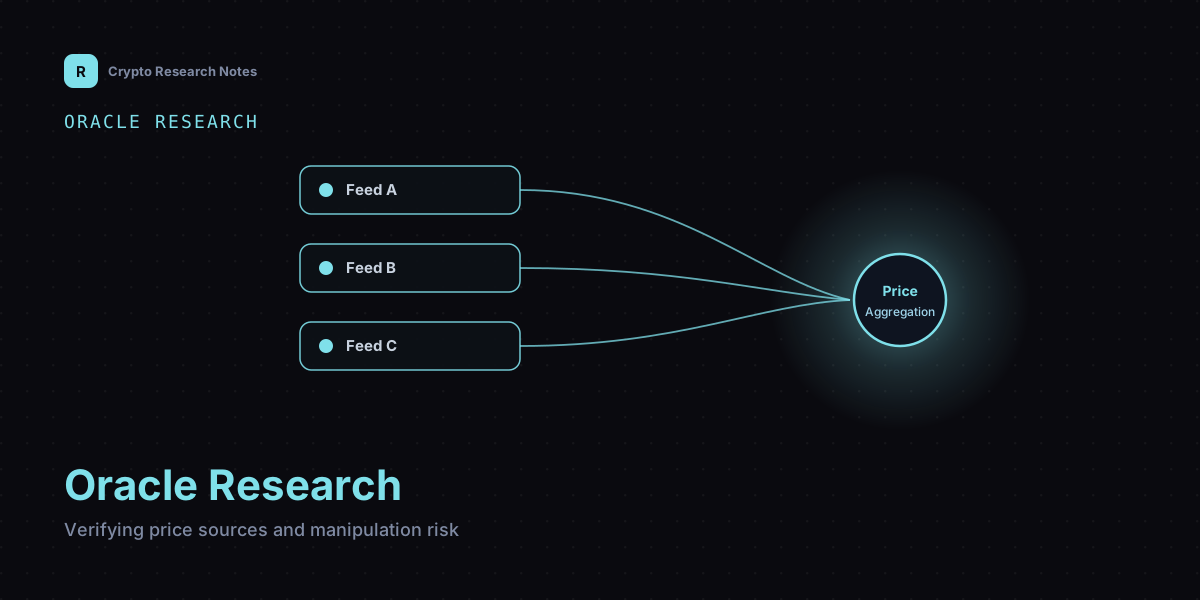
The second category is the decentralized aggregation model, whose defining feature is the introduction of multiple independently operating reporting nodes. Each node retrieves price information from data sources it selects or is assigned, submits the value it individually observes, and a preset aggregation rule — for example, taking the median, computing a weighted average under some weighting scheme, or requiring that a minimum number of reporters' values fall within a reasonable range before being accepted — then computes the final price that gets written on-chain. This design attempts to reduce the impact of manipulation or error at any single point by having "multiple independent observers, aggregated by rule": as long as the participating reporters are truly independent of one another and their data sources and methodologies meaningfully differ, an anomalous reading from any individual node should, in principle, be diluted or filtered out by the aggregation rule. Such designs also typically disclose each node's individually submitted raw value along with the rules underlying the aggregation process, which in principle allows researchers to verify how any specific price update was derived from the raw values submitted by each party.
The third category is the native on-chain pricing mechanism, whose price does not depend on any off-chain node actively reporting at all, but is instead computed directly from the trading data generated within a decentralized exchange's own on-chain liquidity pool — most typically by taking a time-weighted average of the pool's trade prices over some window, yielding a relatively smoothed value that is difficult to move sharply with a single transaction. This design's price source is entirely "endogenous" to the chain: it introduces no off-chain data and no off-chain reporter, and in theory anyone can independently recompute the same price using the same public on-chain data and the same formula, giving it the highest degree of verification transparency. But this also means the quality of its price is tightly bound to the depth, trading activity, and window-length settings of the liquidity pool it depends on, rather than to how closely it tracks some external "true market price."
2.2 The Core Trust Assumptions and Abstract Failure Modes of Each Design
The core trust assumption of the single feeder model is that this one reporting party will honestly and promptly collect and submit prices according to its stated methodology, and that its own keys, servers, and operating environment will not be compromised by a single point of attack. At an abstract level, once this assumption fails to hold — whether because the reporter's own computation logic contains an error, because the off-chain data source it depends on is itself distorted, or because the private key or infrastructure used to submit its price transactions falls under unauthorized control — the on-chain contract has no intrinsic mechanism to identify or reject a price submission that is "wrong but properly formatted," because from the contract's perspective, it is still just a correctly formatted transaction from a trusted address. This means that a failure or manipulation at this single point can, in principle, transmit directly and without resistance into a distorted on-chain price, in turn affecting the liquidation, lending, or settlement logic of every downstream contract that reads that price.
The core trust assumption of the decentralized aggregation model shifts from "one particular reporter is honest and reliable" to "a sufficient number of reporters are mutually independent, and the proportion that are malicious or faulty does not exceed the threshold the aggregation rule is designed to tolerate." If this assumption fails to hold — for instance, if multiple nominally independent reporting nodes in fact share the same underlying data source or the same infrastructure, causing them to fail simultaneously when that source runs into trouble, or if the number of colluding malicious reporters exceeds the tolerance ceiling assumed at the time the aggregation rule was designed — the aggregation mechanism itself flips from being "a protective layer that filters out outliers" into being a channel that launders a majority of erroneous or malicious values into a final price that merely looks credible. In addition, if the parameters of the aggregation rule (such as the minimum interval between price updates or the permitted magnitude of a single move) are mismatched with the actual volatility characteristics of the market, this can also produce price lag or deviation during periods of sharp real-market movement — a risk rooted in mismatched design parameters rather than outright bad actors.
The core trust assumption of the native on-chain time-weighted pricing mechanism is that the liquidity pool underlying the price calculation has sufficient depth and sufficiently dispersed, genuine trading activity that no single participant can, at an affordable capital cost, persistently sway the weighted-average result within the time window. If this assumption fails to hold — for example, if a pool's actual liquidity is far below its apparent size, or if most of the trading volume for that asset in the pool in fact comes from a handful of related addresses — then a participant with a relatively limited amount of capital could, in principle, construct a sequence of trades across the window to artificially push the time-weighted average price up or down. The contract simply and faithfully reads whatever value comes out of that calculation — it has no way to judge whether the underlying trading activity reflects genuine, dispersed market supply and demand. The distinguishing feature of this failure mode is that it requires compromising no private key and tampering with no reported data whatsoever — it exploits, entirely within the letter of the rules, the price formula's dependence on the underlying assumption of liquidity depth. This is precisely why, when verifying this type of price source, examining the depth and trade distribution of the underlying liquidity pool is just as important as examining the calculation formula itself.
3. How to Verify Price Data Sources Independently of a Protocol's Own Claims
"We use a secure oracle" is a claim that surfaces constantly in project docs, whitepapers, and community Q&A, but it is not, on its own, a conclusion you can simply take at face value — it is a compound statement that needs to be broken down into a series of executable verification steps. Embedded in that one sentence are at least three separate things that need independent confirmation: whether the contract address the protocol actually reads its price from matches the architecture it claims to use, whether that price data's update mechanism is genuinely functioning on-chain as intended, and whether this price source shows any anomalous deviation when compared against other independent data sources. The two subsections below map onto these two verification paths — "locating the actual on-chain data source" and "cross-checking against independent sources and the limits of audit claims" — and it is only by combining them that a vague statement of trust gets converted into a set of verifiable facts grounded in raw on-chain data.
3.1 Locating the On-Chain Oracle Contract Actually Being Read
The architecture diagrams shown on a project's website or in its documentation are often just illustrative sketches — the "oracle module" labeled in the diagram may not correspond to any specific on-chain contract address, nor necessarily reflect the call path the code actually executes at runtime. The first step in verifying the true source of price data is to set the architecture diagram aside and locate, directly, the contract within the protocol that actually consumes price data — typically a lending pool, a derivatives liquidation module, or a stablecoin minting contract — and then find that contract's verified source code on a block explorer (if the source code isn't verified and public, you can still infer the call target by comparing decompiled bytecode or known function selectors, but that is a costlier verification path; here we assume the more common case where source code has been verified). In verified source code, you can typically find an interface call used to read the price — for instance, a read-only function that pulls a value from some external address. That external address is either a state variable storing the price directly, or a separate contract address that was written in via the constructor or an admin-set function. What the verifier needs to do is extract that address and confirm it is the actual, currently effective source of price data — not just the brand name mentioned in the documentation.
Once you've identified the actual price contract address being called, the next step is to check whether that address itself can be changed, and by whom. Many price-reading interfaces are not hardcoded to a fixed address; instead, they're set dynamically through a "set data source" function callable by an admin account. This means that even if the address currently being read points to a well-known data provider, the protocol retains the power to swap it out for any other address at some point in the future. The verifier should locate the account holding this permission within the contract source code, and further check whether that account is a multisig and whether a timelock is in place. This permission structure is itself an important component of price data trustworthiness — even if the address currently being read is entirely legitimate, a single point of control in the permission design constitutes an ongoing risk that warrants continued monitoring.
Having confirmed the price data contract address actually in effect and who controls it, the third step is to pull operational facts directly from that contract's on-chain transaction history: the update frequency (the distribution of time intervals between calls to the contract's price-writing function), the timestamp of the most recent update, and the "staleness threshold" set in the contract code (the parameter defining how long a price can go without being updated before consuming contracts should treat it as unusable data and block the relevant operations). All of this can be reconstructed by reading the contract's historical transaction list and parsing the timestamp of every write call — none of it depends on any one-sided statement from the protocol team. If you find that the time since the last update already clearly exceeds the staleness threshold coded into the contract, yet the consuming contract's relevant functions haven't been halted, that indicates the staleness check may be flawed in its implementation or not properly enabled — a concrete signal that warrants further tracing, rather than a simple matter of believing or disbelieving the protocol's assurance that "the data is safe."
3.2 Cross-Checking Independent Price Sources, and Why Audits or a Well-Known Oracle Brand Name Are Not Sufficient Verification on Their Own
Confirming the price actually in effect on-chain and its update timing does not conclude the verification work — the price still needs to be cross-checked against several public price sources that are mutually independent, with no subordinate relationship or shared data lineage between them. "Independent" is the key qualifier here: if the sources being compared actually all draw their quotes from the same upstream data provider, or if one of the comparison sources is itself something the object under review directly depends on, then the comparison only verifies internal consistency within a single dataset — it cannot reveal whether that data source has itself already diverged from the real market execution price. Meaningful cross-verification requires selecting multiple sources that are mutually independent in their data collection methodology, aggregation logic, and contract implementation — for example, on-chain aggregation mechanisms built on different architectures, or public quote interfaces from different trading venues — recording the price from each at the same point in time, and then calculating the degree of deviation between them. If one source shows a persistent, non-random deviation from the rest over a specific time window, that in itself is a concrete signal that should be logged and traced further — it may point to insufficient liquidity at that source, update lag, or the data source being actively manipulated.
Judging the magnitude of deviation also requires a baseline understanding of what constitutes normal market behavior for the asset in question: assets with high volatility and shallow market depth can naturally show larger instantaneous price gaps across venues, and the "normal deviation range" that's acceptable for such assets is entirely different from that of assets with deep liquidity and active cross-market arbitrage. So when comparing multiple independent sources, verifiers should not apply a single uniform deviation threshold — instead, they should judge whether the currently observed deviation exceeds the asset's historical normal range based on that specific asset's historical volatility characteristics. This judgment process itself should also be documented, so that the reasoning behind it can be reconstructed during any later review.
This cross-verification path also directly echoes a methodological point emphasized repeatedly in "An Audit Report Says “Audited” — But Audited What, Exactly: From Conclusions to On-Chain Verification": audit conclusions cannot substitute for direct inspection of a contract's actual on-chain state. The same logic applies fully to oracles — "having passed an audit" only tells you that, at a specific point in time, for a specific version of the code, an auditor completed a review based on the information available to them at that time. It neither guarantees that the configuration actually deployed matches what was audited, nor can it substitute for the independent, real-time on-chain verification steps described in this section. By the same token, the statement "it uses a well-known oracle brand" does not constitute sufficient verification either: brand recognition describes market perception, not a substitute for the full executable process described in this section — contract address confirmation, permission structure review, update-timeliness checks, and multi-source cross-comparison. Only once these verification steps, grounded in raw on-chain data, have actually been completed does "we use a secure oracle" turn from an unverified claim into a well-documented, concrete conclusion.
4. Abstract Mechanism Categories of Price Manipulation Risk
The first abstract risk category worth understanding stems from a price feed's reliance on a single, shallow on-chain liquidity pool. When a protocol's feed is derived, directly or indirectly, from the real-time execution price of a trading pair on-chain, and that pair's liquidity depth is relatively limited, a single sufficiently large trade — or a large sum of capital temporarily pulled in via a flash loan — can, in theory, push the pool's quoted price significantly away from its fair value in the broader market within a single block or even a single transaction. If the protocol happens to read and accept this price at that exact moment, the result can constitute price manipulation in the abstract sense: the attacker does not need to sway the market's consensus price over any sustained period, only to produce a distorted number at the precise instant the feed is read. What defines this failure mode is the mismatch between where the feed's data comes from and how cheap it is to manipulate — the shallower the pool, the greater the leverage an attacker can bring to bear, and the more predictable the timing of the price read, the more plausible this risk pattern becomes.
The second risk category worth understanding stems from a feed system's reliance on a single centralized reporter. If a given piece of price data depends entirely on periodic reporting from one independent node, one signing service, or one centralized API, then a compromise of that reporting channel — whether through a breach, a leaked key, or simply the service going offline, suffering network delays, or undergoing maintenance without updating in time — can leave the protocol continuously reading a stale price for some period. In such a scenario, even after the true market price has moved noticeably, as long as the protocol's internal logic still treats the old price as currently valid, that staleness can be exploited to construct operations detrimental to the protocol — for instance, arbitrage-style extraction that profits from the gap between the stale and the real price. The key question for this failure mode is whether the reporting pathway has a single point of failure, and whether the protocol has mechanisms such as heartbeat timeouts or price-expiry circuit breakers to bound the window during which stale data can still be accepted.
The third risk pattern arises in settings that use decentralized oracle aggregation networks, and its root cause is not decentralization itself but whether the specific parameters have been set with sufficient rigor. A network may, in principle, require a quorum of independent reporters to confirm a price update, but if that quorum threshold is set too low, a handful of reporting nodes can still sway the final aggregated result; or if the aggregation logic is too permissive about the deviation allowed between individual reports, an outlier quote may be diluted and absorbed into an average or median rather than being excluded. In such cases, a decentralized architecture may exist in name without necessarily delivering manipulation resistance commensurate with that label under its actual parameter configuration. The lesson for researchers is that the mere claim of using a decentralized oracle cannot substitute for item-by-item verification of the specific parameters — quorum size, reporter independence, deviation tolerance, and so on.
These three mechanisms are methodologically isomorphic to the other risk categories discussed elsewhere in this series. "An Audit Report Says “Audited” — But Audited What, Exactly: From Conclusions to On-Chain Verification" emphasizes that contract permission risk cannot be assessed merely by asking whether an admin key exists — one must verify the specific on-chain preconditions, such as the scope of permissions, timelocks, and multisig thresholds. "What Proof of Reserves Actually Proves: A Merkle Tree Verifies Inclusion, Not Solvency" similarly points out that custodial risk cannot be assessed merely by asking whether a proof of reserves was provided — one must verify whether the custodial asset pathways and on-chain transfer records behind that proof are genuinely self-consistent. The research method for price manipulation risk follows exactly the same logic: researchers should first build a conceptual understanding of these failure modes — dependence on a single shallow liquidity pool, dependence on a single reporter, loosely configured aggregation parameters — and then return to the specific protocol's feed architecture documentation and on-chain contracts to verify, item by item, whether the concrete preconditions required for each mechanism to hold — liquidity depth, the number and independence of reporters, the actual values of aggregation parameters — genuinely exist, rather than concluding that a price source is sufficiently secure simply because it "uses an oracle" or "draws on a well-known data source." This two-step method — moving from abstract risk categories to concrete on-chain verification — is precisely the core habit of thought that this series of research notes tries to reinforce, again and again, across every topic it covers.
5. Cross-Checking a Protocol's Claimed Safeguards Against Its Actual On-Chain Implementation
Across protocol documentation, official websites, and community Q&As, almost every DeFi protocol touching price data invokes a similar vocabulary of safeguards: circuit breakers (pausing liquidations or lending when price movement exceeds a threshold), price deviation caps (limiting how far a new price can diverge from the historical price, expressed as a percentage), multi-block time-weighted average windows (settling against an average price over a period rather than an instantaneous reading), and fallback oracles (automatically switching to a secondary data source when the primary feed misbehaves or goes stale). These descriptions tend to read as remarkably thorough. Sometimes they're even accompanied by flowcharts laying out trigger conditions and response paths, leaving researchers with the impression that the risk has already been engineered away. But this kind of description is, at bottom, the protocol's own self-reported account of its design intent. It tells you what the team meant to build, not what the contract actually contains or under what conditions those mechanisms actually take effect.
This gap between self-description and implementation breaks down into several recurring verification gaps. The first concerns circuit-breaker trigger thresholds and response scope: documentation is often vague or deliberately non-specific about them, while the contract code may set thresholds so wide they rarely bind, log an event on trigger without actually altering behavior, or gate the trigger condition on parameters that a governance multisig can adjust at will — meaning the breaker may not behave as documented in an actual emergency. The second concerns price deviation caps, which may apply only to certain function entry points rather than every price-reading path; a contract can have multiple locations where price is read, with the protective logic covering only some of them while the rest read the instantaneous price directly and unguarded. The third concerns the time-weighted average window — the actual number of sample points, the time span covered, and the fallback behavior when samples are insufficient all need to be confirmed line by line in the code, because a window that is too short or backed by too few samples materially weakens its ability to resist short-term price manipulation. The fourth concerns the conditions under which a fallback oracle switches over (for instance, how long the primary feed must go unupdated before it's deemed "stale"), the trustworthiness of the data source it switches to, and whether the switchover itself depends on some privileged permission — details that rarely appear in marketing-oriented documentation and can only be confirmed by reading the actual price-fetching functions and the logic governing the relevant state variables.
This verification logic mirrors a methodological point already raised earlier in this series, in "Researching Team Background and Developer Activity: From Verifying Team Pages to Reading GitHub Signals": progress claims in roadmaps and changelogs — "completed," "in progress" — cannot substitute for directly examining the actual commit history, merge records, and releases in the code repository, because there is always a gap in time, in scope, or even in direction between what is claimed and what is implemented. In the same way, a protocol document's claims of "having a circuit breaker" or "supporting a fallback oracle" cannot substitute for directly reading the contract's actual code logic — one needs to locate the specific price-fetching functions, the conditional statements, and the read/write order of the relevant state variables, to confirm whether the stated safeguard actually exists in the form described, whether it covers every relevant price-reading path, and whether there is a bypass or dead logic that has, in effect, never once been triggered. Underneath both cases lies the same research discipline: any summary statement — whether it appears in a roadmap, an audit report, or product documentation — is only a compressed representation of some underlying set of facts, and that compression inevitably drops detail or introduces distortion. It cannot be treated as a substitute for the underlying facts themselves.
In practice, this means that when a researcher evaluates a protocol's price-protection design, the "list of mechanisms described in the documentation" should be treated as a set of hypotheses awaiting verification, not as an established conclusion. For each claimed safeguard, one can try to locate its actual implementation on a block explorer or in the contract source, check whether its configured parameters match the documentation, look through the historical transaction record for instances where the mechanism was actually triggered or circumvented, and check whether the relevant parameters can be altered at will by a small set of addresses through governance or admin privileges. If a safeguard's key parameters have sat for a long time at an extremely permissive default, or if the code contains a branch that has been commented out or never once been invoked externally, these are signals that a gap exists between what is claimed and what is implemented — worth treating as a starting point for further verification, not as grounds to immediately conclude that the protocol's overall design is either unreliable or sound. Holding onto this distinction — that a claim is a hypothesis awaiting verification, and that implementation detail is the actual evidence — is the key step in putting oracle and price-data research on a verifiable footing.
6. Common Misconceptions About Oracle Security
The first common misconception is treating the label "decentralized" as automatically equivalent to "tamper-proof." In practice, an oracle system's claim to be built on multiple independent nodes or data sources does not by itself establish that those nodes or sources are actually independent of one another. What a researcher needs to verify concretely is whether the data sources feeding into the aggregation genuinely come from distinct, sufficiently liquid markets, whether the node operators share common funding backgrounds or governance ties, and whether the aggregation logic itself has a threshold at which a small number of parties could sway the median or weighted result. A large number of nodes that are only nominally run by different entities is no substitute for checking these structural questions. This is a general methodological point and is not directed at any particular oracle project or protocol.
The second common misconception is assuming that a longer time-weighted average price (TWAP) window is necessarily safer, while overlooking the fact that window length is only one of many variables in resisting manipulation — the depth of the underlying liquidity pool matters just as much, if not more. A price feed built on a pool with very shallow liquidity can still be pushed by sustained capital deployed across multiple blocks, even with an averaging window stretched to several hours or longer, particularly during periods of low overall market volume. Conversely, a shorter window built on a deep liquidity pool may actually carry a higher cost to manipulate. Window length therefore needs to be assessed together with the pool's historical depth and the price-impact curve for large trades — it cannot be treated as sufficient proof of security on its own. The point here is about method, not about any single protocol's or price feed's specific design.
The third common misconception is equating "has passed an audit" with "the oracle design itself is sound." Audit reports typically focus on whether the code implementation contains known vulnerability patterns, whether permission management follows best practice, and whether external calls behave as expected — but the audit scope does not automatically extend to assessing the robustness of architectural design choices such as the price aggregation mechanism, the logic for selecting data sources, or the rules for handling outliers. These design-level issues can exist even when the code implementation itself is entirely correct. A researcher who reads only the audit's summary conclusions, without examining the stated scope of the audit, the specific findings, and the list of unresolved issues, can easily mistake "no obvious bugs in the code" for "the entire oracle mechanism is sound in economic and game-theoretic terms." This falls into the same category of error discussed in "An Audit Report Says “Audited” — But Audited What, Exactly: From Conclusions to On-Chain Verification" — namely, that audit conclusions cannot substitute for independent verification of the underlying design and the core data itself. Here again, no specific project's audit status is being singled out; the concern is with the general pattern.
The fourth common misconception is concluding that an oracle has malfunctioned or been manipulated simply because its price temporarily diverges from an exchange's spot price, while ignoring that some degree of divergence between the two can be a normal, structural byproduct of differing data sources and update cadences. An oracle's quoted price is typically the aggregated output of a specific update cycle drawing on a specific set of data sources, whereas an exchange's order-book price is a continuous, real-time reflection of live matching. During fast-moving markets, a brief divergence between the two may simply reflect update lag or differences in data-source coverage, rather than evidence that the mechanism has failed. What a researcher should actually examine is the time window over which the spread appeared, whether it coincided with abnormal trading activity, and whether the time it took for the spread to converge is consistent with the oracle's own designed update frequency — rather than drawing conclusions from the mere existence of a price gap. As with the previous points, this observation is about method in general and does not target any specific oracle or trading scenario. At bottom, all four of these misconceptions stem from treating easily obtained surface-level signals — labels, parameter values, audit conclusions, price snapshots — as if they were themselves substantive proof of the underlying mechanism's soundness. This structural pattern is the same one flagged in "An Audit Report Says “Audited” — But Audited What, Exactly: From Conclusions to On-Chain Verification" ("audit conclusions cannot substitute for direct on-chain verification") and in "Researching Team Background and Developer Activity: From Verifying Team Pages to Reading GitHub Signals" ("language in a roadmap or changelog cannot substitute for checking actual commit and release history"): researchers must always keep asking whether the raw data behind a surface-level signal genuinely exists.
7. A Verification Checklist Worth Keeping on Record
The verification steps discussed above — address verification, update-mechanism identification, independence assessment, and manipulation-cost estimation — can be distilled into a fixed observation checklist. Its purpose is to help researchers apply the same set of verification steps consistently across different protocols, avoid missing critical checks, and make it easier to keep comparable records for future review. The checklist itself is nothing more than a "has this been checked" action list — it produces no score and no conclusion.
It bears special emphasis that this checklist does not constitute, and must not be used as, a scoring system or ranking tool for reaching conclusions about the "trustworthiness," "security," or "quality" of any specific protocol or project. No single item on this list, no combination of items, and no "percentage checked off" can substitute for the independent judgment a researcher must form from concrete on-chain evidence, actual contract code, and real market data. Any attempt to convert this checklist into a score, a star rating, a leaderboard, or a "pass/fail" label and apply it directly to a real project falls outside the intended purpose of this checklist — this article does not support, and does not recommend, using it that way.
- Have you located the oracle address actually called by the business contract (rather than the address listed in official documentation), and confirmed the two match
- Has this oracle address ever undergone a contract-level pointer change, and if so, through what permission and what process was it carried out
- Is the price update triggered by a heartbeat (fixed time interval), a deviation threshold, or a combination of both, and what are the specific parameters in each case
- Have you determined the specific value of the staleness threshold, and how the contract handles a stale price once that threshold is exceeded
- How many independent reporting nodes or data sources are there, and have you attempted to verify whether these nodes are genuinely independent of one another in terms of infrastructure and operating entity
- Have you cross-checked the price discrepancy between at least two independent price sources within the same time window, and does the magnitude of that discrepancy fall within an expected range
- Does a circuit breaker or price-deviation cap mechanism exist, and what are the trigger threshold and the specific action taken once triggered (pause, revert, switchover)
- If a time-weighted average price (TWAP) is used, what exactly is the window length, and have you checked whether that window matches the actual liquidity depth of the underlying trading pool
- Has the underlying pool that the TWAP relies on recently experienced a major liquidity swing or migration, such that its effective depth no longer matches historical levels
- Does a backup oracle or fallback path exist, and have its trigger conditions and switchover logic been independently confirmed (rather than taken solely from documentation)
- Does the historical update record show any unusually long gaps, and if so, have you determined the cause at the time (network congestion, node failure, manual pause, etc.)
- Does the caller of the oracle's update transaction hold any special privileges (such as the ability to pause, replace data sources, or adjust parameters), and who holds those privileges
- Have you reviewed this oracle's historical performance across other protocols that rely on it, and whether any cross-protocol cascading anomalies have occurred
- Is the weighting of the price data's original sources (spot exchanges, derivatives markets, etc.) disclosed, and have you verified whether that weighting could be disproportionately swayed by a relatively small amount of capital
- Have you recorded the timestamp of this verification and the block height of the data examined, so that future reviews can distinguish "state at the time" from "current state"
- For oracle parameters that are adjustable through governance (such as thresholds, whitelists, or weights), have you checked whether the treasury or multisig has any related proposal recently passed or pending execution
8. Conclusion
The issue examined in this article is not, at its core, a new topic. It is another application of the same methodological thread this series has already confirmed three times over — in "An Audit Report Says “Audited” — But Audited What, Exactly: From Conclusions to On-Chain Verification," "What Proof of Reserves Actually Proves: A Merkle Tree Verifies Inclusion, Not Solvency," and "Researching Team Background and Developer Activity: From Verifying Team Pages to Reading GitHub Signals": no summary claim can substitute for independent verification of the raw data it purports to summarize. This is the fourth concrete setting in which the thread reappears. In the first three cases, the object requiring verification was an audit conclusion, a reserve snapshot, or a claim about team credentials and roadmaps. This time, what needs to be verified is the DeFi protocol's own set of claims about where its price data comes from, who updates it, and what mechanisms guard against anomalies. A protocol's documentation or front-end interface stating that "prices are supplied by an oracle" or that it has "integrated multisig and a decentralized node network" carries exactly the same evidentiary weight as an audit report's "no critical vulnerabilities found," an exchange announcement's "assets are fully reserved," or a team page's "core contributors remain active." All of these are statements that require verification — they are not verification itself.
Building on this thread, the verification methods this article develops in detail operate on several levels. First, locate the actual on-chain oracle contract address the protocol reads prices from, rather than stopping at the level of documentation, to confirm which specific data-source contract the protocol's pricing logic truly points to. Second, check that contract's update frequency, heartbeat interval, and staleness threshold to assess whether, under extreme market conditions, lagging updates could cause the contract to mistakenly treat stale data as valid. Third, cross-check the same asset's price across multiple independent sources — different oracle networks, real-time quotes from different venues — for persistent or anomalous divergence, which can serve as a clue to potential single-source dependency or thin liquidity. Fourth, identify several categories of abstract manipulation risk, including exploiting momentary quotes in low-liquidity markets, exploiting the absence of cross-validation when relying on a single data source, and exploiting update-delay windows to manipulate price — general attack pattern categories, not references to any specific historical incident. Fifth, verify whether the protective mechanisms a protocol claims to have (such as price-deviation circuit breakers, multi-source weighting, or time-weighted averaging) are actually implemented in the contract logic deployed on-chain, rather than existing only in a whitepaper or marketing materials. Finally, the article also lays out several common cognitive pitfalls researchers fall into in this area, cautioning against equating the mere statement of "integrating a well-known oracle brand" with risk having been eliminated.
It bears repeating that this article, in its entirety, discusses only methodological paths for verification. It makes no factual assertions or conclusive judgments about any specific DeFi protocol, oracle network, trading venue, or historical security incident. Nothing in this article constitutes, or should be understood as, an assessment of any specific project's security, trustworthiness, or investment value, nor does it constitute investment advice of any kind. Researchers applying the methods described here to specific protocols must still rely on their own independently obtained and verified on-chain data, and should draw conclusions with appropriate caution.