
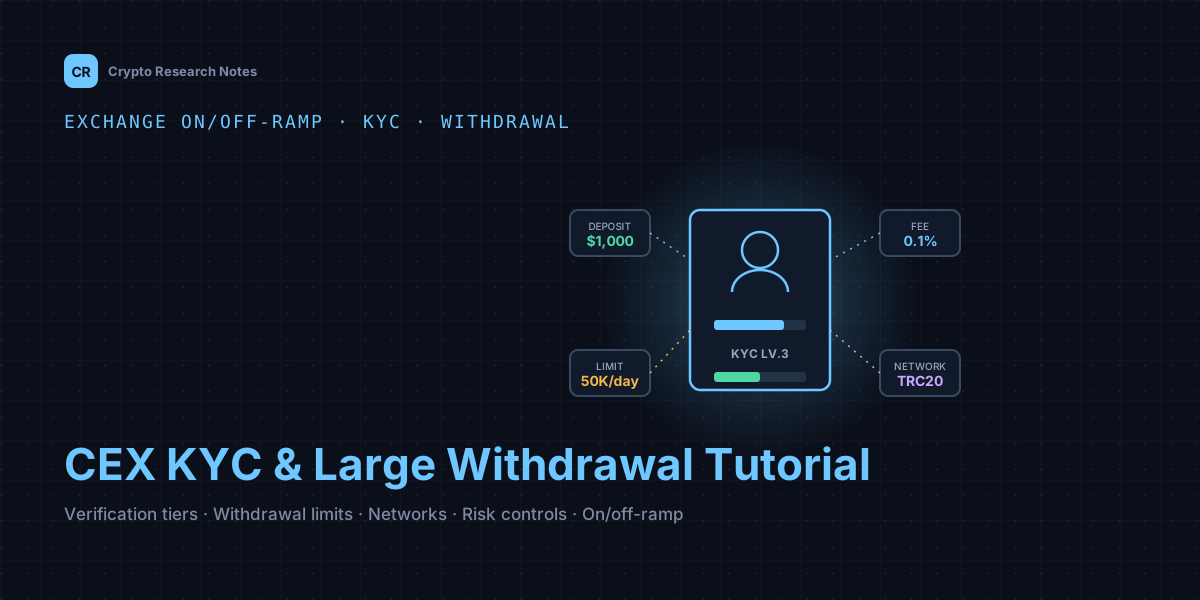
1. Why This On/Off-Ramp Tutorial Starts With KYC
If you have only ever moved a few hundred dollars in and out, you probably never noticed KYC as a real gate. The moment you try to pull a larger balance out — converting a few months of stablecoins back to your bank account, or moving arbitrage profits to your own on-chain wallet — you run into the same wall: "Your verification level is insufficient. Please complete tier upgrade."
This is not the exchange being difficult. Every major centralized exchange is bound by KYC/AML regulations globally, and your verification tier is tied directly to what you can do and how much you can move. Any serious exchange on/off-ramp tutorial has to start here, otherwise everything downstream about networks, fees, and channels loses focus — you cannot even clear the basic ceiling.
Put simply: KYC tier sets the ceiling, channels and networks set efficiency, and risk control decides whether this particular transaction actually lands. The three layers stack — and that is where the real craft of on/off-ramp lives.
2. Verification Tiers: LV1 to LV3 Are Very Different Worlds
2.1 What Actually Differs Between Tiers
Names vary across exchanges, but the structure is broadly the same three layers:
- Basic (LV1): email or phone signup only — you can view markets and do small spot trades, but fiat deposit is mostly disabled and daily withdrawal limits are painfully low (typically a few thousand USD).
- Identity verified (LV2): government-issued ID upload plus liveness check. Fiat deposits, C2C, and normal withdrawals unlock; daily withdrawal usually rises to the tens of thousands of USD.
- Advanced (LV3): LV2 plus proof of address (utility bill, bank statement), occupation and source-of-funds declaration, and often manual review. Large withdrawals, institutional features, and higher leverage open up.
Important: tier upgrades are not instant, especially the LV2 to LV3 jump — 3 to 7 business days is normal. If you plan a large withdrawal next month, start the upgrade two weeks ahead. Do not discover you are stuck in a review queue on the day you actually need the money.
2.2 Common KYC Rejection Reasons
Rejections are almost never about fake documents — they are about small details: glare hiding the ID number, dim lighting or glasses reflection during liveness, address proof name not matching the account, statement older than 3 months, passport within 6 months of expiry. Every one of these can be prevented before you upload.
A less obvious pitfall: severe mismatch between registered phone country, usual login IP, and passport nationality will trigger a risk flag even with clean documents, prompting more documentation. Frequent travelers and cross-border users hit this most often.
3. Withdrawal Limits and Two Off-Ramp Channels
3.1 Daily, Monthly, and Per-Transaction Limits Are Three Different Things
Seeing "daily withdrawal limit $100,000" makes people assume they can move it all in one shot — until they hit the per-transaction ceiling, which is often half the daily cap or lower. The most-missed step in any on/off-ramp tutorial: before withdrawing, open account settings and read daily, monthly, and per-transaction limits together, then plan how to split.
Fiat and crypto withdrawal limits are usually counted separately: a platform may give you $50k/day fiat and $2M/day crypto, on independent tracks. Knowing this saves you from "waited all day on the wrong channel."
3.2 Channel A: Fiat Off-Ramp (Bank Wire, C2C)
Fiat off-ramp lands directly in your bank account, which is clean and traceable — but it is bound by each country's banking compliance, so it is slower, limits depend on the bank side, and banks may refuse. C2C (peer-to-peer) is more flexible in some regions but adds counterparty risk, and repeated cycles can get your bank account flagged.
A more realistic pattern: use C2C for small, day-to-day amounts; use bank wire for larger, well-documented sums, ideally after briefing your relationship manager on the source of funds. This channel fits the "money needs to become fiat life again" scenario.
3.3 Channel B: Stablecoin Withdrawal (USDT/USDC to Your Wallet)
If the goal is not fiat but moving funds to your own on-chain wallet for DeFi, cross-chain, or long-term custody, stablecoin withdrawal is the most efficient channel. It is not bottlenecked by banking compliance and lands within minutes. But it introduces two new decisions: which chain, and to which address.
Chain choice depends on purpose: Ethereum mainnet fits large amounts and broad DeFi access, but congested gas can hit tens of dollars; TRC20 (Tron) is nearly free and fits day-to-day transfers and cross-exchange shuffling; Arbitrum, Base and other L2s suit frequent DeFi interaction; Solana and BSC serve specific ecosystems. Before sending, confirm the destination platform or wallet actually supports the chosen network — sending ERC20 USDT to a TRC20-only address is very hard to recover.
4. Risk Controls and Appeals: When the Money Is Stuck
4.1 What Triggers a Freeze
A large withdrawal that gets held or delayed usually matched one of these patterns:
- New login location or device fingerprint change followed shortly by a large withdrawal — read as possible account compromise.
- Destination address linked to a "flagged address" set — chain-analytics tools believe it touched illicit funds.
- Amount far outside your historical behavior — an account that has never withdrawn suddenly moves $100k almost always triggers manual review.
- Expired KYC, elevated IP-region risk, or recent password recovery activity.
4.2 The Right Response When Frozen
Do not panic and do not retry the withdrawal — retries only add to the risk score. The right order: open an in-app official ticket, attach copies of KYC materials, source-of-funds explanation, and destination-address purpose; cooperate with any additional video verification or supplementary documents; then wait for review. It can take from a few hours to several days, but as long as documents are truthful and funds are legitimately sourced, the vast majority of cases are resolved.
Two rules: appeals only happen through in-app official channels — any "internal support who can speed it up" DM is a scam; do not try to close the account or attempt other large transfers during the appeal — those look like circumvention and only escalate the case.
4.3 Lowering Risk Before You Withdraw
Much of the risk-control friction can be prevented upfront: a week before a large operation, do a few small "warm-up" withdrawals to establish a normal behavior baseline; keep login device and IP region stable; do not combine "password change + 2FA change + large withdrawal" in one day; if you must rotate a bound phone number, wait through the security window (typically 24-48 hours) before touching large sums. These small habits meaningfully cut the flag rate.
5. A Follow-Through Scenario: Turning Stablecoins Into Daily Spend
Getting the withdrawal out is only step one. Many people hit the next real problem: stablecoins land in a self-custody wallet, but plenty of daily overseas bills — cloud servers, AI API subscriptions, software tools, cross-border commerce — still only accept cards. You need something to bridge stablecoin to card payment.
A common bridge is the virtual credit card: no physical mailing wait, online review and a usable card number in minutes, ready for overseas subscription checkout; some platforms offer a US virtual credit card whose BIN range enjoys higher acceptance across mainstream merchants. Take RDVCC (Rongda virtual credit card) as one example — its platform self-describes as a virtual card issuing platform, emphasizes licensed upstream issuance, supports Visa virtual card and other major card networks, and lets you top up cards directly with USDT. As a virtual credit card platform it targets overseas subscription and cross-border tool payment. The example fits here because it connects "on-chain stablecoin → card payment" as a single path, which helps illustrate the flow. As always, the above is the platform's own description — actual features, fees, and settlement experience should be judged from official disclosures and your own usage; this article makes no endorsement. Any pairing of a virtual card with stablecoins must serve genuine, compliant spending, follow the relevant platform terms and the laws of your jurisdiction, and must never be used for cash-out, laundering, or evading regional restrictions.
Zoomed out: exchange off-ramp, stablecoin transfer, and card spend are one continuous chain — security and compliance awareness should run through all of it, whether it is on-chain approvals, off-chain payment tools, or KYC files at the exchange. The principle is the same: least authority, verified sources, traceable footprints.
6. One-Time Checklist Before a Large Withdrawal
Distilled into a checklist you can run through the day before:
- Confirm your KYC tier can cover this amount and that documents are within validity.
- Read daily, monthly, and per-transaction limits together in settings; plan the split.
- Pick a channel: fiat off-ramp (bank/C2C) or stablecoin withdrawal — do not mix.
- If stablecoin, confirm which network the destination supports; align network name (TRC20/ERC20/Arbitrum/Base…).
- Start warm-up small withdrawals a week ahead to build a normal behavior baseline.
- Keep login device and IP region stable; avoid password/2FA changes on withdrawal day.
- Have source-of-funds documents ready (payslip, business income proof, tax records) for instant upload if flagged.
- Only appeal through in-app official tickets; ignore anyone offering "internal expedited service."
7. Summary and Long-Tail Questions
One-line summary of this on/off-ramp tutorial: what large exchange withdrawals really need to clear is not a technical gate but a compliance gate — KYC tier caps the ceiling, channel choice sets the path, and risk control decides landing. Understand those three layers and the vast majority of withdrawal issues stop feeling like panic events.
Long-tail questions people often search: How long does KYC take? Basic identity is typically same-day; advanced tier is 3–7 business days. Can I directly convert TRC20 USDT to ERC20 USDT? No — they are different token contracts on different chains; use a cross-chain bridge or in-exchange conversion. How long can a frozen withdrawal be stuck? Standard appeal reviews usually resolve in hours to days; only cases involving legal cooperation drag on, and most ordinary large withdrawals never reach that path. If I renew my passport, does the old KYC still work? You need to upload the new document and re-verify, or the exchange may treat your credentials as invalid during withdrawal. All of the above may change with platform policy — before any actual withdrawal, defer to the latest official notice from the exchange you use. This entire article is a study and methodology piece, not investment advice; crypto assets are highly volatile and risky, so make your own judgment and be responsible for your own decisions.