
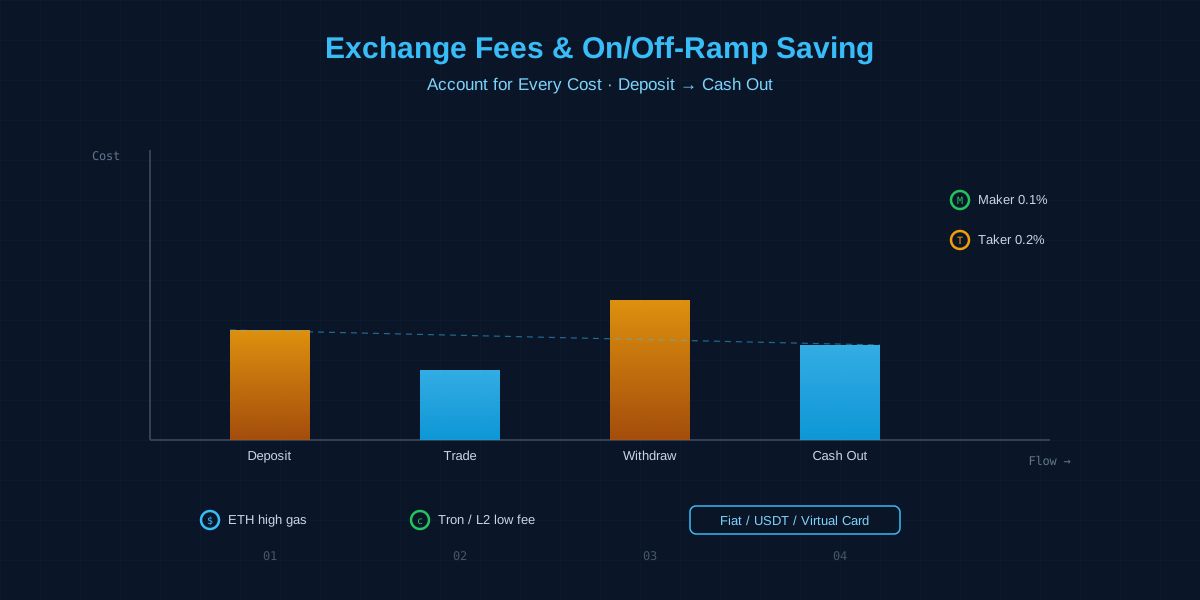
1. First, know how many times you actually get charged
Before talking about saving, you need to see where the money goes. Many newcomers assume the exchange only charges once, "when you trade." In reality, a full round trip passes through at least three or four toll gates. Listing them out is step one of this on/off-ramp tutorial, and the foundation for everything that follows.
A typical path looks like this: you convert fiat (dollars, yuan, whatever) into a stablecoin or buy coins directly through some channel - that carries a deposit/buy-in cost. Then you make a few spot trades - that carries a trading fee, the much-discussed maker/taker rate. If you move coins to your own wallet or another platform, you pay a withdrawal fee, which is essentially on-chain gas plus an exchange markup. Finally, when you want to lock in gains and convert back to fiat, cashing out carries yet another cost.
Of these four, the trading fee is the most clearly printed, so ironically it is the easiest to optimize. The ones that quietly cost you the most are deposit, withdrawal, and cash-out - because their cost usually hides inside exchange-rate spreads, network choices, and channel fees, rather than being stated plainly like a trading rate. So this tutorial puts the spotlight on the "invisible" costs, and helps you price the whole chain at once.
- A full round trip passes through at least four toll gates: deposit, trade, withdrawal, cash-out.
- Trading fees are most transparent and easiest to optimize; deposit/withdrawal/cash-out costs hide in spreads and channel fees.
- Do the math on the whole chain's total cost, not just one link's headline rate.
2. Trading fees: understand maker vs taker
Spot trading fees are almost always charged as a percentage of the filled amount, split into two tiers: maker (the one who posts an order) and taker (the one who fills an order). Understanding these two words is the single most immediately rewarding part of this tutorial.
2.1 What maker and taker really mean
Put simply: if your order does not fill instantly but sits on the order book "waiting for someone to trade against it," you are a maker, providing liquidity. If your order fills the moment you submit it by eating someone else's resting order, you are a taker, consuming liquidity. Exchanges want people to post orders, so the maker rate is usually lower than the taker rate - sometimes zero or even negative (a rebate). This means that using a limit order instead of a market order can often cut your fee roughly in half.
2.2 A simple worked example
Say a platform charges 0.1% maker and 0.2% taker, and you want to buy 10,000 USDT worth of a coin. Fill instantly with a market order (taker) and you pay 20 USDT; post a limit order and let it fill (maker) and you pay only 10 USDT. That's 10 USDT on a single trade - do that dozens of times a month and the gap becomes very real. Active traders especially should build the habit of "post, don't take, whenever you can."
2.3 Token discounts and fee tiers
Most exchanges offer two more ways to cut fees: pay fees with the platform's own token, usually for a 25%-or-more discount; and fee tiers based on your 30-day volume or holdings, where more volume means a lower rate. For ordinary users, the platform-token discount is the easiest win and worth enabling first. Just note that holding the platform token carries its own price risk - don't hoard more than you need just to save on fees. That crosses from "saving" into "an investment decision," which should be considered separately.
- Maker (posting) rates are usually lower than taker (filling); using limit orders meaningfully cuts trading fees.
- Paying fees with the platform token is the easiest discount to capture, often 25% or more.
- Fee tiers scale with volume/holdings; ordinary users should just enable the token discount first.
3. Withdrawal networks and gas: the right chain saves a lot
Withdrawals are where "pick wrong, pay more" hits hardest. Sending the same USDT over different networks can cost tens of times more or less, while the asset that lands is exactly the same. This section is about choosing the withdrawal network.
3.1 Why one coin has many networks
Stablecoins like USDT exist as contract versions on Ethereum, Tron, and various Layer 2s. They represent the same value, but run on different chains with wildly different gas. When Ethereum mainnet is congested, one transfer's gas can be several or even a dozen-plus dollars; on Tron or some Layer 2s, the same transfer might cost pennies. So before withdrawing, confirm "which network does the receiving address support," then pick a cheap chain. To compare swap and transfer costs across chains at a glance, you can use a stable cross-chain swap and exchange gateway to price it out first, then act.
3.2 Withdrawal fee = gas + platform markup
The withdrawal fee an exchange charges is usually not exactly the real on-chain gas - there may be a platform markup on top. Some platforms charge a flat amount (e.g., a flat 1 USDT for USDT-Tron), others roughly track live gas. The way to judge value is to convert the fee into a percentage of the amount withdrawn. Paying 1 USDT to withdraw 100 USDT is 1% - expensive; paying the same 1 USDT to withdraw 10,000 USDT is 0.01% - negligible. So small withdrawals especially should use a cheap network, or batch up to a decent amount before withdrawing, to avoid being nibbled by flat fees.
3.3 Don't sacrifice safety to save on gas
Saving assumes safety. When picking a cheap network, always confirm the receiver (another exchange or wallet) actually supports that chain, or the assets can be lost outright and unrecoverable. Also, when sending to a new address for the first time, test with a small amount before the big transfer. Between safety and cost, safety always wins - the gas you save can never make up for one wrong-chain transfer.
- Gas differs enormously by network; confirm the receiver's supported network, then pick the cheap chain.
- Convert the withdrawal fee into a percentage of the amount to judge value; small withdrawals especially need a cheap network.
- Saving gas can't cost you safety: confirm chain support, and test-send small before large.
4. Fiat on/off-ramp channels: the spread is the hidden big one
If trading and withdrawal costs are relatively transparent, the fiat on/off-ramp is where the cost hides deepest - because it rarely shows up labeled as a "fee." It disguises itself as an exchange-rate spread, a channel fee, or a difference in settlement time. This section unpacks the common methods.
4.1 P2P vs official channels
Many platforms deposit via P2P, where you buy and sell USDT directly with other users at an agreed price. P2P looks "fee-free," but the real cost lives in the spread between the price you get and the fair market price - that spread is what the merchant earns. To judge value, don't just read "no fee"; compare your fill price against the spot price at that moment. Official fiat channels (bank card, third-party payment) usually charge a stated percentage - transparent, but not necessarily cheaper.
4.2 Buying coins directly with a bank/credit card
Swiping a card to buy coins is the most convenient and usually the most expensive: issuer, payment processor, and exchange may each add a markup, and the all-in cost can reach several percent. For an occasional small deposit, the convenience may be worth it, but at large size or high frequency the cost becomes eye-watering. One power tip worth mentioning: some cross-border crypto services, data subscriptions, and cloud resources only accept overseas cards, and a US virtual credit card removes a lot of payment friction. Virtual card issuers like RDVCC are also commonly used by researchers to subscribe to on-chain tools and market-data services - open a card on demand, cap the limit, and it's far less stressful than exposing your main card.
4.3 Cashing out: don't let the spread eat your profit at the last step
Cashing out mirrors depositing - same spreads and channel fees. Plenty of people grind out a profit trading, then casually accept a bad rate on the way out, effectively handing part of it back. Before cashing out, compare live quotes from one or two channels, especially for large amounts: a 0.5% spread difference on tens of thousands is hundreds of dollars. Fold on/off-ramp into your cost accounting, and only then is the chain complete.
- P2P cost hides in the spread; don't be fooled by "zero fee" - compare fill price to fair spot.
- Card purchases are the most convenient and priciest; be careful at size, and use a virtual card to cut cross-border friction.
- Cashing out has spreads too; compare quotes for large amounts so you don't hand profit back at the last step.
5. Hidden costs people overlook
Beyond the four visible fees, several "hidden costs" get overlooked. They aren't printed on the fee page, yet they genuinely dent your final return.
5.1 Slippage: the invisible tax on big orders and thin coins
Slippage is the gap between the price you expected when ordering and the price you actually filled at. On illiquid pairs, or when you drop one large order, it eats through several price levels of the book, pushing your average fill noticeably off - a loss more hidden than the fee itself. The fix: when trading thin coins or large size, split into several fills, or use limit orders to lock the price and avoid quietly overpaying via slippage.
5.2 Funding rates and leverage costs
If you touch derivatives, a perpetual's "funding rate" is a holding cost settled every few hours; holding a one-sided position long term can bleed fees continuously. That goes beyond spot on/off-ramp, but it's still part of your cost - price it before you engage. This tutorial focuses on spot and ramps, so we only flag derivative costs here.
5.3 Time cost and tooling cost
Spending hours shuttling funds between platforms to save a few dollars in fees isn't necessarily worth it - your time is a cost too. The sensible move is to pick one or two main platforms with reasonable rates and a smooth experience, and put your energy into the decisions themselves. To switch efficiently between platforms and on-chain tools, a handy crypto navigation hub helps you quickly find gateways to exchanges, market data, and analytics - and the time saved is often worth more than the fees.
- Slippage is the invisible tax on big orders and thin coins; control it with split fills or limit orders.
- Perpetual funding rates are a holding cost that bleeds one-sided positions; price it before engaging.
- Time is a cost too; don't shuttle funds for pennies - pick main platforms and focus on decisions.
6. A checklist you can actually follow
Here's the whole thing condensed into a checklist you can run before your next operation to avoid most wasted money.
First, trade as a maker with limit orders, and enable the platform-token fee discount. Second, before withdrawing, confirm the receiver's supported network and - safety first - pick the cheapest chain; batch small amounts before withdrawing. Third, on both deposit and cash-out, compare your fill price to fair spot, and don't fall for the "zero fee" spread trick. Fourth, for large or thin-coin trades, split orders and use limit orders to control slippage.
Fifth, for cross-border payments and tool subscriptions, use a limit-capped virtual card instead of your main card to cut friction and risk. Sixth, sum the cost of the whole chain and compare platforms and methods by "percentage of principal," rather than being lured by one link's low rate. Seventh, periodically review your total fees for the month - many people are shocked the first time they add it up, and that shock is the best motivation to save. Run these seven steps and you'll know your true trading cost.
- Trade as a maker with limit orders + enable the token discount; withdraw on the cheapest safe network.
- Compare deposits/cash-outs to fair spot to dodge spreads; split large or thin-coin orders to control slippage.
- Compare by "percentage of principal," and review your monthly fee total regularly.
7. Wrap-up and disclaimer
The core message of this on/off-ramp tutorial is plain: fees can be saved, but the right way isn't chasing "zero rates" everywhere - it's understanding the exchange's fee structure first. Trading fees split into maker/taker, withdrawal fees hinge on which network you pick, on/off-ramp costs hide in spreads, and there are hidden costs like slippage and funding rates on top. Lay them all out and compare on one consistent "percentage of principal" basis, and only then can you choose well at every link. The savings look small and scattered, but compounded over the long run they add up to a lot.
To be clear: this article approaches everything from a methodology and cost-accounting angle. All rate figures are illustrative examples for explanation; actual rates follow each platform's latest official disclosure. It recommends no specific exchange, payment channel, or tool, and constitutes no investment advice of any kind. Crypto assets are highly volatile and risky, and on/off-ramp may involve compliance requirements in your jurisdiction, so understand local rules, judge independently, and act within your means. This piece is for study and research only.