
1. Why Airdrop and Sybil Detection Research Deserves Its Own Article
Several earlier articles in this series — "An Audit Report Says “Audited” — But Audited What, Exactly: From Conclusions to On-Chain Verification," "What Proof of Reserves Actually Proves: A Merkle Tree Verifies Inclusion, Not Solvency," "Researching Team Background and Developer Activity: From Verifying Team Pages to Reading GitHub Signals," "Verifying Oracle Prices: A Few Blocks of Feed Delay Is a Manipulator's Window," and "Cross-Chain Bridges: Assets Never Actually Cross — They're Locked on One Side, Minted on the Other" — each examine a completely different research object, yet together they establish the same methodological thread running through the whole series: any conclusory statement one party makes — whether an audit report's "no critical vulnerabilities found," an exchange's reserve snapshot, a team page's biographical claims, a protocol's own description of its price sources, or a bridge's account of its validator set and custody arrangement — is merely a "claim," not evidence in itself. A researcher must look past that claim and go back to the underlying raw data it corresponds to — the actual on-chain contract state, real fund flows, commit history, the actual oracle contract address, the actual custody-contract parameters — to verify it independently. The oracle and bridge-security articles in particular went a step further and jointly established a more specific sub-methodology: first lay out, in full, the abstract categories a given mechanism's design or attack surface can fall into, each with its own core assumption and failure mode, and only then train the skill of judging which category a specific real case actually belongs to. This "classify first, then verify by category" approach forms an analytical framework that keeps proving effective whenever the underlying mechanism is complex and easily dressed up in reassuring language.
At the same time, "On-Chain Data Analysis: An Address Is Not an Identity, a Transaction Is Not Intent" already systematically established how to read address- and transaction-level on-chain metrics — including how to think about active-address counts, transaction frequency, and basic patterns of fund movement — while "Tokenomics Research: How Much Unlock Pressure Hides Behind the Circulating Supply Number" already went in depth on token allocation structure and holder concentration as an object of research, explaining why a headline allocation percentage alone cannot reflect genuine holder dispersion. Neither article, however, extended that discussion to a more specific and thornier scenario: when token distribution takes the form of an "airdrop," how does one verify whether that distribution is genuinely dispersed and authentic at the address level? And among a large pool of participating addresses, how does one identify the ones that are not independent individuals at all, but a batch of addresses controlled in bulk by the same actual operator — "Sybil addresses"? These two questions sit exactly where the on-chain-data thread and the tokenomics thread converge in the specific context of airdrops, and this article sets out to bring the two threads together and treat them systematically.
Airdrops and Sybil detection deserve a dedicated article precisely because this is a structurally distinctive screening problem that warrants its own systematic treatment: in an airdrop distribution scenario, a project team or researcher faces a massive pool of candidate addresses, and the task is to separate "genuine, independent users" from "a large batch of addresses manipulated by the same actual operator" — with the latter deliberately disguising itself as the former on-chain. This screening problem itself constitutes an entire set of abstract signal categories that call for systematic treatment — including whether funding sources share a common origin, how similar behavioral timing sequences are, and how templated interaction paths are — together with a corresponding set of evasion tactics, with both sides locked in an ongoing methodological contest. This research structure closely mirrors, in its methodological skeleton, the "how do you verify whether a claim is genuine" problems this series has tackled before — whether audit conclusions, proof of reserves, team credentials, or the trust assumptions behind oracles and bridges — all of them boiling down to "there may be a gap between the claim and the underlying data, and it must be independently verified." But airdrops and Sybil detection point to an entirely new, previously untreated concrete object, which is why the topic warrants its own dedicated, systematic article.
It bears stating explicitly: this article, from beginning to end, is a discussion of methodology only. It does not name any real airdrop campaign, real project team, or real historical Sybil-attack incident; every mechanism and pattern discussed is described in abstract, hypothetical terms and does not point to any specific, identifiable entity or event. Nor does this article constitute investment advice of any kind — and it is emphatically not a tutorial or how-to guide on "how to participate in airdrops," "how to improve your airdrop eligibility," or "how to evade Sybil detection to capture more airdrop rewards." Throughout, the article's stance stays firmly on the side of the researcher or project team verifying the genuineness of a distribution and identifying Sybil patterns — never on the side of a participant trying to maximize their own take. Any specific figures or percentages that appear in the text are fictional examples introduced purely for illustration and do not correspond to real data from any real event.
2. How Sybil Addresses Are Constructed and Categories of Detection Signals
In the context of airdrops, a Sybil attack fundamentally means this: a single real-world actor controls a large number of on-chain addresses that appear unrelated on the surface, and uses them to impersonate many independent users in order to satisfy the eligibility criteria of a campaign, thereby capturing a distribution far larger than its legitimate share. The core tension underlying this type of attack is that an on-chain address is, in itself, nothing more than an identifier derived from a public key that is cheap to create in bulk, while most eligibility criteria are designed on the premise that "number of addresses" or "address behavior" can serve as a reasonable proxy for "number of independent users." Once that proxy relationship is forged at scale and at low cost, the resulting distribution systematically deviates from the degree of decentralization the designers originally intended. Understanding how Sybil addresses are constructed, and which abstract categories of signals researchers can rely on to identify them, is the essential framework that must be established before assessing the true distributional integrity of any token distribution.
2.1 Common Abstract Patterns Used to Construct Sybil Addresses
The first pattern can be called "bulk scripted operation." Its hallmark is the programmatic generation of large numbers of address/private-key pairs, each of which then executes a highly similar, minimal sequence of actions trimmed down to just what's needed to clear the eligibility bar — for instance, performing only the specific actions the threshold explicitly checks for, without any additional organic usage beyond that. The underlying assumption of this approach is that as long as a single address's sequence of actions formally satisfies the rules of the threshold, the distribution mechanism has no way to distinguish genuine user behavior from a script's repeated execution. The weakness of this approach is that across hundreds or thousands of addresses, the parameters, timing intervals, and call ordering of these action sequences tend to display a degree of uniformity distinctive of scripted execution — a consistency that is itself anomalous when measured against the natural, dispersed distribution of real user behavior.
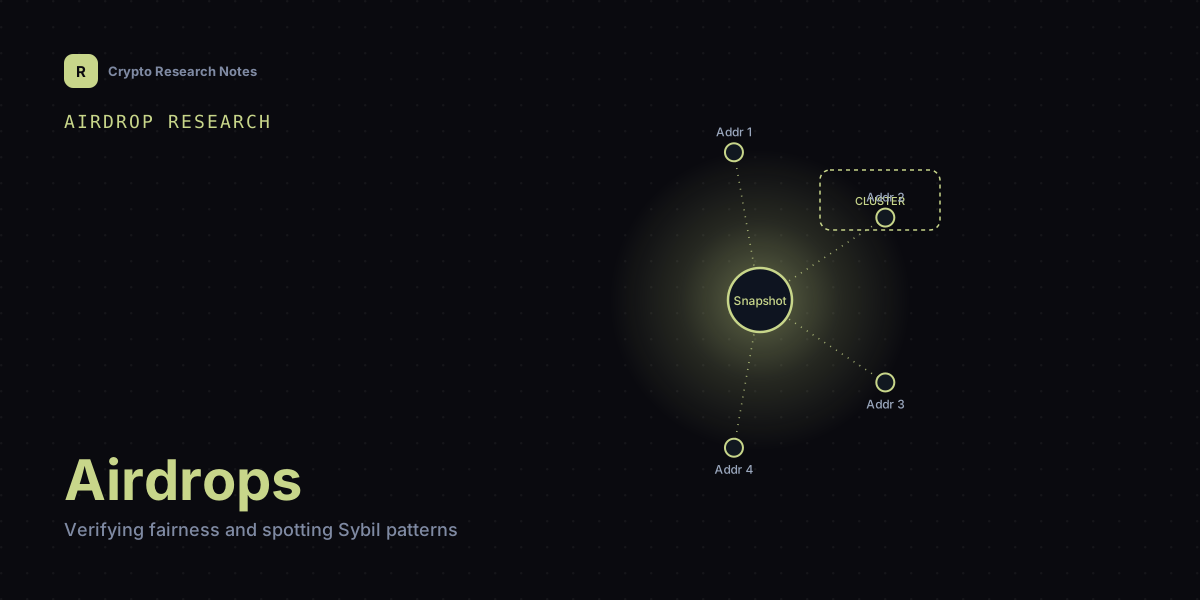
The second pattern can be called "fragmented funding origin." It starts from one or a small handful of source addresses, splits funds into many portions, and distributes them to a large number of newly created addresses, each of which then participates in the target activity independently. This creates the surface appearance that each address has its own independent source of funds and looks like an independent user. The reasoning behind it is that if the fund-splitting process involves enough intermediate steps, each individual amount is small enough, and the transfer timing is sufficiently spread out, on-chain observers will struggle to trace the many participating addresses back to a common source. In practice, though, as long as a researcher is willing to trace the transfer paths upstream, these addresses will typically still converge — within a limited number of hops — on the same source address or a small cluster of source addresses, forming a recognizable tree-like or star-shaped structure in the funding graph.
A third pattern, "link-chain severance," works by inserting mixers, cross-chain bridges, DEX swaps, or multiple relay hops into the path along which funds flow from the source to the many participating addresses. The goal is to sever the direct funding linkage between addresses and make it technically harder to reconstruct a full path through transfer-graph analysis alone, on the theory that enough layers of obfuscation or cross-chain hops will defeat on-chain linkage analysis once the chain of custody is broken. Its limitation, however, is that obfuscation or bridging typically severs only the direct financial linkage — it does not simultaneously eliminate correlation signals along other dimensions, such as behavioral timing patterns, gas funding sources, or on-chain environment fingerprints. This is precisely why the identification signal categories discussed below need to be cross-validated across multiple dimensions.
2.2 Common Abstract Signal Categories Used to Identify Sybil Addresses
The first category consists of correlation signals derived from fund-flow graphs. The core method is to reconstruct the inflow and outflow paths of participating addresses into a directed graph, and examine whether a large number of addresses converge on the same source address within a limited number of hops, or whether — after the campaign ends — the distributed assets they received are subsequently re-consolidated into the same address or a small cluster of addresses. This signal category is effective precisely because, regardless of what splitting strategy the operator employs, as long as the funds ultimately need to be controlled by the same real-world actor, the fund flow tends to exhibit a recognizable topology in graph structure — a star-shaped dispersion, tree-like branching, or eventual convergence — which stands in contrast to the dispersed, patternless distribution of sources and destinations one would expect from a genuinely independent group of users.
The second category consists of similarity signals derived from behavioral timing patterns. The core method is to compare whether large numbers of addresses, in completing the actions required to meet eligibility criteria, exhibit nearly identical time windows, nearly identical intervals between operations, and nearly identical operation ordering. A genuinely independent group of users will typically show a natural, dispersed distribution in participation timing, operational cadence, and decision-making order, owing to individual variation. A group of addresses controlled sequentially or in parallel by the same script or the same operator, by contrast, is far more likely to show anomalous clustering in timestamp distribution and highly repetitive patterns in operation sequencing. This consistency in the time dimension provides an independent line of verification separate from the fund-flow graph.
The third category consists of signals derived from gas funding sources and on-chain environmental fingerprints. The core method is to examine whether a large number of addresses received their initial gas funding from the same source address before their first on-chain operation, and whether these addresses share other anomalous commonalities in their on-chain environment — for example, similar address creation times, similar patterns in which contracts they chose to interact with, or traces of relying on the same underlying infrastructure nodes. Because a newly created address typically needs an external injection of a small amount of native token to pay for its first transaction's gas fee, this initial funding step tends to be the weakest link for an operator to fully decentralize. Even when the fund-splitting or link-severance strategies described above have already been effectively deployed, commonalities in gas funding sources can still serve as the key signal that reconnects a large set of superficially independent addresses back to the same real-world actor.
3. How to Independently Verify the True Distribution of an Airdrop, Regardless of What the Project Team Claims
Airdrop announcements routinely include language such as "this distribution has undergone rigorous Sybil filtering," "the distribution reached tens of thousands of genuine users," or "each address received an average of X tokens." These statements sit in exactly the same category as several other kinds of claims examined earlier in this series: the audit conclusions discussed in "An Audit Report Says “Audited” — But Audited What, Exactly: From Conclusions to On-Chain Verification," the reserve snapshots discussed in "What Proof of Reserves Actually Proves: A Merkle Tree Verifies Inclusion, Not Solvency," and the roadmap and changelog claims discussed in "Researching Team Background and Developer Activity: From Verifying Team Pages to Reading GitHub Signals." The same holds for claims like "we use a secure oracle," discussed in "Verifying Oracle Prices: A Few Blocks of Feed Delay Is a Manipulator's Window," and claims like "this bridge is secured by multisig," discussed in "Cross-Chain Bridges: Assets Never Actually Cross — They're Locked on One Side, Minted on the Other" — all of them are conclusory assertions rather than verifiable evidence. All of these claims share the same structural gap: the project team hands you a summary judgment, while what a researcher actually needs is the raw data and calculation process required to independently reproduce that judgment. This is precisely where the address- and transaction-level raw data emphasized in "On-Chain Data Analysis: An Address Is Not an Identity, a Transaction Is Not Intent," and the holding-concentration metrics emphasized in "Tokenomics Research: How Much Unlock Pressure Hides Behind the Circulating Supply Number," need to be brought back into play for the airdrop context. In practice, this means not stopping at the aggregate figures in the announcement, but instead locating the on-chain snapshots and distribution records that actually underlie those figures, recomputing them using the same methods, and checking the results line by line against the official claims — while also independently spot-checking the population of addresses the team claims to have filtered out as Sybils, rather than simply assuming the filtering logic itself is airtight. The two subsections below correspond to these two layers of verification.
3.1 Locating the Actual On-Chain Distribution Snapshot and Claim Records
The first step in verifying the true dispersion of a distribution is to move past the prose in the project's announcement and locate the on-chain data source where the distribution actually took place. Most airdrop distributions follow one of two typical structures. In the first, the project team sends batch transfers directly to a list of qualifying addresses, in which case you can filter the token contract's Transfer event logs for the records belonging to that batch. In the second, the project team deploys a dedicated claim contract that users must actively call to receive their tokens, in which case you should locate that claim contract's address and read its claim events (often named Claim or something similar), or enumerate every transaction that interacted with the contract. Regardless of which structure is used, what the researcher needs to obtain is the raw, transaction-by-transaction, address-by-address record — not a summary paragraph provided after the fact by the project team. Only raw records can be recomputed and cross-checked; the announcement's prose can only be repeated, not verified.
Once you have the raw distribution records, the next step is basic statistical reconstruction: how many deduplicated addresses actually received a distribution, and what shape does the distribution of amounts take across those addresses? Characterizing that shape should not rely on the mean alone, since a handful of large recipients can easily pull the average up and mask the fact that most addresses received only a trivial amount. A better approach is to compute a concentration metric such as a Gini coefficient, or to plot a Lorenz curve and group addresses into quantiles by amount received, examining what share of the total distribution each quantile accounts for — this lets you see whether the distribution is close to uniform or heavily concentrated in the hands of a small group at the top. This entire statistical exercise should be carried out independently from raw on-chain data, without relying on any intermediate calculation supplied by the project team, so that the resulting concentration conclusion is not colored by the team's own narrative.
The final step is to line up the independently computed address count, amount distribution, and concentration metrics against the project team's specific public claims — "number of addresses covered," "average distribution amount," "the distribution is already sufficiently decentralized," and so on — item by item. If the team claims to have covered tens of thousands of addresses, but the deduplicated on-chain recipient count comes in noticeably below that order of magnitude, or if the official average conceals an extremely high Gini coefficient, that gap is itself a signal warranting further scrutiny: it means there is an as-yet-unexplained discrepancy between the official narrative and the raw data. The point of this line-by-line comparison is not to arrive at a conclusory judgment such as "this project's distribution is unfair," but to confirm whether every summary statement the team has made can be traced back to, and recomputed from, the underlying on-chain data. Any claim that cannot be reproduced this way should be treated as an unverified assertion.
3.2 Cross-Checking Address Linkages, and Why a Project's Own Claim of Sybil Filtering Is Not Sufficient Verification
Once the statistical reconstruction of distribution scale and concentration is complete, the next step is to independently spot-check the linkage among the addresses that actually received the distribution, using two complementary techniques: fund-flow tracing and timing-pattern comparison. Fund-flow tracing means sampling a batch of recipient addresses and checking whether they previously received small, batched amounts of seed funding from the same source address — for instance, the same exchange withdrawal address or the same funding-distribution address. This "fan-out from a common source, then disperse" fund topology is one of the classic signatures of a Sybil address cluster. Timing-pattern comparison means examining whether the interactions these addresses performed to qualify for the airdrop show suspiciously uniform time intervals, similar gas settings, or nearly identical transaction ordering. A genuinely independent population of users typically shows a natural, dispersed timeline of behavior, whereas address clusters driven by scripts tend to display scripted regularity.
The sample for this independent spot check should not be limited to the set of addresses the project team itself has flagged as "suspicious" or "already filtered." It should instead be drawn — randomly or via stratified sampling — from the full population of addresses that actually received a distribution, because what needs verifying is precisely whether the filtering rules themselves have gaps. Checking only the addresses the project has already flagged merely reconfirms the internal consistency of the project's own filtering logic; it tells you nothing about the genuine integrity of the distribution outcome as a whole. The spot check should focus particularly on addresses that successfully passed the official filter and ended up on the final distribution list, because if the official filtering rule has a blind spot, the problem will be hiding precisely within the population that "passed review" — not within the list of addresses that got filtered out.
This methodological point is structurally identical to how this series treats the claim "we use a secure oracle" in "Verifying Oracle Prices: A Few Blocks of Feed Delay Is a Manipulator's Window," and the claim "this bridge is secured by multisig" in "Cross-Chain Bridges: Assets Never Actually Cross — They're Locked on One Side, Minted on the Other." A project's own assertion that it has completed Sybil filtering is still just a claim awaiting verification, not a conclusion to be taken at face value — just as whether an oracle is genuinely secure requires locating the actual on-chain oracle contract and its price-feed parameters to confirm, and whether a bridge's multisig custody genuinely holds up requires locating the actual on-chain custody contract and validator-set parameters to confirm, the effectiveness of Sybil filtering likewise has to be confirmed through an independent spot check of address linkages. The value of an independent spot check lies not in replacing the project team's filtering work or in rendering some more authoritative counter-judgment, but in its ability to surface the blind spots that the team's own filtering rules failed to cover — blind spots that a verification approach relying solely on official claims could never reach in the first place.
4. Abstract Categories of Sybil-Detection Evasion Tactics
There is always a dynamic arms race between detection methods and the tactics used to evade them. Understanding the abstract categories of evasion tactics is a precondition for assessing the reliability of any given detection method. This is the same methodological stance emphasized in "Tokenomics Research: How Much Unlock Pressure Hides Behind the Circulating Supply Number": concentration of holdings cannot be judged as genuine or not from surface-level allocation data alone, and verifying true circulation requires understanding the full range of hidden mechanisms at play. The first abstract category of evasion targets detection signals along the time dimension. If a detection method relies primarily on a high degree of consistency in operation timing — for instance, a large number of addresses executing the same sequence of actions within an extremely narrow time window — as its core signal for flagging Sybil activity, then in principle, deliberately staggering the timing of operations across addresses, introducing random delays, or even simulating the irregular rhythms of a genuine user's behavior could all reduce the likelihood that this batch of addresses gets caught by a time-pattern-based detection method. This suggests that temporal clustering can serve as a valuable initial screening signal, but should not be treated as sufficient grounds on its own for labeling addresses as Sybils — particularly when dealing with participants who deliberately disguise their behavioral cadence.
The second abstract category of evasion targets detection signals along the fund-linkage dimension. Many detection methods rely on tracing the flow of funds between addresses — for example, multiple addresses receiving their initial funding from the same source address, or sharing the same gas-fee-paying account — to determine whether a cluster of addresses is related. In principle, if the funding source behind each address is independent and non-overlapping, and if the paths funds take into each address, as well as the accounts used to pay gas fees, are deliberately kept distinct, this severs the on-chain fund-linkage clues that would otherwise be directly observable between addresses. Such addresses would then appear as isolated, untraceably connected nodes within a fund-tracing graph, reducing the likelihood that a fund-linkage-based detection method would group them into the same cluster. The existence of this evasion tactic means that the effectiveness of fund-linkage analysis depends heavily on the completeness of the underlying data and the depth to which the tracing graph is built — once fund paths show signs of deliberate severing or circuitous routing, shallow linkage analysis is prone to missing the connection. This echoes the logic emphasized in "What Proof of Reserves Actually Proves: A Merkle Tree Verifies Inclusion, Not Solvency," which stresses that a static reserve snapshot cannot substitute for verifying actual on-chain fund movements: just as a single point-in-time or single-path judgment of fund linkage cannot substitute for ongoing verification of the depth and completeness of the fund graph.
The third abstract category of evasion targets detection signals along the address-history dimension. Some detection methods use whether an address has a lengthy history of interactions, or whether it has previously engaged in diverse on-chain activity, as an important reference point for judging whether it belongs to a genuine long-term user — since batches of freshly created addresses typically lack this kind of historical depth. In principle, if a participating address is not newly created but instead has been acquired through some means after already accumulating a long usage history and a diverse record of interactions, and is then used to masquerade as a genuine long-term user participating in a distribution campaign, such addresses could exhibit characteristics, under historical-dimension verification, that closely resemble those of real veteran users — thereby undermining the effectiveness of detection methods that rely solely on address age and historical activity level as their basis for judgment. This also suggests that the authenticity of an address's history likewise needs to be cross-verified against other dimensions such as behavioral consistency and linkage patterns, rather than being relied upon in isolation as proof of genuine user identity — much as "Researching Team Background and Developer Activity: From Verifying Team Pages to Reading GitHub Signals" cautions against taking a seemingly complete team profile at face value, and instead calls for cross-verification against independently verifiable external clues.
These three categories of evasion tactics share the same methodological path as the abstract categories of price-manipulation risk discussed in "Verifying Oracle Prices: A Few Blocks of Feed Delay Is a Manipulator's Window," the abstract mechanisms of bridge compromise discussed in "Cross-Chain Bridges: Assets Never Actually Cross — They're Locked on One Side, Minted on the Other," the methodological point in "An Audit Report Says “Audited” — But Audited What, Exactly: From Conclusions to On-Chain Verification" that audit conclusions cannot substitute for direct on-chain verification, and the address- and transaction-level verification foundations established in "On-Chain Data Analysis: An Address Is Not an Identity, a Transaction Is Not Intent." Only by first systematically understanding the abstract categories of evasion tactics that may exist can one design detection methods that are harder to circumvent and more comprehensive in coverage, rather than remaining stuck at the level of countering one already-known tactic. This analogy also points toward a more general conclusion: any single-dimension detection signal — whether timing patterns, fund linkage, or address history — may have room to be specifically evaded, because once an evading party understands the core signal a detection method relies on, it becomes possible to design operations specifically engineered to bypass that signal. For this reason, multi-dimensional cross-verification — combining independent signals such as timing patterns, fund graphs, address history, and behavioral patterns into a single holistic judgment — is far more robust than relying on any single signal, and this is the basic methodological stance researchers should adopt when verifying the true degree of decentralization in a token distribution.
5. Cross-Checking Projects' Claimed Anti-Sybil Mechanisms Against What Was Actually Implemented On-Chain
In airdrop distribution announcements or rules documents, project teams almost always include a passage describing their risk-control capabilities — claiming to have deployed a multi-dimensional Sybil-detection algorithm, built in a manual review step, or required participants to complete some form of identity verification to qualify. The purpose of this kind of language is to convey to the community the impression that "the distribution results have been carefully filtered." But from a research-methodology standpoint, such self-description is itself only a claim: it describes the process the project wants outsiders to believe took place, not the verifiable result left behind after that process was actually carried out. A rules document can state "we removed all Sybil addresses," but the document itself proves neither that the algorithm actually ran nor how strict its detection criteria were or how comprehensive its coverage was. This is the same distinction this series has repeatedly emphasized elsewhere: there is an inherent gap between a claim and its actual implementation, and the researcher's task is to measure that gap.
This logic has already been applied systematically across several other contexts. "Researching Team Background and Developer Activity: From Verifying Team Pages to Reading GitHub Signals" points out that progress claims written into a roadmap or changelog cannot substitute for directly checking the actual commit and release history of the code repository, because the former is narrative while the latter is the trace left by actual behavior. "Verifying Oracle Prices: A Few Blocks of Feed Delay Is a Manipulator's Window" and "Cross-Chain Bridges: Assets Never Actually Cross — They're Locked on One Side, Minted on the Other" similarly explain that a protocol's stated price sources or validator mechanisms cannot substitute for directly verifying the actual on-chain oracle contracts or the code logic of cross-chain custody contracts, because an announcement can describe any idealized state, but only the logic actually written into and executed by the contract determines the system's real behavioral boundaries. A project's claimed anti-Sybil mechanism in the airdrop context is essentially the same category of problem showing up at the distribution stage: the algorithm, review process, or identity-verification requirement the project describes is likewise a narrative about an internal process, not evidence about the final on-chain distribution outcome. What connects the two — the claim and the outcome — is independent verification of the distribution result itself, and that verification is what the rest of this section lays out.
The concrete verification path is to take the abstract Sybil-construction features discussed earlier — for example, common-origin forking patterns in fund provenance, high synchronization in behavioral timelines, and convergent consistency in holding and subsequent disposal paths — and reapply them to the actual set of addresses that ultimately received the distribution, rather than stopping at reading the rules document. In practice, one can draw a sample of addresses at reasonable scale from the public distribution list or on-chain transfer records, then trace each one's source of funds, historical interaction behavior, and post-distribution asset flows, checking whether these addresses still cluster together and exhibit the combinations of features described in the abstract categories above. If the filtering mechanism the project claims to have used genuinely worked, then among the sample that ultimately received the distribution, address clusters strongly matching Sybil characteristics should make up only a small proportion, and their mutual correlation should be weaker than in the original, unfiltered pool of participating addresses. Conversely, if the spot check finds that the final list still contains large numbers of address clusters sharing common fund origins, synchronized behavior, and converging disposal paths, that indicates the claimed detection and review process did not, in practice, achieve its stated filtering effect — or that the detection criteria themselves have systematic blind spots.
It bears emphasizing that the conclusions drawn from this kind of cross-verification should be confined strictly to the methodological level: the more pronounced the address-cluster features found in the spot check, and the higher their proportion, the only thing this can establish is that "there is an observable gap between the claimed mechanism and the actual distribution outcome" — it cannot be equated directly with a judgment about whether the project team acted in good faith or whether its algorithm was deliberately lenient. The causes of such a gap are multifaceted: it could stem from inherent limitations in the detection technology itself, from attackers evolving increasingly covert construction methods, or from insufficient resources having been devoted to the review step at the execution level. What a researcher can safely offer is a measurement of the objective fact of how dispersed or concentrated the actual distribution outcome is, and whether this measurement deviates noticeably from the filtering goals the project publicly claims to pursue. Determining the cause of any such deviation and assigning responsibility for it requires additional context beyond what an on-chain sample check alone can support, and falls outside what can be concluded from spot-checking on-chain data alone. This is precisely the boundary of interpretation that should be maintained when applying the "claim vs. actual implementation" verification framework to the Sybil-filtering context.
6. Common Misconceptions About Airdrops and Sybil Detection
When assessing whether an airdrop or token distribution is genuinely decentralized, one common misconception is to treat the sheer number of claiming addresses as direct proof of dispersion — assuming that more participating addresses automatically means a broader, more authentic user base. This judgment overlooks a basic fact: address count is a surface-level metric that can be artificially inflated, not a direct measure of the number of independent participants. What actually determines whether a distribution is truly dispersed is the fund-aggregation path behind those addresses — that is, whether the tokens or incentive funds ultimately flow back on-chain to a small number of source wallets or a handful of affiliated collection addresses — together with the similarity in behavioral timing patterns across those addresses, such as whether they were mass-created by the same script within an extremely short window, or exhibit highly consistent transaction cadence and sequences of operations. This is the same research orientation emphasized in "On-Chain Data Analysis: An Address Is Not an Identity, a Transaction Is Not Intent," which stresses that address- and transaction-level metrics must be interpreted alongside fund flows rather than viewed in isolation as raw totals. Concluding that a distribution is already sufficiently dispersed based solely on total address count, without examining fund-aggregation paths or behavioral timing patterns, is methodologically unsound. This caution applies at the level of general research methodology and is not directed at any specific project or campaign.
A second common misconception is to treat a project's or campaign organizer's claim of having deployed an advanced Sybil-detection algorithm as automatically equivalent to the final distribution being free of concentration problems. An algorithm claim is essentially a commitment about method, whereas whether the distribution outcome is genuinely dispersed is an empirical question about results — and there is no necessary causal guarantee linking the two. A detection algorithm may have limited coverage (for instance, designed to catch only a known category of prior abuse patterns while lacking the ability to identify novel Sybil strategies), or its enforcement standards may have been loosened in practice due to the cost of false positives, community pushback, or rule adjustments, creating a gap between the method as claimed and the distribution as actually implemented. Researchers assessing the true dispersion of a given distribution should treat the claim of having used a detection algorithm as itself an object requiring verification, not as a conclusion that substitutes for verification. This is the same category of methodological requirement repeatedly emphasized elsewhere in this series: audit conclusions cannot substitute for directly verifying the contract ("An Audit Report Says “Audited” — But Audited What, Exactly: From Conclusions to On-Chain Verification"), custody claims cannot substitute for verifying the on-chain custody contract ("What Proof of Reserves Actually Proves: A Merkle Tree Verifies Inclusion, Not Solvency"), and a team's self-reported activity level cannot substitute for verifying actual commit and release records ("Researching Team Background and Developer Activity: From Verifying Team Pages to Reading GitHub Signals"). None of this is a comment on any specific project's algorithm or specific outcome — it is only a note on general research method.
A third misconception holds that the larger the total number of addresses covered by a distribution, the fairer that distribution must necessarily be — without recognizing that the total address count itself may already be inflated by Sybil addresses padding the count. When the participation threshold is low and detection mechanisms have blind spots, the same set of actual controllers can massively expand the denominator of total addresses simply by mass-generating new ones, creating the visual impression of broad coverage. But growth in the total driven by this padding is an entirely different concept from genuine dispersion — the former reflects how easy it is to generate addresses, while the latter reflects the actual distribution of tokens or entitlements across independent participants. This distinction belongs to the same structural category as the point made in "Tokenomics Research: How Much Unlock Pressure Hides Behind the Circulating Supply Number" regarding token allocation and holder concentration — namely, that nominal allocation and actual circulation are not the same thing. In both cases, a surface-level denominator or scale figure masks the true underlying state of concentration. A researcher who uses total address count as an undifferentiated proxy for fairness risks being misled by this surface-level scale effect, neglecting to verify concentration itself (for example, via the Gini coefficient, or the share held by the top N addresses). None of this speaks to the scale or outcome of any specific distribution campaign — it stays at the level of general methodology.
A fourth misconception arises on the side of participants or researchers themselves: the belief that simply completing whatever threshold actions a campaign specifies — reaching a certain transaction count, maintaining some minimum balance, or keeping an address active within a particular time window — guarantees that one's address will not be misjudged or flagged as part of a Sybil cluster. This overlooks the fact that Sybil-detection methods typically do not rely on meeting a single dimension of criteria, but rather on a composite judgment built from cross-referenced signals across multiple dimensions: the relatedness of fund sources, consistency in behavioral time series, fund transfers or gas-payment relationships with other addresses, repeated patterns in operational sequences, and more — all evaluated jointly. Satisfying the threshold on one dimension does not mean the overall behavioral pattern won't display concentration or correlation on other dimensions, and therefore offers no guarantee against being flagged as a Sybil. As with the points above, this is not aimed at the specific threshold design or specific detection outcome of any particular campaign; it is a general methodological caution. It is worth noting that all four misconceptions above share the same structural flaw: treating some readily available surface-level signal — address count, an algorithm claim, aggregate scale, or meeting a single dimension of criteria — as a stand-in for the conclusion itself, while skipping verification of the causal link between the signal and that conclusion. This is the same structural issue discussed earlier in this series in "Verifying Oracle Prices: A Few Blocks of Feed Delay Is a Manipulator's Window" and "Cross-Chain Bridges: Assets Never Actually Cross — They're Locked on One Side, Minted on the Other," as well as the caution in "DAO Governance: When Voting Power Concentrates in a Few Addresses, Does “Decentralized” Still Hold" that on-chain treasury flows cannot be inferred from proposal text alone.
7. A Verification Checklist Worth Keeping on Record
Consolidating the verification angles discussed above into a single record is meant to help researchers systematically preserve a trail of "what evidence has been confirmed and what has not" when analyzing a given token distribution, rather than arriving at a vague, impressionistic conclusion. The checklist itself is a neutral observation framework: each item corresponds to a factual question — has something been located, computed, or cross-checked — and presupposes no particular direction of judgment.
It bears special emphasis: this checklist does not constitute, and must not be used as, a scoring system for the credibility, compliance, or "Sybil suspicion" of any specific airdrop, project, or participating address. No single item, nor any combination of items, can substitute for the independent judgment a researcher must form from concrete evidence and specific context — and none of it should be used directly to characterize, score, or level accusations against any real project, real team, or real address. The checklist's role is limited to prompting what should be checked and to what extent it has been checked; its output is merely one input into subsequent independent analysis, not the analysis itself.
- Has the actual on-chain snapshot block height or snapshot time window for this distribution been identified, rather than relying solely on the wording of the project's announcement
- Has the complete claim record — not just the snapshot list — been obtained, and has the discrepancy between the two been checked (for example, whether the number of snapshotted addresses matches the number of addresses that actually claimed)
- Have concentration metrics for the total number of distribution addresses and the distribution amount — such as the Gini coefficient or the share held by top addresses — actually been calculated, rather than cited from someone else's ready-made conclusion
- Has a sample of addresses that received the distribution been spot-checked for common funding-source linkage, tracing whether their initial funding came from the same upstream address or the same consolidation path
- Has the similarity of operational timing patterns across addresses been examined — for instance, whether a large number of addresses completed the same sequence of interaction steps within an extremely short time window
- Has the source of gas-fee payments for these addresses been checked, looking for a pattern in which a single address repeatedly pays gas on behalf of a large batch of other addresses
- Has the distribution of address-creation timestamps been examined, for example whether an unusual concentration of addresses was batch-created within a narrow time window
- Has the degree of repetition in contract-call parameters and call order been examined, to judge whether there are clear traces of scripted, templated operations
- Has the destination of funds after the distribution been checked — for example, whether there is a pattern of rapid consolidation into a small number of collection addresses
- Has the actual scope of execution of the project's claimed Sybil-detection algorithm been verified, including the proportion of addresses covered by the screening, the exclusion criteria, and the degree of public disclosure
- Has it been verified whether the manual review step the project claims to have performed has any verifiable execution record, or whether it is merely an assertion with no traceable process evidence
- Has it been checked whether known functional addresses — such as exchange consolidation addresses or cross-chain bridge addresses — were reasonably excluded from the statistics, so as to avoid misclassifying normal business addresses
- Has it been checked whether the same batch of addresses overlaps with other historical distribution activities, and whether such overlap alone can constitute a conclusion
- Have the data sources, query timestamps, and tool versions relied upon for this verification been recorded, so that the conclusions can be reproduced or refuted by others
- Has a clear distinction been drawn between "correlation shown by the data" and "a causal inference made by the researcher," avoiding the direct equation of statistical features with proof of Sybil behavior
- For items marked "unresolved" on the checklist, has a specific account of the evidentiary gap been added, rather than jumping straight to a qualitative conclusion
8. Conclusion
The problem this article addresses is not an isolated new topic. It is the sixth time this series has applied the same methodological thread it has repeatedly tested across its previous five installments—this time to airdrop distribution: "An Audit Report Says “Audited” — But Audited What, Exactly: From Conclusions to On-Chain Verification," "What Proof of Reserves Actually Proves: A Merkle Tree Verifies Inclusion, Not Solvency," "Researching Team Background and Developer Activity: From Verifying Team Pages to Reading GitHub Signals," "Verifying Oracle Prices: A Few Blocks of Feed Delay Is a Manipulator's Window," and "Cross-Chain Bridges: Assets Never Actually Cross — They're Locked on One Side, Minted on the Other." That thread is this: no conclusory claim made by any single party can substitute for independent verification of the raw data underlying it. Audit conclusions must be checked against the on-chain contracts themselves; reserve snapshots must be checked against actual fund flows; roadmaps and changelogs must be checked against real commit and release histories; and the trust claims made about oracles and cross-chain bridges must be checked against on-chain contracts and validator parameters. In the same way, whether an airdrop distribution scheme has actually achieved the "fair, decentralized distribution" or "effective Sybil resistance" it claims cannot be concluded merely from the project's own distribution announcements or descriptions of its anti-Sybil mechanism—it must instead be verified independently against the raw data of on-chain addresses, transactions, and token holding distributions. At the same time, this article also merges two threads previously established elsewhere in the series: the address- and transaction-level metric-reading approach from "On-Chain Data Analysis: An Address Is Not an Identity, a Transaction Is Not Intent," and the token allocation concentration analysis method from "Tokenomics Research: How Much Unlock Pressure Hides Behind the Circulating Supply Number." It takes these two toolsets—previously applied to general on-chain observation and to token allocation structure analysis, respectively—and focuses them specifically on the more granular research problem of measuring the true dispersion of an airdrop distribution and identifying Sybil addresses.
On the methodological side, this article first abstracted and summarized several ways Sybil addresses are constructed and the corresponding categories of detection signals, helping researchers understand why certain behavioral patterns appear statistically anomalous rather than simply relying on intuition. It then explained how to move beyond a project's own distribution announcements or "deduplicated" reporting figures by independently obtaining raw on-chain address and transaction data to recompute the true dispersion of a distribution outcome—including how to weigh the two-sidedness of metrics such as holding concentration and address correlation, which may or may not actually reflect the real situation. Next, it summarized the categories of abstract techniques that can, in practice, be used to evade Sybil detection, making clear that detection mechanisms themselves have limitations and cannot be treated as an absolutely reliable filter. Building on this, it further discussed how to verify whether the anti-Sybil mechanism a distribution scheme claims to employ is actually consistent with its real distribution outcome—that is, whether the claimed rules and the final distribution observable on-chain corroborate one another. Finally, it laid out several common cognitive pitfalls researchers tend to fall into in this area, cautioning against the risk of drawing conclusions from a single metric or a single point-in-time snapshot.
It bears repeating that everything in this article remains at the methodological level. It does not pass judgment on the fairness or credibility of any specific airdrop campaign, real project, or historical event. Any specific figures, ratios, or case scenarios appearing in the text are fictional, illustrative examples used solely to aid understanding of abstract concepts, and do not refer to any event that actually occurred. Nothing in this article constitutes investment advice of any kind, nor does it constitute guidance on how to participate in an airdrop, how to improve airdrop eligibility, or how to evade Sybil address detection mechanisms. Its sole purpose is to provide researchers with a methodological framework for verifying the authenticity of token distributions and identifying Sybil patterns.