
1. Why Vote-Market Mechanics Deserve Their Own Research Line
The liquidity-mining article in this series looked at why liquidity providers are paid in token emissions and how to decompose that yield into its real components. The DAO-governance article looked at general voting mechanics and how to check whether decision-making power is concentrated. This piece sits in between those two: it is not about why emissions exist, and not about governance in general, but about a narrower and often overlooked question — who actually decides which pools receive more emissions, and what happens once that decision-making power becomes something that can be bought and sold.
In many token-emission systems, the allocation of rewards across pools is not fixed by a formula but is periodically re-decided by a vote among token holders, often weighted by how long they have locked their tokens. That voting process creates a market of its own: whoever controls enough voting weight can direct emissions toward a chosen pool, and other parties may find it profitable to pay for that voting weight rather than earn it. Researching this layer means treating "vote-direction power" as an asset with its own price, its own buyers and sellers, and its own centralization risks — distinct from the emissions themselves or the governance system that hosts the vote.
- Scope of this article: abstract categories of vote-locking and bribe-market mechanisms only, illustrated with fictional figures.
- No real protocol, token, or bribe marketplace is named or implied to have engaged in any specific practice described here.
- Goal: a repeatable checklist for evaluating any vote-locking or bribe system a researcher encounters.
2. Vote-Locking Mechanisms and Voting-Power Concentration
A common design pattern asks holders to lock a governance token for a chosen duration — days, months, or years — in exchange for boosted voting power, often scaled so that longer locks earn disproportionately more weight per token. The stated rationale is to align incentives with long-term holders: locking removes tokens from circulating supply, reduces immediate sell pressure, and theoretically rewards participants who care about the protocol's multi-year health rather than short-term extraction. In practice, the design also creates a new object worth studying — the distribution of who holds locked voting power and for how long.
A researcher examining a vote-locking mechanism should not stop at confirming that locking exists; the interesting question is what the lock distribution actually looks like once deployed. A system with a theoretically fair boost curve can still end up functionally captured if a small number of addresses hold the large majority of maximum-duration locks, since those addresses then control most of the votes that decide emission direction.
- Distribution of lock durations chosen across all lockers, not just the average.
- Share of total voting power held by the top 5-10 addresses, and whether that share is trending up or down over time.
- Whether locked positions are held directly by end users or by intermediary contracts/pooling vehicles (a theme this article returns to in Section 5).
- How voting weight decays as a lock approaches expiry, and whether that decay is exploited around vote snapshots.
3. How Bribe Markets Work: Paying for Someone Else's Vote
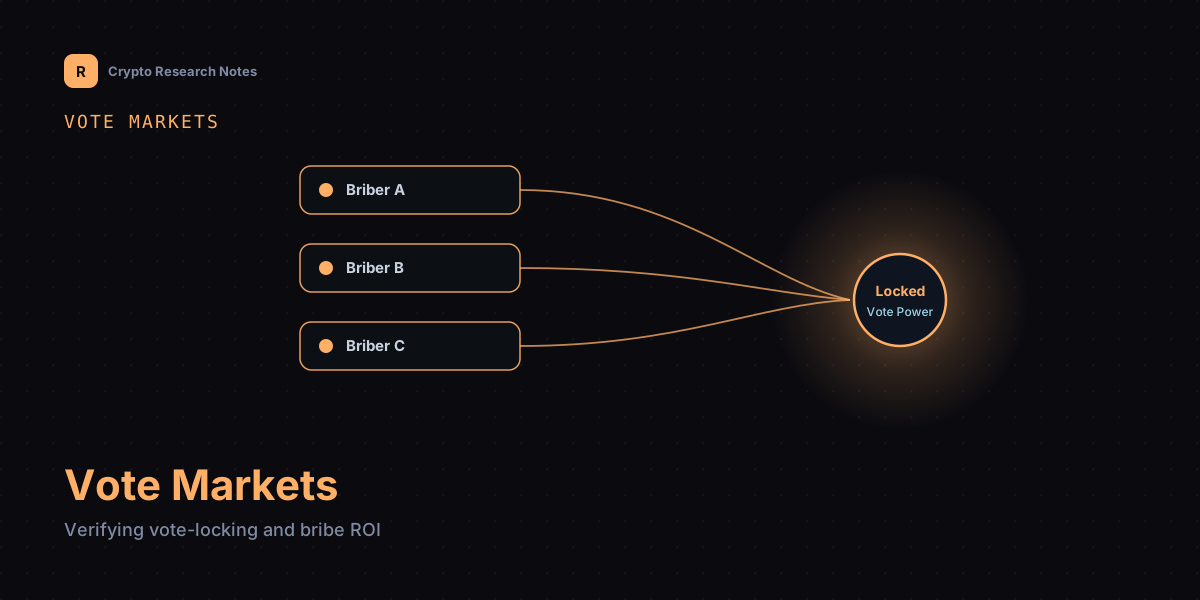
Once emission direction is decided by a vote, a protocol that wants more emissions routed to its own pool has two broad options: increase its own token emissions directly, which dilutes its own holders, or pay existing locked-token holders to direct their votes its way. Third-party bribe marketplaces exist to make the second option efficient — they let a protocol post a reward pool that any voter can claim by directing votes as requested, without either side needing to negotiate individually. The economic logic is straightforward: this is worth doing whenever the bribe cost per unit of extra emissions is cheaper than the dilution cost of minting those emissions directly.
Consider a purely illustrative example, invented for this discussion: suppose directing an extra $100,000 of weekly emissions toward a pool would cost a protocol $100,000 of newly minted tokens if done directly, but the same emission shift can be purchased on a bribe market for $40,000 paid to vote-holders. In that invented scenario, bribing is the cheaper path by a wide margin, and a rational protocol would be expected to prefer it. Researchers evaluating a real system should look for exactly this kind of comparison using the protocol's actual, disclosed numbers.
- Ratio of bribe spend to the emissions value being redirected, compared against the cost of minting that value directly.
- Whether bribe markets are open/transparent (public bid data) or opaque (privately negotiated).
- Whether bribe payments come from a protocol's treasury, its token emissions, or external revenue.
4. Verification Metrics: Bribe ROI and Genuine Participation
A useful verification exercise is calculating bribe ROI from the voter's side: divide the bribe income received per unit of locked voting power by the extra emission APY that the same vote captures for that voter's own position. If a voter earns more from the bribe payment than they would ever realize from the underlying pool's activity, their incentive to vote is purely mercenary and detached from any judgment about which pool actually deserves emissions. This mirrors the mercenary-capital concept from the liquidity-mining article, applied one layer up: instead of mercenary liquidity chasing the highest yield, this is mercenary voting power chasing the highest bribe.
Distinguishing genuine long-term governance participants from vote-sellers requires looking at behavior over multiple voting rounds, not just one. A participant who consistently votes for the same pools regardless of bribe availability, or who holds positions in the pools they vote for, looks structurally different from an address that redirects its vote every round toward whichever bribe is currently largest.
- Bribe ROI: bribe income per unit of voting power divided by the emission APY that vote secures for the voter's own holdings.
- Vote consistency across multiple rounds — does an address's vote target change whenever bribes change?
- Whether large voters hold meaningful positions in the pools they direct votes toward, versus holding no exposure at all.
- Concentration of voting power among the top addresses (echoing the centralization checks from the DAO-governance article, applied specifically to the emission vote rather than general governance).
5. Vote-Power Outsourcing and the Aggregator Attack Surface
A further layer has emerged in many vote-locking ecosystems: aggregator platforms that accept deposits of the underlying token, lock them on behalf of many users, and pool the resulting voting power under a single operator. In exchange, depositors typically receive a liquid receipt token and a share of whatever bribe income the aggregator collects by auto-voting for the highest-paying option each round. This is a convenient product for individual users, who gain liquidity and passive bribe yield without managing locks themselves — but it also concentrates a large share of an entire protocol's emission-direction power inside a single intermediary.
If that aggregator itself is controlled by a small operator team, or if its own governance token is concentrated among a handful of holders, then control over the base protocol's emission decisions has effectively been outsourced to a second, less scrutinized layer. This is the same "verify who actually holds power" methodology the DAO-governance article applied to protocol governance directly, now applied recursively to the aggregator sitting on top of it.
- What share of total locked voting power in the base protocol is held by aggregator platforms rather than individual addresses.
- Who controls the aggregator's own voting/admin keys, and how concentrated that control is.
- Whether the aggregator's auto-vote logic is transparent and rule-based, or discretionary and opaque.
- Whether a single aggregator, or a small number of them, could unilaterally swing an emission vote.
6. Common Misconceptions and Conclusion
Three misconceptions recur when researchers first look at vote-locking and bribe systems. First, treating a large total value of locked tokens as inherently healthy governance — lock volume says nothing about how concentrated that locked power is, or whether it is being outsourced to a handful of aggregators. Second, overlooking the hidden centralization that aggregator platforms introduce, since on the surface they appear to decentralize participation by letting more small holders earn bribe yield, while in practice funneling decision-making power upward. Third, treating bribe income as being as sustainable as protocol fee income; bribes are paid by outside parties pursuing their own emission-direction goals and can vanish the moment those parties' incentives change, unlike fees generated by organic protocol usage.
Taken together, vote-locking design, bribe-market economics, bribe-ROI verification, and aggregator concentration form a coherent research line distinct from emissions design or general governance analysis. A researcher who has already decomposed LP yield and checked governance centralization in earlier stages of research should treat this vote-market layer as the mechanism connecting the two: it is where the decision about who gets emissions is actually made, and increasingly, where that decision itself has a price. As with the rest of this series, the goal here is a methodology and a checklist, not a verdict on any specific protocol.
- Misconception: high total lock volume equals healthy, decentralized governance.
- Misconception: aggregator platforms only add convenience, with no new centralization risk.
- Misconception: bribe income is as durable and sustainable as organic fee income.