
1. Why "Locked" Is a Claim Requiring Verification, Not an Automatic Fact
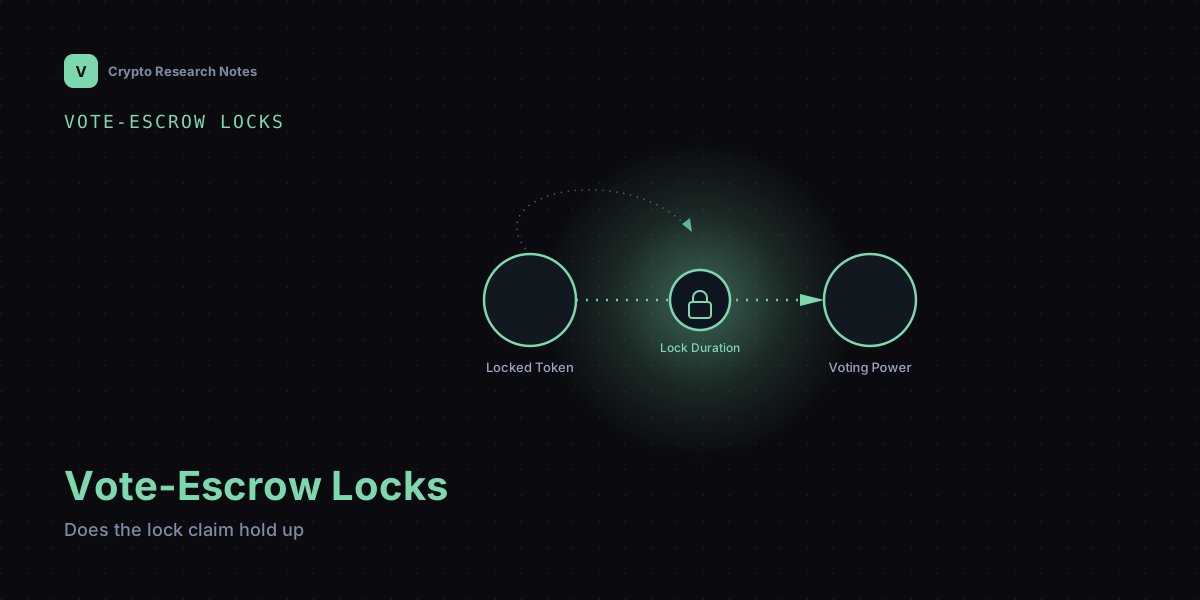
A vote-escrow (commonly abbreviated "ve") design asks holders to deposit a governance token into a locking contract for a duration they choose — weeks, months, or up to some multi-year maximum — in exchange for voting power that typically scales with how long the lock is set to run. A four-year lock might grant close to the maximum possible voting weight per token, while a one-month lock grants only a small fraction of that weight for the same token amount. Many implementations pair this with boosted rewards: locked positions often earn a multiplier on staking or liquidity-provision yield that unlocked holdings do not receive, giving holders a second reason to lock beyond the vote itself.
Once a meaningful share of supply sits in these contracts, protocols routinely report it as "locked supply" or "supply removed from circulation," and dashboards subtract it from total supply to produce a smaller, more flattering circulating-supply figure. The implicit claim bundled into that framing is twofold: that the removed tokens will not reach the open market for the stated duration, and that locking itself signals holders who are aligned with the protocol's long-term health rather than short-term extraction.
Neither half of that claim is self-evidently true simply because a lock exists. The tokens have not left existence — they still sit on a balance sheet somewhere, now recorded as a balance inside a smart contract instead of a wallet. Whether that balance is genuinely inaccessible before its stated expiry, whether the contract's actual rules match what marketing material describes, and whether locking reflects real conviction rather than a vote-power or yield-farming strategy are all separate, checkable questions — the subject of the rest of this piece, and a natural continuation of how this series has treated locked voting power and circulating-supply figures in earlier articles.
- Ve locks convert a token deposit into voting power and often a reward boost, typically scaled by chosen lock duration.
- "Removed from circulating supply" is a claim about future behavior and contract enforcement, not a statement about tokens ceasing to exist.
- The tokens remain intact and reassignable in principle; the interesting question is what actually stands between a holder and re-entering circulation.
2. Verifying Lock Duration and Unlock Progress: On-Chain Contract Facts vs. Marketing Claims
A protocol's documentation or landing page will typically describe the locking mechanism in a few sentences: available lock durations, a formula linking duration to voting weight, and perhaps a note about an early-exit penalty. None of that text is binding — the deployed contract's bytecode and current parameter values are what actually govern what happens to a locked token. Governance votes can and do change these parameters after launch (adjusting the maximum lock length, the penalty curve for early withdrawal, or the decay rate applied to voting power as a lock approaches expiry), and a documentation page is frequently the last thing updated when that happens. A researcher should pull the current values directly from the contract — reading its verified source and calling its view functions, or using a block explorer's "read contract" interface — rather than trusting a paragraph of prose.
Two contract-level details matter most in practice. The first is whether early withdrawal is actually blocked, or merely discouraged through a penalty such as a fee, a burn, or a forfeiture of accrued rewards. A "locked" position that can be exited at any time for a cost is a materially weaker claim than one that is contractually immovable until expiry, even though both might be described as "locked" in a summary dashboard. The second is the decay schedule: many ve designs decay voting power linearly as a lock approaches its end date, and some allow holders to top up or re-lock to reset that decay, which matters when interpreting any single voting-power snapshot.
Beyond parameters, the contract also holds the ground truth for volume and timing: the total token balance currently held by the locking contract, and, critically, the distribution of individual lock-end timestamps across all positions. Aggregating that distribution into unlocks-per-month or unlocks-per-quarter turns a single "X% locked" headline into a timeline, which Section 5 develops into a full methodology.
- Read the deployed contract's live parameters directly; documentation can lag behind governance-approved changes.
- Distinguish contractually-blocked withdrawal from a penalty-discouraged withdrawal — both get called "locked."
- Pull the locking contract's total balance and the full distribution of lock-end timestamps, not just a dashboard's single aggregate figure.
3. Liquid Wrapper Tokens: How Much Does Tokenizing a Locked Position Undermine the Meaning of "Locked"
A separate layer of complexity appears once a locking mechanism becomes popular enough to attract third-party protocols built on top of it. A common pattern: a wrapper protocol accepts either a fresh token deposit or an existing lock, commits it to a long — often maximum-duration — lock under its own control, and in return issues the depositor a freely tradeable token representing a claim on that locked position's economics, and sometimes a share of the voting power, though the wrapper issuer frequently retains actual voting control itself. The depositor can then sell that wrapper token on a secondary market at any time, for whatever price it will fetch, effectively converting an illiquid multi-year lock into a liquid, exit-at-will position.
This does not break the base protocol's contract-level lock: the underlying tokens genuinely remain inside the locking contract, still counted in whatever balance a block explorer reports, still generating the wrapper protocol's voting power and rewards. What has moved is the economic exposure. The original depositor who wanted out has exited, in substance, by selling the wrapper; the buyer on the other side of that trade now holds the "locked, long-term-aligned" position, but may hold it for minutes rather than years, with no particular interest in the base protocol's governance beyond arbitraging the wrapper's price against the underlying.
The consequence for a researcher reading a "locked supply" figure is that the number can be technically accurate and economically misleading at the same time. A token is only meaningfully removed from circulating supply if the entity holding the economic claim on it is actually choosing not to sell — once a liquid wrapper exists, that choice has been decoupled from the lock itself and can change hands every block. Checking whether a wrapper market exists for a given locking mechanism, how large it is relative to total locked value, and whether the wrapper trades at a persistent discount to the underlying — itself a signal of exit demand exceeding available liquidity — should be a standard step before accepting a locked-supply claim at face value.
- Wrapper protocols tokenize a locked position, letting the original depositor exit early by selling the wrapper rather than waiting out the lock.
- The base contract's locked balance stays technically correct; what changes is who bears the economic exposure and holding intent.
- A wrapper trading at a persistent discount to the underlying is itself evidence of exit demand the headline "locked supply" number does not capture.
4. The Misalignment Between Voting Power and Economic Interest: Locking for Votes Doesn't Mean Genuine Long-Term Alignment
The vote-bribery article in this series examined what happens once locked voting power becomes something that can be bought and sold on a bribe market: a locker's vote stops being solely a governance decision and becomes an income-generating asset that outside parties will pay to direct. That earlier analysis has a direct bearing on how a "locked equals aligned" marketing narrative should be read. Locking a token for maximum voting weight is, on its own, evidence only that the holder wanted maximum voting weight — it says nothing about why they wanted it.
Three distinct motives can produce an identical maximum-duration lock. A holder might lock because they genuinely believe in the protocol's multi-year trajectory and want governance influence to match. A holder might lock purely to harvest a reward boost that is only available to locked positions, treating the vote as an incidental byproduct. And a holder might lock specifically to capture bribe income, in which case the optimal strategy each round is to direct votes toward whichever bribe pays best, regardless of which outcome is actually good for the protocol — the same mercenary-voting dynamic this series has already described. From outside the contract, all three lockers look identical: same lock duration, same voting weight, same contribution to the "locked supply" figure.
A researcher trying to separate these motives has to look past the lock itself and at behavior over time. Does an address's vote target shift every round toward whatever is currently paying the highest bribe, or does it stay consistent regardless of bribe availability? Does the locker hold other exposure to the protocol beyond the locked governance token, or is the lock its only stake in the outcome? A large locked balance that also collects substantial, inconsistent bribe income across rounds is better read as a yield position wearing governance clothing than as evidence of long-term alignment.
- A lock proves only that a holder wanted voting weight — not whether the motive was governance conviction, a reward boost, or bribe extraction.
- Vote-target consistency across multiple rounds, independent of bribe size, is a stronger alignment signal than lock duration alone.
- Check whether a locker holds other protocol exposure beyond the locked token itself, or whether the lock is a standalone, extractable voting asset.
5. A Verification Method: Comparing Disclosed Locked Supply Against On-Chain Contract Balances and Mapping the Unlock-Expiry Distribution
The verification exercise has two parts, and both rely on data a locking contract exposes directly rather than on a project's self-reported summary. The first is a reconciliation: pull the token balance actually held by the locking contract address from a block explorer, and compare it against whatever "total locked" figure the protocol's dashboard or tokenomics page reports. These two numbers should sit close together; a persistent gap — the dashboard figure running higher than the contract balance — suggests the disclosed number may be counting positions that have already unlocked but not yet been withdrawn, or may simply be stale.
The second, more revealing part extends the unlock-pressure methodology from the tokenomics article in this series to the ve-lock context specifically. Rather than reading a single "X% locked" headline, pull every individual lock's end timestamp from the contract and bucket them into a timeline — by week, month, or quarter, depending on total lock volume. The resulting histogram is an unlock-cliff map: it shows not just how much is locked in aggregate, but when it stops being locked.
Consider a purely illustrative, invented example: a fictional protocol discloses "62% of supply locked," which reads as a single stable figure. Mapping the underlying contract's lock-end timestamps might instead show that 40% of that locked total shares a single expiry date eighteen months out, because an early bulk-lock incentive campaign pushed a large cohort of holders toward the maximum lock length in the same week, while the remaining 60% is spread evenly across the following three years. The 62% headline is accurate, but it obscures a concentrated future date on which a large single tranche becomes freely transferable at once — a materially different risk profile than a smoothly distributed unlock schedule, even though both could be summarized identically as "62% locked" today.
- Reconcile the disclosed "total locked" figure against the locking contract's actual on-chain token balance; a persistent gap is a research flag.
- Bucket every position's lock-end timestamp into a timeline to build an unlock-cliff map, not just a single aggregate percentage.
- A concentrated cluster of expiries on one future date carries different risk than the same total locked amount spread evenly over time — the numbers above are invented for illustration only.
6. Common Misconceptions and Conclusion
Three misconceptions recur when researchers first encounter a vote-escrow locking mechanism. The first is treating a large "locked supply" percentage as automatically meaning low sell pressure and strong long-term alignment — as Sections 1 and 5 covered, the headline percentage says nothing about contract-level enforcement, nothing about how that total is distributed across future expiry dates, and nothing about the motives behind any individual lock. The second is failing to check whether a liquid-wrapper market exists for the locked position; if one does, a meaningful share of the "locked" balance's real economic exposure may have already changed hands, and the original conviction the lock was meant to signal may no longer be present at all. The third is conflating voting power with genuine economic alignment, when a locker's dominant incentive — as the bribe-market dynamics discussed in Section 4 and in this series' earlier vote-market article make clear — may point toward short-term bribe extraction rather than any interest in the protocol's sustainable trajectory.
Taken together, these checks form a single research discipline: read the locking contract's actual parameters and balances rather than a dashboard summary, check whether a secondary market has been built on top of the lock that lets economic exposure move independently of contract state, and separate the existence of voting power from any assumption about what its holder actually wants. This article has treated the ve-lock mechanism as the point of origin for both dynamics this series examined earlier — the bribeable voting power studied in the vote-market article, and the circulating-supply arithmetic studied in the tokenomics article — and argued that the "locked, removed from circulation" claim sitting upstream of both deserves the same on-chain scrutiny as the claims built on top of it.
This article discusses abstract categories of vote-escrow locking mechanisms only. It does not name, describe, or evaluate any specific real-world protocol or token, and all figures presented as examples are invented for methodology illustration only. Nothing in this article constitutes investment advice; readers should conduct independent research and are responsible for their own decisions.
- Misconception: a large locked-supply percentage automatically implies low sell pressure and long-term alignment.
- Misconception: assuming no liquid-wrapper market exists for a locked position without checking, when one may let holders exit early in substance.
- Misconception: equating voting power obtained through locking with genuine economic alignment, when the locker's real incentive may be short-term bribe income.