
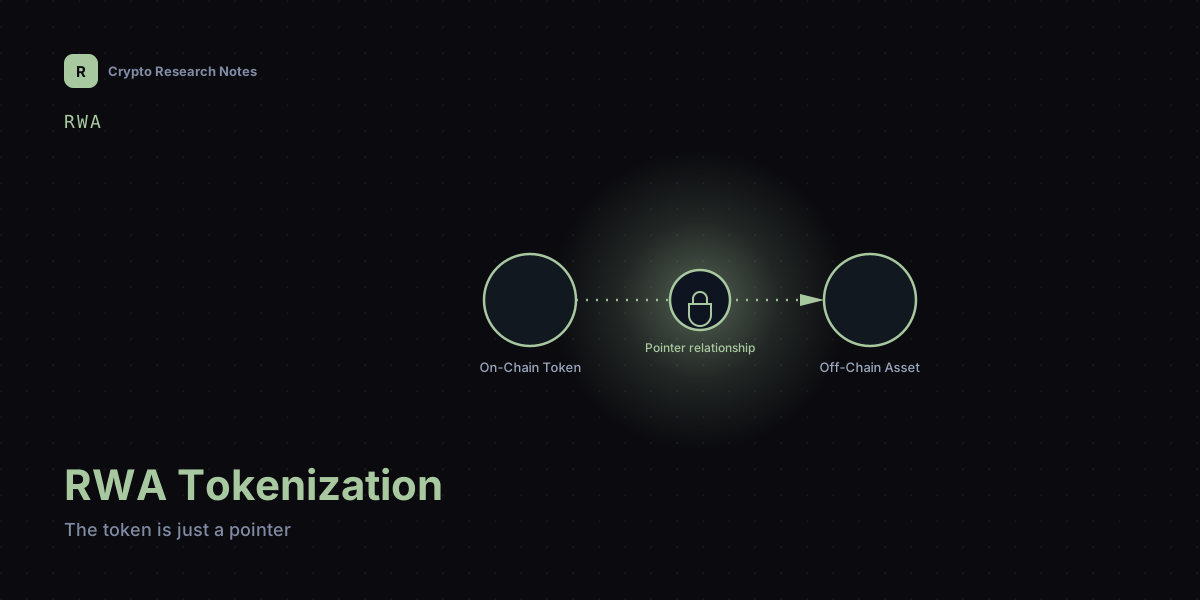
1. Why RWA Tokenization Is a Different Trust Problem: The On-Chain Token Is Just a Pointer
A purely native on-chain asset derives its entire existence from consensus. An ETH balance is not a claim on something else held somewhere else — it is the thing itself, and its validity is settled entirely by the protocol that produced it. No off-chain party needs to honor a promise, maintain a vault, or keep a ledger in sync for that balance to remain real. This is the trust model researchers are used to: adversarial, but self-contained.
A real-world asset (RWA) token breaks that self-containment. When a token represents a claim on off-chain treasuries, private credit, real estate, or commodities, the token itself is not the asset — it is a pointer or receipt referencing value that exists entirely outside the chain. The smart contract can enforce who holds the token and how it moves, but it cannot enforce that the off-chain asset behind it actually exists, is correctly valued, or will actually be delivered to the holder on demand. That entire layer sits in legal documents, custody arrangements, and disclosure practices that the blockchain has no visibility into.
This matters because it changes what "verifying the asset" even means. Verifying a native token is a data-analysis problem: read the chain. Verifying an RWA token is a hybrid problem: read the chain to see what the token claims, then separately verify the off-chain reality the claim depends on. Our prior article on stablecoin peg mechanisms touched this only as one of three collateral models — off-chain reserve-backed stablecoins alongside crypto-collateralized and algorithmic designs. That treatment was necessarily narrow, scoped to price-peg stability. RWA tokenization is a far broader category that extends well past stablecoins into tokenized treasuries, private credit instruments, and similar products — all of which share this same underlying pointer-to-off-chain-value structure and the trust questions that come with it.
- Native on-chain asset: value and existence settled entirely by consensus, no off-chain trust required.
- RWA token: a pointer to off-chain value, dependent on legal structure, custody, and disclosure.
- The research task splits into two layers — on-chain claim, off-chain reality — that must each be checked separately.
2. The Strength of the Legal Bond Between Token and Underlying Asset
The single most consequential question in RWA research is not how the token trades, but what legal right, if any, the holder actually has to the underlying asset. Three structures are common in practice, and they produce very different risk profiles even when the token interface looks identical. At one end, a holder has an enforceable redemption right — a contractual mechanism that legally obligates the issuer to deliver the underlying asset or its cash equivalent on request. At the other end, a token may be backed by nothing more than an unenforceable promissory statement: marketing language asserting that assets exist, with no legal instrument a holder could actually enforce in court or arbitration.
Between these sits the question of bankruptcy remoteness — whether the underlying asset is legally segregated from the issuer's own balance sheet, typically through a special-purpose vehicle or trust structure. If the structure is bankruptcy-remote, an issuer's insolvency should not impair holders' claim to the underlying asset, because that asset was never legally part of the issuer's estate to begin with. If it is not, holders may find themselves as unsecured general creditors competing with every other claimant against the issuer.
Consider two fictional tokenized short-term debt products, invented purely to illustrate: Product A's terms grant holders a direct, enforceable redemption right against assets held in a bankruptcy-remote trust; Product B's terms describe the same asset pool but grant holders only a right to expect distributions "at the issuer's discretion," with no segregation from the issuer's operating balance sheet. Both display an identical token interface and identical marketed yield. Only reading the underlying legal documentation reveals that Product B holders are, in substance, unsecured creditors of the issuer.
- Enforceable redemption right vs. unenforceable promissory language — read the actual terms, not the marketing summary.
- Bankruptcy remoteness: is the asset legally segregated from the issuer's balance sheet?
- Identical-looking tokens can carry entirely different legal claims to the same class of underlying asset.
3. Verifying the Custodian and Disclosure Mechanism
Once the legal claim is understood, the next question is operational: who actually holds the underlying asset, and how would anyone outside the issuer know if that changed? This is the same verification action our proof-of-reserves article described for centralized exchanges, applied to a different subject. There, the question was whether an exchange's claimed reserves matched what it actually held. Here, the subject shifts to an RWA issuer and whatever custodian — bank, trust company, transfer agent — physically or legally holds the referenced asset.
Four elements determine whether a researcher can trust the custody claim at all. First, custodian identity and independence: is the custodian a separate, regulated entity, or is it affiliated with the issuer in a way that weakens the check-and-balance? Second, audit frequency: is the asset pool attested to daily, monthly, or only at wide, irregular intervals that leave long windows of unverified exposure? Third, auditor independence: does the attesting party have any financial relationship with the issuer that could compromise its incentive to report accurately? Fourth, and often most overlooked, disclosure granularity.
A single aggregate dollar figure — "assets under custody: $X" — disclosed periodically is a categorically weaker signal than itemized, position-level disclosure showing individual instruments, maturities, and counterparties. An aggregate figure can mask concentration risk, mismarked assets, or even double-counted collateral shared across products; it asks holders to trust a summary rather than verify a composition. Itemized disclosure lets a researcher actually reconstruct and sanity-check the claimed asset pool.
- Custodian independence from the issuer.
- Audit frequency and the length of unverified exposure windows.
- Auditor independence from the issuer being audited.
- Disclosure granularity: aggregate figure versus itemized, position-level detail.
4. Verifying That On-Chain Supply Matches Off-Chain Asset Scale
A legally sound structure and a reputable custodian still leave one operational question unanswered: does the token supply actually in circulation correspond, at every point in time, to a matching scale of off-chain assets in custody? This is the RWA analogue of the redemption-path stress test described in our stablecoin peg article — there, the concern was whether a stablecoin's issuance could be redeemed under stress; here, the concern is whether issuance was ever backed 1:1 in the first place, continuously, rather than only at the moment of a periodic attestation.
The research approach is to treat minting and burning as an auditable time series, not a one-time claim. Every mint event should correspond to a documented increase in the custodied asset pool — new collateral actually received, not merely authorized. Every burn should correspond to a real reduction. Where issuers publish only point-in-time attestations, a researcher is effectively trusting that supply matched backing at the moment of the snapshot, with no visibility into what happened between snapshots. An issuer under liquidity pressure has an obvious incentive to mint ahead of receiving the corresponding asset, temporarily overstating backing until the gap is closed — a pattern that is invisible without transaction-level, continuous reconciliation.
Historical precedent across adjacent token categories shows this is not a purely theoretical risk: issuers under stress have, at various points, over-issued claims relative to what was actually held, only for the gap to surface later. A rigorous researcher treats "supply currently matches custody" as a claim to be re-verified on an ongoing basis, not a fact established once and assumed to persist.
- Mint events should map to documented, contemporaneous increases in custodied assets — not just authorization to mint.
- Point-in-time attestations leave the interval between snapshots unverified.
- Continuous reconciliation is the only way to catch temporary over-issuance under stress.
5. Liquidity Mismatch and Run Risk
A dimension entirely absent from purely on-chain assets is the mismatch between how fast the token trades and how fast the underlying asset can actually be converted to cash. A native token's liquidity and its "settlement" are the same event — a transfer is final the moment it confirms. An RWA token decouples these two things by design: the token can be bought, sold, or redeemed-in-principle 24/7 on a blockchain, while the underlying asset — private credit, real estate, longer-dated bonds — may take days, weeks, or in illiquid conditions considerably longer to actually sell or mature into cash.
Under normal conditions this mismatch is invisible; redemption requests trickle in at a pace the issuer can fund from cash on hand or short-term liquidity. The risk surfaces specifically under a run scenario: if a large share of holders demand redemption simultaneously — driven by market stress, a rumor, or a correlated event elsewhere in the ecosystem — the issuer must convert enough of the underlying asset pool into cash fast enough to meet that demand. If the underlying asset cannot be liquidated on that timeline, holders face delayed redemption, discounted redemption, or gating, even though the token itself never stopped trading on-chain.
Consider a fictional tokenized private-credit product, invented purely to illustrate: the token trades continuously on secondary markets, but the underlying loans have a stated average maturity of 18 months and no active secondary market of their own. If redemption requests equal to 40% of outstanding tokens arrive within a single week — a stress scenario, not a base case — the issuer has no realistic path to liquidate a matching share of the loan book in that window, regardless of how solvent the pool is on a mark-to-model basis.
- Token liquidity (instant, 24/7) is structurally decoupled from underlying asset liquidity (days to months, or illiquid).
- Run risk materializes only under concentrated, simultaneous redemption demand, not steady-state usage.
- Solvency on paper does not guarantee the asset pool can be converted to cash on the timeline redemption requires.
6. Common Misconceptions and Conclusion
Three misconceptions recur often enough in RWA research to call out explicitly. First, treating "it's on-chain" as synonymous with "more transparent and safer." Putting a claim on-chain makes the token's transfer history transparent; it does nothing to make the underlying off-chain trust mechanism — the legal structure, the custodian, the audit regime — any more visible or reliable than it would be off-chain. The chain transparently records a pointer; it says nothing about what the pointer points to.
Second, evaluating a custodian primarily by name recognition, or accepting a disclosed aggregate dollar figure as sufficient evidence of backing. A recognizable custodian name is not a substitute for checking auditor independence and disclosure granularity, and an aggregate figure cannot be reconciled against actual positions the way itemized disclosure can. Familiarity is not verification.
Third, conflating the token's on-chain tradability with the underlying asset's real-world liquidation speed. That a token can be sold in seconds says nothing about how quickly the issuer could actually convert the referenced asset pool into cash if many holders wanted out at once — the two clocks run at entirely different speeds, and only the second one matters under stress.
Taken together, the throughline across all five preceding sections is that RWA tokenization does not eliminate off-chain trust — it repackages it inside an on-chain wrapper, and the wrapper's smoothness can make the underlying trust dependencies easier to overlook, not harder to find. A rigorous researcher treats the token as a starting point for questions, not an endpoint of verification: what is the legal claim, who custodies the asset and how independently is that checked, does issuance actually track custody over time, and what happens to liquidity under stress.
This article discusses abstract mechanism categories only. No real RWA protocol, issuer, or custodian is named or referenced, and all figures used in examples are invented purely to illustrate a mechanism. Nothing here constitutes investment advice.
- "On-chain" describes the token's transfer record, not the reliability of the off-chain trust mechanism behind it.
- Custodian name recognition and aggregate disclosure are not substitutes for auditor independence and itemized detail.
- On-chain tradability and off-chain liquidation speed are different clocks — do not conflate them.