
1. Why DAO governance deserves its own chapter in this series
In the fifth article, Tokenomics and Unlock Pressure, we mentioned in passing when discussing value-capture models that governance rights themselves can be considered a form of value capture — holding a token confers some amount of voting weight over protocol parameters, treasury spending, or future direction. But that article's focus stayed on supply, distribution, and unlock schedules; governance rights were touched on only briefly as one category of value capture, without explaining how they actually function in practice. In the sixth article, What an Audit Report Actually Covers, we spent considerable space on how to verify multisig signing thresholds and timelock delay parameters on-chain — but that discussion centered mainly on a single project's admin privileges: who can upgrade a contract, who can change key parameters, and whether those actions are constrained by a timelock. Each article grazed a piece of DAO governance without ever treating it as a subject in its own right.
This article picks up both threads and asks how to approach DAO governance itself as a distinct research domain. On the surface, a DAO's governance process often leaves only a simple impression — "this project has DAO governance," "this proposal passed" — but that sentence conceals several entirely separate mechanisms: who initiated the discussion and on what platform, whether that discussion carries any binding force, how voting weight is calculated and tallied, who actually triggered the on-chain transaction that executed the change, and whether that transaction passed through a mandatory waiting period beforehand. These mechanisms are independent of one another, and looking at any single link in isolation can leave a misleading impression. Only by tracing the entire chain can a researcher form a reasonably complete picture of how a governance process actually operates.
It needs to be said upfront that everything discussed in this article operates at the level of research methodology. The goal is to help readers build a framework for observing and recording a DAO's governance process — not to conclude whether a given DAO governs itself well or whether a given project is sufficiently decentralized. Governance activity levels, voting power distribution, and treasury configuration are all objective facts that can be observed and recorded, but drawing a conclusion of "secure" or "insecure," "decentralized" or "centralized" from those facts requires the researcher to weigh the complete context of the specific project. This article does not make that judgment for any specific project, and none of it constitutes investment advice of any kind.
2. The governance proposal lifecycle: from off-chain discussion to on-chain execution
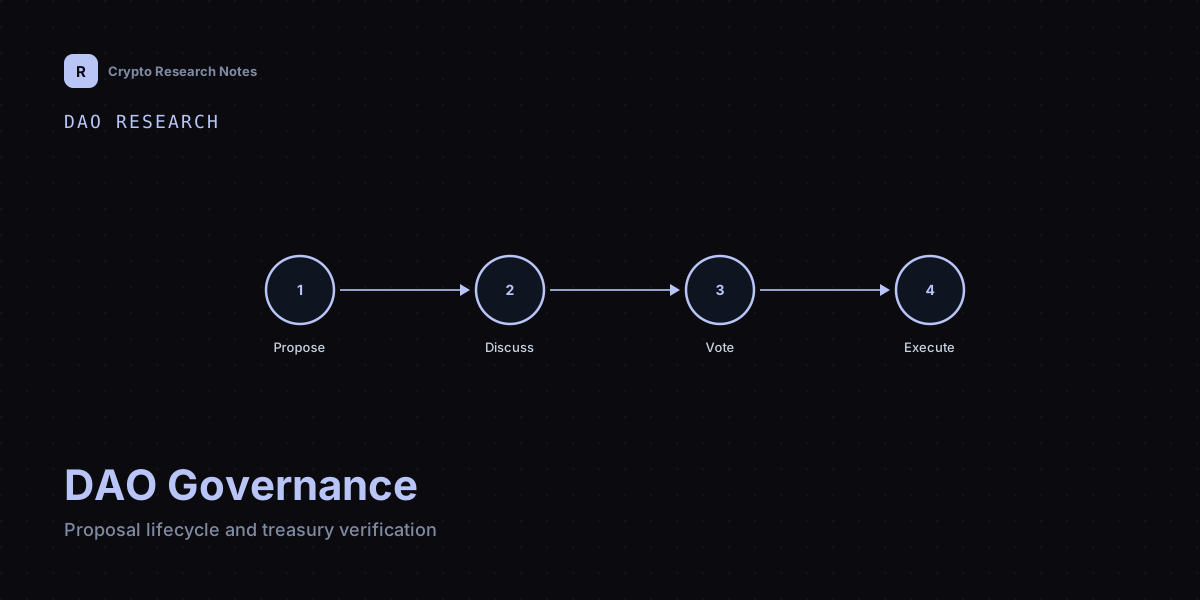
A governance proposal passes through several stages of an entirely different character on its way from initial idea to taking effect on-chain, and each stage carries a different degree of bindingness, participation cost, and reversibility. If a researcher doesn't first separate these stages clearly, it's easy to conflate "high discussion volume" with "actually binding." The two subsections below cover the off-chain and on-chain phases in turn.
2.1 The off-chain phase: forum discussion and the temperature check
The vast majority of DAO governance proposals don't appear on-chain awaiting a vote from day one — they first go through a purely off-chain discussion phase. The typical pattern is that someone opens a discussion thread on the project's governance forum (often built on Discourse or Commonwealth), spelling out the parameter they want changed, the treasury spend they're proposing, or the feature they'd like to see added. Community members reply below the thread and propose revisions. This stage is usually called the "draft proposal" or, one step earlier, the "idea" stage. No voting mechanism is involved at all at this point — it's purely text-based discussion. Anyone can comment, but comments carry no on-chain or off-chain binding force on their own, and neither the project team nor the proposer is obligated to revise the proposal based on the feedback. This is worth noting when researching: how heated a forum discussion gets reflects community attention, not whether the proposal will ultimately be adopted.
Once discussion converges on a reasonably concrete version of the proposal, many DAOs move into a so-called "temperature check" phase, typically taking the form of a vote on an off-chain voting platform like Snapshot. (Snapshot, Tally, DeepDAO, OpenZeppelin Governor, Compound Governor Bravo, and other specific tools or platforms mentioned in this and later sections are referenced purely as illustrative examples for explaining research methods — they are not an assessment of any platform's security, reliability, or governance quality, nor a recommendation to use them.) Snapshot's distinguishing feature is that voting itself doesn't consume gas, because it doesn't require submitting an on-chain transaction. Instead, it computes each address's voting weight by reading a snapshot of token holdings at a given point in time (hence the name "Snapshot"), and records the vote results in an off-chain storage system (such as IPFS) that anyone can later audit. The key property of this kind of vote is that it is non-binding — a Snapshot vote's outcome doesn't automatically trigger any on-chain action; it functions more like a formal opinion poll used to gauge whether a proposal has enough community support to move forward. If a researcher sees that "a proposal passed on Snapshot with 95% support," they need to understand that this statement alone does not mean the proposal has taken effect on-chain — it only means the proposal passed a non-binding signaling vote.
2.2 The on-chain phase: binding proposals, the voting period, and execution
If a proposal gains enough support during the off-chain phase, and it involves an action that genuinely needs to change on-chain state (such as disbursing funds from the treasury, adjusting a protocol parameter, or upgrading a contract), the process typically moves into a second stage — formally submitting the proposal to an on-chain governance contract. Implementations of this kind are commonly based on the OpenZeppelin Governor framework or the earlier Compound Governor Bravo pattern. When a proposal is submitted on-chain, it comes bundled with the specific set of actions to be executed (target contract addresses, functions to call, parameters to pass) — meaning the biggest difference between an on-chain proposal and an off-chain discussion thread is that an on-chain proposal isn't a block of descriptive text, but a set of machine-executable instructions. Once the proposal passes, the contract executes that instruction set exactly as specified — there's no room for executing "the general spirit" of the forum discussion.
Once an on-chain proposal is submitted, it enters a fixed-length voting period, and whether an address can vote directly during that period depends on a crucial prerequisite action: delegation. In mainstream on-chain governance contracts like Compound Governor Bravo and OpenZeppelin Governor, the address that actually holds voting rights at a given snapshot block, as recorded by a checkpoint, is the "delegatee" — not the token holder itself. A token holder must first perform a delegation action to obtain voting power they can exercise directly. If that delegation targets the holder's own address (i.e., "self-delegation"), the holder can then vote directly with their own address. If a token holder has never delegated at all, their corresponding on-chain voting weight is zero, and they cannot vote directly. And if a holder delegates their voting power to another address, voting eligibility transfers to the delegate address — the original holder no longer has voting eligibility from that point on and can no longer vote directly with their own address; voting power is exercised exclusively by the delegate. In other words, "holding tokens" and "holding voting power that can be directly exercised on-chain" are not the same thing — a delegation action must occur in between to determine who ultimately exercises that voting power. This is the core mechanism that Section 3 will unpack in full around delegation. Voting itself typically consumes gas, which is one of the most immediately visible differences between on-chain voting and Snapshot's off-chain voting. Once the voting period ends, if the protocol's preset passing conditions are met (this usually involves a quorum requirement and an approval-ratio requirement, discussed in detail in the next section), the proposal moves into a "passed, pending execution" state. This is where the timelock — a mechanism the sixth article emphasized repeatedly — re-enters the picture. Many DAO governance contracts route the execution of a passed proposal through a timelock contract such as TimelockController. A passed proposal doesn't take effect immediately — it must wait out a preset delay period, during which anyone can observe exactly what action is about to be executed. The existence of this delay period is, in essence, an extension of the principle discussed in the sixth article — "critical actions are constrained by a timelock" — from the context of a single project's admin privileges to the final stage of the DAO governance process itself: even after a proposal has passed the voting stage, as long as its execution is routed through a timelock contract, it still has to clear the same mandatory waiting period before it actually takes effect.
3. Reading voting power distribution and delegation
Whether a proposal passes, and whether a pass genuinely represents the community's will, ultimately comes down to how voting power is distributed across addresses. This section starts with how voting power itself is calculated and how it's currently distributed, then moves on to delegation — the key mechanism that shapes actual voting-power concentration.
3.1 Token-weighted voting and how to check voting-power concentration
The vast majority of DAO governance uses token-weighted voting — each governance token generally corresponds to one vote, so the more tokens an address holds, the more weight it carries in a vote. A direct consequence of this design is that voting power distribution tends to correlate closely with token holding distribution, and token concentration itself is exactly the topic repeatedly discussed in the fifth article, Tokenomics and Unlock Pressure — the allocation ratio between the team and early investors, and the actual circulating concentration after unlocks. Concentration observed at the tokenomics level projects directly onto voting-power concentration at the governance level. The fifth article warned of a trap when discussing the community allocation share specifically: a high "community share" written on an allocation table doesn't mean actual on-chain holdings are dispersed, because some tokens nominally allocated to the community can still end up settling in a handful of addresses or exchange accounts — this needs to be verified on-chain rather than taken from the nominal allocation structure. This section and the next essentially apply that same "nominal structure can't substitute for on-chain verification" methodology from the fifth article a second time, in a governance context — only the object being verified changes from "token allocation" to "voting power / delegation weight distribution." A researcher looking to understand a DAO's voting power distribution can approach it from two directions: first, by looking directly at a block explorer for the ranking of top holders in the governance token contract or its corresponding delegation-snapshot contract, and observing what share of voting power the top addresses each hold; second, by using a third-party governance-data aggregator such as Tally or DeepDAO (again, these two names are cited purely as methodology examples, not an assessment of their data accuracy or platform reliability, nor a usage recommendation) — these platforms typically rank all of a DAO's current delegates by voting power, which takes considerably less effort than manually pulling on-chain data yourself.
It's worth noting that the top addresses by voting power are not necessarily "individuals" — quite often they are exchange custodial addresses, the protocol's own treasury address, market-maker addresses, or institutional investor addresses. An address like that appearing at the top of the voting-power leaderboard carries an entirely different meaning from an active community member who accumulated tokens and became a large delegate on their own. When recording voting-power concentration, a more solid approach is to annotate each of the top-ranked addresses with whatever identifying clues can be established (whether it's a known exchange cold wallet, the project's own treasury, or a publicly identified community delegate), rather than recording only a blanket "top-10 addresses hold X%" figure — because the nature of the addresses behind that number varies enormously and directly affects how the percentage should be interpreted.
3.2 Delegation: low participation and delegate concentration, a recurring pattern
Many governance tokens support a "delegation" mechanism, letting holders choose not to vote themselves and instead delegate their voting power to another address to exercise on their behalf. That delegate address can be an active community member within the DAO, an independent delegate who specializes in governance research, or a delegation account set up by some institution or service provider. As noted in the previous section, once delegation is complete, voting eligibility transfers to the delegate address, and the original holder no longer holds direct voting eligibility — this is the technical precondition for why delegation concentration is worth watching in the first place. The rationale behind delegation is usually to lower the barrier to participation for ordinary token holders — many people hold tokens but don't have the bandwidth to study every single proposal in detail, and delegating their voting power to someone they trust, who is willing to track governance continuously, can in theory improve overall decision quality. That's why nearly every mainstream DAO governance framework has delegation built in.
In practice, a recurring pattern is that a DAO's on-chain voting participation rate (the share of circulating tokens that vote directly or through delegation) is often significantly lower than the total token supply, while voting power itself is highly concentrated among a small handful of delegates. Taken together, these two observations form a pattern worth recording but not one that should be jumped to a conclusion from — when low participation and concentrated delegation coexist, it means on-chain voting weight ends up concentrated, in effect, on a few delegate addresses. That is a neutral, structural description; it does not by itself mean a DAO's "governance is broken" or "is being manipulated," nor can it be directly equated with those few delegates having decisive real-world influence over the outcome of any specific proposal — that still needs to be verified case by case against the actual voting distribution of that specific proposal and the participation of other delegates and direct voters, rather than jumping straight from the structural fact of "concentrated delegation" to the causal conclusion that "the outcome is decided by a few people." Concentrated delegation could very well be the result of the community voluntarily choosing to trust certain people — for instance, if the community broadly recognizes a few delegates' professional judgment and actively concentrates voting power with them — or it could simply reflect that ordinary holders have little interest in participating in governance at all. When recording this kind of observation, a researcher should list the participation-rate figure and the delegation-concentration figure as they are, rather than immediately labeling the phenomenon as positive or negative.
4. Verifying a DAO treasury directly on-chain
However rigorous a proposal's voting mechanism is, it ultimately comes down to actual control over funds. This section turns to the most concrete landing point of DAO governance: the treasury. We'll first confirm the treasury address itself, then carry over the on-chain verification methods from the sixth article and apply them to the treasury context.
4.1 Locating the treasury address and cross-checking it against governance documentation
One of the most important vehicles through which DAO governance ultimately lands is the treasury — the protocol-native tokens, stablecoins, other assets, and even revenue generated by the protocol itself that a DAO holds are typically kept in one or more on-chain addresses, and many proposals are precisely about how that treasury capital should be allocated and spent. The first practical step in researching DAO governance is to locate the treasury address itself. Common sources include the project's official documentation, pinned threads on the governance forum, and a DAO's profile page on a platform like Tally or DeepDAO (again, cited here purely as methodology examples, not an evaluation of any specific platform) — these channels usually list the treasury contract address explicitly. Once you have the address, the next step is to open a block explorer and verify what assets and quantities that address actually holds, and whether that roughly matches the treasury size and asset composition described in the documentation or forum posts. It's worth noting upfront that discrepancies between documented descriptions and actual on-chain holdings have quite a few common and entirely legitimate technical or administrative causes — a DAO may simply manage more than one treasury, some assets may have been temporarily moved to another contract to execute an already-passed proposal, documentation may lag behind the latest on-chain changes, or the gap may just come down to differences in accounting basis or token decimal precision. These situations show up fairly often in practice, and a discrepancy doesn't necessarily mean something is wrong. Even so, this kind of gap is still worth recording as a point of comparison, and the way to dig further is to check whether multiple treasury addresses exist or whether assets have been temporarily reallocated to another contract — not to jump to a conclusion.
Many DAOs don't have just a single treasury address — there may be a main treasury, an ecosystem fund, an operations expense pool, and other addresses serving different functions, each potentially managed by a different governance process, and some may even sit on different chains. When mapping out a treasury's structure, a fairly solid approach is to list every treasury address mentioned in the governance documentation or forum posts one by one, verify each one's on-chain balance individually, and clearly record the stated purpose of each address — this step is essentially cross-checking "what the documentation says" against "what's recorded on-chain," a basic research habit this series has emphasized repeatedly since the second article, On-Chain Data Analysis Method, and one that applies equally well in the DAO treasury context. Again, the verification method discussed in this subsection is a general research step; this section does not target any specific DAO and draws no conclusion about any project's treasury management.
4.2 Carrying over the sixth article's method: verifying a treasury's multisig and timelock configuration
Once the treasury address is confirmed, the next question to ask is exactly the same one discussed in the sixth article, What an Audit Report Actually Covers: is this address a multisig wallet? If so, how many signers are there in total, and what fraction of them constitutes the execution threshold? Who is behind these signing addresses, and can their identities be publicly verified? If withdrawals from the treasury are also constrained by a timelock, what exactly is that timelock's delay parameter, in seconds or days? The previous article covered in detail how to read a multisig contract's signer list and threshold parameter directly on a block explorer, how to read a TimelockController contract's minimum delay parameter, and how to check which addresses have been granted the PROPOSER/EXECUTOR/CANCELLER roles — this entire verification toolkit can be carried over here unchanged. The only difference is that the object being verified shifts from "the admin-privilege holder of a single project" to "the holder of fund control over a DAO treasury." Exactly how to read the multisig threshold and timelock delay parameters won't be repeated here — it's a direct reuse of the method already covered in the sixth article.
One thing worth flagging on its own: in many DAOs' actual architecture, the treasury itself is controlled by a multisig, and that multisig is in turn constrained by layers of governance contract and timelock. In other words, a treasury fund withdrawal, in theory, first requires passing an on-chain proposal vote, then clearing the timelock's mandatory waiting period, and finally being co-signed by at least the minimum number of signers required by the multisig's threshold — that's a complete chain of authority, and a researcher can pull out and verify each link's parameters individually. It should be noted that only two verification dimensions in this chain are genuinely new to this article — voting period length and quorum requirement — since those are stages unique to the DAO governance process itself; the other two — timelock delay and the number/threshold of multisig signers — are verified using exactly the same method discussed in the sixth article, a direct reuse of an existing method rather than something new introduced here. These four parameters are not equally weighted "new methods," and that distinction is worth making explicit when recording them. After recording all four parameters separately, a missing parameter or one that doesn't match the documentation could correspond to any number of explanations — documentation lagging behind, a parameter currently being adjusted through a governance proposal, or different treasuries carrying different permission configurations — and doesn't necessarily mean the governance design has a problem. It can simply be logged as a standalone observation; for instance, some DAOs deliberately choose a shorter timelock or a lower multisig threshold for the sake of faster response times, which is a design trade-off and not something this article takes a position on. The verification steps in this subsection are, again, purely a general methodology description; this section draws no security conclusion about any specific DAO's treasury configuration.
5. Cross-verifying proposal claims against on-chain execution
The preceding sections separately covered the proposal lifecycle, voting power distribution, and treasury configuration. This section ties those threads together into a single, concrete cross-verification exercise — the core methodological payoff of this article. The approach: pick a proposal that has already "passed," go back to the forum thread and the Snapshot voting page, and record precisely what the proposal originally claimed it would do — for example, "disburse a given amount of stablecoins from the treasury to a team for marketing" or "adjust a given protocol parameter from A to B" — noting down those specific figures and target actions exactly as stated. Then turn to the on-chain governance contract, find the on-chain proposal ID corresponding to that proposal, and inspect the specific calldata submitted with the proposal — that is, which contract's which function it actually calls, and what parameters it passes. Compare what you read here, point by point, against what the forum post described, checking whether the figures, addresses, and action types match exactly.
The next step is to find the execution transaction corresponding to that proposal — if the proposal went through a timelock waiting period after passing, the execution transaction will typically occur some fixed interval after the voting period ended. You can search for that execution transaction's hash directly on a block explorer, and inspect its internal transactions and event logs to confirm whether the actual transfer amount, receiving address, or post-adjustment parameter value exactly matches what the proposal's original text and on-chain calldata described. What this cross-verification step often turns up is not "fraud" but easily overlooked technical discrepancies — for instance, a proposal's text might state an approximate round-number amount, while actual execution produces a small residual difference due to a currency conversion or token-decimal issue; or a proposal may have passed an off-chain Snapshot signaling vote, but the corresponding binding on-chain proposal was never submitted, leaving a gap — or no execution at all — between "passed" and "executed." This gap between an off-chain signaling vote and binding on-chain execution is itself one of the most worthwhile phenomena to record when researching DAO governance — it's a reminder that "the forum thread says this proposal passed" and "the on-chain state has been updated per the proposal" are two separate things that each need to be verified, and neither can substitute for the other. The causes of this kind of gap are usually procedural or technical — the team may still be preparing the execution transaction, the multisig signers may not yet have all signed, or the proposal itself may have been shelved by a later decision — none of which amount to "fraud" or "breach."
This cross-verification approach is, in essence, an extension of the same idea discussed in the sixth article — comparing an audit's conclusions against a contract's actual on-chain state: an audit report describes "how the code the auditors saw at the time was supposed to behave," while a governance proposal describes "how the action approved by the vote is supposed to be executed." Both share the same trait — they are text-level commitments — and it falls to the researcher to go back to the chain and check, point by point, whether that commitment was fulfilled accurately and in full. It's worth stressing again that everything discussed in this section is purely a research step. A discrepancy between a proposal's execution record and its text description can have many legitimate explanations, or ones that simply call for further inquiry. This article draws no conclusion about the authenticity or security of any specific DAO's or proposal's execution, and this section, like the others, targets no specific DAO or proposal — it's methodology only.
6. Common misconceptions about DAO governance
In the course of researching DAO governance, there are a few simplified lines of reasoning that can slip unnoticed into a research conclusion, and they're worth listing separately as a reminder to avoid. The first is equating "this project has a DAO" directly with "this project is decentralized." Whether a project has set up a DAO governance structure or issued a governance token only tells you it has adopted a particular category of governance mechanism — whether actual decision-making power is dispersed across thousands of addresses or concentrated in a handful of whales or addresses controlled by the project team itself needs to be verified concretely through the voting-power distribution and delegation-concentration data discussed in the preceding sections. The phrase "has a DAO" cannot substitute for that verification work. The methodological core behind this particular misconception is the same one discussed in the fifth article, Tokenomics and Unlock Pressure, under "the trap of a high community allocation share" — the nominal structure presented on an allocation table or a governance page ("high community share," "has a DAO") cannot substitute for verifying actual on-chain holdings and voting-power distribution. This is simply that same method from the fifth article applied a second time, now to a governance context, rather than a brand-new observation unrelated to what came before.
The second common misconception is equating a high or low quorum requirement directly with good or bad governance quality — seeing a DAO with a relatively low quorum setting and immediately judging it as "lax governance" or "easily manipulated by a small group," or seeing a high quorum setting and immediately judging it as "rigorous governance." A quorum setting needs to be interpreted against that DAO's actual token distribution and historical participation-rate data: if token holdings are very dispersed and the number of addresses that routinely participate in governance is already limited, setting the quorum too high can actually cause a large share of proposals to fail simply for lack of votes — which may not be the outcome the designers wanted. Conversely, a lower quorum paired with an active culture of community discussion can perfectly well function well. Evaluating a quorum setting in isolation, detached from the underlying data, tends to produce a one-sided conclusion.
The third misconception is treating how heated a forum discussion is as a proxy for on-chain governance participation — a proposal with dozens of animated replies on the forum doesn't mean that proposal will draw a proportionally equal level of participation at the Snapshot or on-chain voting stage. Forum discussion and actual voting are two independent behaviors: the former reflects the community's attention to and willingness to discuss a given topic, while the latter reflects whether token holders are actually willing to spend the time — and even gas fees — to exercise their voting power. These two frequently diverge noticeably, and a researcher should record them separately rather than using one as a stand-in for the other. The fourth misconception is treating the mere existence of delegation as a negative signal, on the theory that delegation means ordinary holders have "given up" their governance rights. As discussed in Section 3, delegation is a feature that nearly every mainstream governance framework deliberately builds in, precisely so that holders without the bandwidth to study every proposal can entrust their voting power to a delegate they trust. Whether a high degree of delegation concentration is worth flagging depends on the specific analysis of the delegates' identity, transparency, and track record — it shouldn't be judged as a governance problem simply because the delegation mechanism exists. All four of these simplified lines of reasoning, at bottom, treat a single observed metric as a final conclusion about "security" or "degree of decentralization." The position this article repeatedly emphasizes is that these metrics are only raw observational material gathered during research — how to interpret them, and whether to dig further, is a judgment the researcher has to make against the full context of the specific project. This article draws no conclusion about the governance quality or security of any specific DAO.
7. Observations worth recording during research
Pulling together the methods from the preceding sections, here is a checklist of observations that can be jotted down and tracked continuously over the course of DAO governance research, meant as a practical reference. One clarification up front: the items below are simply clues worth noting during research — they are not a scoring rubric, and still less a basis for reaching a conclusion about any specific DAO or project. Whether a given characteristic shows up or not means neither that governance "has a problem" nor that it "doesn't" — how far to dig, and how deep, still depends on the researcher's overall judgment of the whole project. This section, too, does not discuss any specific DAO.
- Which specific stages does this DAO's governance process consist of (forum discussion, Snapshot signaling vote, binding on-chain proposal, timelock wait, on-chain execution), what is the binding status of each stage — non-binding or binding — and is there clear documentation of this.
- What voting-period length, quorum requirement, and approval-ratio requirement does the on-chain governance contract set, and how does the actual participation rate of historical proposals compare against those thresholds.
- What is the nature of the addresses currently ranked at the top by voting power (or delegation weight) — are they identifiable community delegates, project-team-affiliated addresses, exchange addresses, or unidentifiable ordinary addresses.
- What is the participation rate in the delegation mechanism, is voting power concentrated in a handful of delegates far beyond the others, and if so, is that concentration long-standing and stable or a recent, noticeable shift.
- Has the DAO treasury address been accurately located, do the asset types and quantities actually held on-chain roughly match the scale described in governance documentation or forum posts, and are there multiple treasury addresses serving different functions.
- Is the treasury address a multisig wallet, what exactly are the number of signers and the execution threshold, can the signing addresses' identities be publicly verified; are treasury withdrawals constrained by a timelock, and what exactly is the timelock delay parameter.
- Spot-check a handful of already-"passed" proposals: does the specific action recorded in their on-chain calldata match exactly what the forum post and Snapshot page described.
- Have the on-chain execution transactions corresponding to these passed proposals actually occurred, and do the actual transfer amount, receiving address, or changed parameter value recorded in the execution transaction fully correspond to the proposal's original text and on-chain calldata — and is there any case of an off-chain signaling vote passing while on-chain execution never happens.
8. Summary
This article gathered up threads mentioned separately in earlier installments of this series — governance-token value capture, and on-chain verification methods for multisigs and timelocks — and brought them together under one dedicated topic: DAO governance research. The core approach remains consistent with earlier articles: forum discussions, Snapshot pages, and project documentation describe "how this governance process is supposed to work, what this proposal is supposed to do," while the voting records in the on-chain governance contract, the timelock parameters, the treasury's multisig configuration, and the actual calldata of execution transactions are what a researcher can read directly on a block explorer — "how the governance process actually works, what the proposal actually executed." Solid research requires comparing the two against each other, rather than stopping at the single sentence "this project has DAO governance."
It's worth stringing the article's methods into a single, immediately actionable checklist: given a DAO, first work out exactly how many stages its governance process consists of, which stages are binding, and whether token holders have already completed (self-)delegation and thus hold eligibility to vote directly; then look up the distribution of voting power and delegation weight, and check what kind of addresses occupy the top ranks; next, locate the treasury address, carry over the multisig-threshold and timelock-delay verification methods taught in the sixth article unchanged, and read out the specific configuration of the treasury's fund-control setup one by one; finally, pick a few historically "passed" proposals and do a point-by-point comparison across the forum text, the on-chain calldata, and the execution transaction. Having worked through this whole cycle, DAO governance research links up into essentially the same complete methodological loop as the on-chain verification methods discussed in the earlier articles.
Finally, to reiterate: everything in this article is a discussion of learning and research methodology only. It does not address the security, degree of decentralization, or quality of any specific DAO, project, or governance mechanism, and none of it constitutes investment advice. The tools and platforms mentioned in the text — Snapshot, Tally, DeepDAO, OpenZeppelin Governor, Compound Governor Bravo, and others — are cited purely as illustrative examples for explaining research methods; they do not represent an assessment of their security, reliability, or governance quality, nor a usage recommendation. DAO governance carries multiple layers of uncertainty, including smart contract risk, voting-power concentration risk, and governance-attack risk; crypto asset prices are highly volatile and carry substantial risk, and readers should exercise independent judgment and take responsibility for their own decisions.