
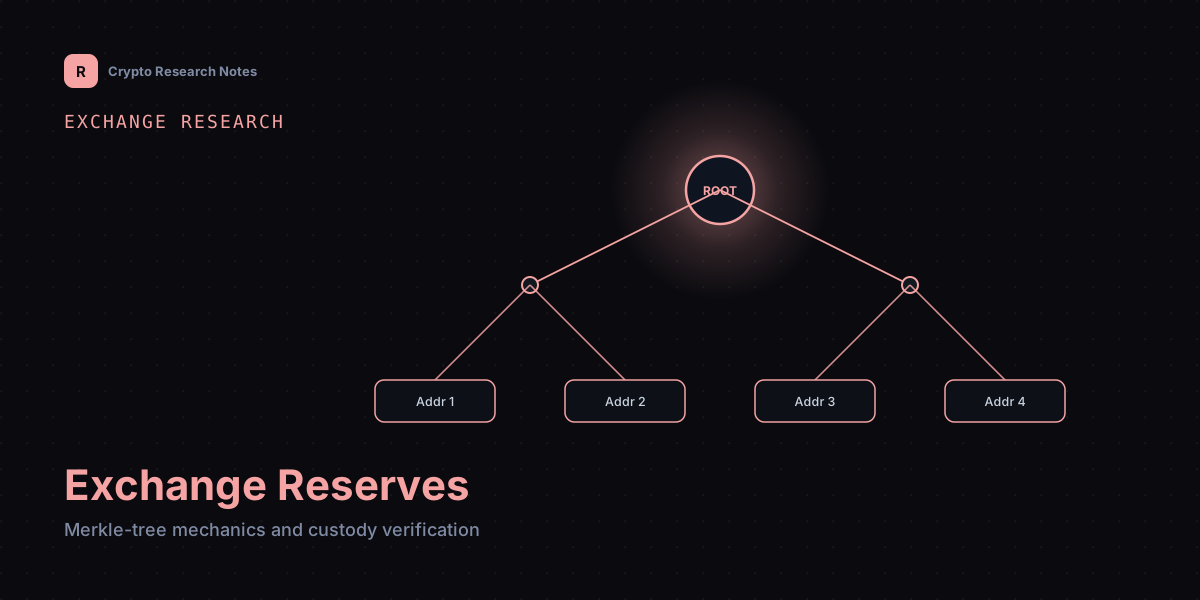
1. Why Proof of Reserves Deserves Its Own Article in This Series
In the second article, "On-Chain Data Analysis Method," we discussed how to read inflows and outflows at exchange addresses, treating known exchange addresses as a reference point for observing broader market fund flows — a large inflow into, or outflow from, an exchange address over some period can serve as one signal for gauging market sentiment or capital migration. But that article's focus, when discussing exchange addresses, was always on the direction of funds relative to the exchange as a node in the flow network — it never went as far as asking whether the exchange's total held assets actually cover its liabilities to users. In other words, the second article cared about the exchange address as a node in a fund-flow network; this article cares about whether the exchange itself, as a custodian, can have its solvency claims verified. It's worth noting that proof of reserves and custodial solvency have not come up anywhere in the previous seven articles of this series, not even in passing — unlike the sixth article's revisiting of the first article's "an audit does not mean absolute security," or the seventh article's revisiting of the fifth article's "governance rights are also a form of value capture." This piece isn't responding to some earlier claim made within the series; it's the first time the methodology those articles built up — verify on-chain rather than take documentation at face value — is applied to an entirely new research object: the proof-of-reserves reports that centralized exchanges publish about themselves.
This new object deserves its own treatment because the verification challenge it poses differs fundamentally from anything discussed so far. A DAO treasury's multisig signer addresses and timelock parameters are fully public contract state that anyone can read directly on-chain. Proof of reserves, by contrast, splits into two halves with very different verifiability: the asset side (on-chain wallet balances) can genuinely be independently verified by an outside researcher, while the liability side (the exchange's total liabilities to all its users) is inherently dependent on the exchange's own internal ledger — an outside researcher has essentially no way to independently recompute that number without the exchange's own data. This asymmetry — verifiable assets, unverifiable liabilities — is exactly what this article sets out to unpack, and it's also where the proof-of-reserves mechanism is most easily misread.
As with the earlier pieces, it needs to be said up front: everything here is discussed purely at the level of research methodology, aimed at helping readers understand the technical mechanics of proof-of-reserves reports, what they can verify, and where verification breaks down — not at reaching any conclusion about any specific exchange's solvency, security, or trustworthiness. This article does not name or imply an assessment of any real exchange. Whether an exchange publishes proof of reserves, how often, in what form, and how deeply an auditor was involved — these are all observable, recordable facts. But drawing a conclusion of "this exchange is safe" or "unsafe" from those facts requires the researcher's own judgment based on a specific institution's full context. This article makes no such judgment for any specific exchange, does not constitute investment advice of any kind, and implies nothing about the timing of any deposit, withdrawal, or asset allocation decision.
2. What Merkle-Tree Proof of Reserves Actually Proves — and Its Boundaries
This section breaks down the technical mechanism behind proof of reserves — first explaining what problem it was designed to solve and what it can mechanically achieve, then turning to what it clearly cannot cover. Two subsections follow.
2.1 How a Merkle Tree Lets an Individual User Verify Their Own Balance Was Included
One common technical implementation behind proof of reserves is organizing every user account balance into a Merkle tree. Roughly: at some agreed snapshot time, the exchange takes each user account's balance (together with a random salt to prevent users from reverse-engineering each other's holdings) as a leaf node, then hashes pairs together and merges them upward level by level, arriving at a single root hash (the Merkle root). This root hash is published publicly, typically alongside the on-chain balances of the major reserve wallets as of that same moment. If a user wants to verify their own balance was honestly included in the tree, the exchange typically provides a lookup tool or a downloadable verification proof — the user enters their account information, and the system returns the set of hash values needed along the path from their own leaf node up to the root. The user (or a third-party verification script) can recompute that path; if the resulting root hash matches the root hash the exchange publicly published, that confirms the user's own balance entry was indeed included in the tree's computation, unaltered.
What makes this mechanism genuinely clever is that it satisfies two seemingly conflicting goals at once: it lets each user independently verify "my balance was included," while exposing none of any other user's specific balance — because every node on the verification path other than the user's own leaf is just an aggregated hash value, from which no specific user's balance on that branch can be reverse-derived. What this design fundamentally solves is a problem of "privacy-preserving verifiable aggregation." But there are two layers of preconditions worth separating out here, corresponding to two different questions: what the user's own verification step depends on, and whether the Merkle tree structure itself is reliably implemented.
The first layer: for a user to complete the verification above, it strictly depends on the root hash they recompute themselves matching the root hash the exchange publishes publicly — and the act of obtaining that "officially published root hash" still runs through traditional trusted channels like the official website, announcements, or social media accounts, not a process that is independently verifiable at the cryptographic level. That channel itself could be tampered with, or could show different root hashes to different users or different network locations (an attack sometimes called "root hash splitting" in the industry) — if an attacker, or the exchange itself, is able to present a specially-constructed root hash to a specific user (paired with a specially-constructed subtree or forged path containing only that user), that user could complete every verification step and still have no way, from the mechanism alone, to tell whether the root hash they saw matches what other users saw. Mitigating this typically requires additional independent distribution channels — publishing the root hash across multiple mutually independent public venues (on-chain transaction memos, third-party audit reports, synchronized coverage from multiple independent outlets) so different users can cross-check whether the root hashes they each received match. But that already goes beyond what the Merkle tree mechanism itself guarantees — it's an additional, separately designed safeguard. Because of this, the common description "verifiable without trusting a third party" needs a qualifier: the Merkle tree mechanism does genuinely remove the user's dependence on trusting the exchange's honest declaration of a specific balance figure, but the step of obtaining the authoritative root hash still rests on trust that some public channel hasn't been tampered with or selectively manipulated — that trust assumption isn't eliminated in a cryptographic sense, it's relocated and narrowed.
The second layer concerns whether the Merkle tree structure itself is correctly implemented. The conclusion "if the root hash matches, the path is valid" only holds if the tree's construction has no implementation-level flaws — for instance, how an odd number of leaf nodes is padded or paired (and whether one gets duplicated in a way that's exploitable), whether leaf-node hashing includes a domain-separation prefix to prevent second-preimage attacks (distinguishing "leaf node" from "internal node" so an attacker can't disguise an internal node's hash as some leaf), and whether negative amounts or malformed balance entries are validated and rejected rather than silently included as ordinary leaves. These are all engineering-implementation questions; the mathematical properties of the Merkle tree data structure alone don't automatically guarantee any particular implementation is free of such flaws. So the more precise statement is: a Merkle tree can, in mathematical structure, support the goal of letting a user independently verify their own balance was included — but whether a specific proof-of-reserves report actually achieves that goal depends on whether its root-hash publication and retrieval channel is trustworthy, and whether the tree's implementation correctly handles the details above. Together, these two conditions are the real preconditions behind the phrase "verifiable without trusting a third party" — not something that follows automatically just because the word "Merkle tree" is used.
It's worth noting that this subsection covers only the specific technical step of "how a user verifies their own balance was correctly included in the tree." A proof-of-reserves report typically also includes two other components — the on-chain wallet balances disclosed on the asset side, and the asset/liability ratio comparison — each with its own, quite different, verification difficulty and limitations, discussed in detail in Sections 3 and 4. This section is meant only to lay out the most basic technical mechanics — what the Merkle tree actually solves and what preconditions it depends on — so readers don't mistake what this one component achieves for what the entire proof-of-reserves report achieves, and don't mistake "Merkle-tree-based" itself for an automatically-earned guarantee of correctness.
2.2 What This Mechanism Clearly Cannot Prove
The verification scope discussed in the previous subsection has very clear boundaries — at most it lets a user confirm that their own account balance was included in the Merkle tree's computation, unaltered, and even that confirmation rests on the two preconditions of a trustworthy root-hash publication channel and a correctly implemented tree. Beyond that, the proof-of-reserves mechanism, by design, never touches — and cannot touch — several other equally important questions; laying them out one by one makes this clearer. First, the Merkle tree itself says nothing about the composition of liabilities — it merely organizes the user balance data the exchange itself has tallied into a structure that can be verified entry by entry. Whether those balance figures completely, accurately, and honestly reflect the exchange's true total liabilities to all users is something the Merkle tree mechanism provides no guarantee of whatsoever — if the exchange selectively omitted certain accounts before generating the tree, or adjusted the total liability figure itself, the mathematical correctness of the Merkle tree structure is completely unaffected, because it only guarantees that the data inside the tree hasn't been tampered with after the fact, not that the data included in the tree is itself complete and truthful. In current mainstream practice, what the Merkle tree commits to is almost always the liability side (i.e., the set of user balances), but that's just industry convention, not an inherent limitation of the cryptographic technique itself — the same hash-tree structure could in principle be used to make a similar verifiable commitment about the composition of the asset side; such applications are just rarely seen today. When this article later refers to "Merkle tree = a liability-side mechanism," it means the scope of current mainstream practice, not the full scope of what the technology itself is capable of.
Second, proof of reserves says nothing at all about whether an exchange carries undisclosed off-chain, fiat-denominated, or other forms of debt — for instance, whether it has borrowed externally, or has separately arranged, undisclosed liabilities to institutional clients that fall outside this snapshot's scope. That information is entirely outside what the proof-of-reserves mechanism covers, because a proof-of-reserves report, by nature, presents only the portion of assets and liabilities the exchange is willing to voluntarily disclose and chooses to include in its reporting scope — it does not constitute an independent audit of the full balance sheet. Third, proof of reserves also never touches the question of whether the exchange has put user assets to other uses — the risk generally known as rehypothecation. Even if the on-chain balance on the asset side looks sufficient at a given snapshot, that says nothing about whether those assets remained held separately and untouched in day-to-day operations between snapshots (as opposed to being lent out, used for market-making, or otherwise deployed). Proof of reserves is a static snapshot at a single point in time; it does not track, and cannot track, how assets were actually used between two snapshots. Fourth, and most easily overlooked: proof of reserves proves the state at one specific snapshot moment — not any other moment, and certainly not solvency in any continuous sense. This time-dimension limitation is unpacked in more detail in Sections 4 and 5.
Taken together, these points allow for a reasonably accurate summary of what proof of reserves actually accomplishes: it's a cryptographic tool for solving the relatively narrow verification problem of whether an exchange honestly included a specific user's balance in its tally — essentially an auxiliary check on the completeness of liability-side data, not a comprehensive proof of an exchange's overall financial condition, asset quality, operational risk, or solvency. And even that narrow verification problem rests on the two preconditions that the root-hash publication channel is trustworthy and the tree implementation is flaw-free. When a researcher sees the statement "this exchange has completed proof of reserves," the safer interpretation is: "this institution, at a given point in time, for a disclosed subset of assets and liabilities, provided a mechanism that allows for partial verification" — not "this institution's asset position has been independently and comprehensively audited and confirmed." The gap between those two readings is exactly what the remaining sections of this article unpack.
3. Reading the Asset Side: Locating and Verifying Reserve Wallet Addresses
The previous section covered the mechanics and boundaries of the liability-side Merkle tree mechanism. This section turns to the other half of a proof-of-reserves report — the asset side, i.e., the specific assets an exchange claims to hold to cover user liabilities. It has two parts: the first discusses how to locate these wallet addresses and independently verify their on-chain balances; the second discusses the crucial gap between an address being "labeled" and an address having its control "independently confirmed."
3.1 Locating Reserve Wallet Addresses from Public Sources and Verifying Balances Directly on a Block Explorer
The asset side of a proof-of-reserves report typically lists a set of on-chain wallet addresses, claiming these are the reserve wallets the exchange uses to cover user assets. The first practical step for a researcher who obtains such a report is identical to the verification approach discussed in the second article: don't settle for the aggregate figures printed in the report — instead, copy down each reserve wallet address listed, open the block explorer for the corresponding chain (e.g., the explorers commonly used in the Ethereum ecosystem, or the equivalent explorer for whichever chain applies), and directly query the current native-token and major-token holdings for that address, checking the on-chain figures against what the report claims line by line. This step has a low barrier to entry — anyone with the addresses can do it — and it's the one part of a proof-of-reserves report that an outside researcher can most easily complete independently, without needing the exchange's cooperation.
In practice, the sources for a proof-of-reserves report's asset-side disclosures typically include the exchange's own dedicated web page, reports issued by third-party auditors or assessment firms, and verification-tool pages linked from the exchange's social media or announcements. When cross-checking on-chain balances, researchers should watch for a few easily-overlooked details: first, addresses listed in the same report may be spread across several different chains, requiring separate lookups on each chain's own explorer — one chain's explorer can't be applied to all the addresses; second, some addresses hold more than just a single native token — they may also hold various staking receipts, liquidity positions, or other derivative assets, whose valuation can be fairly complex, such that simply multiplying token quantity by market price may not accurately reflect the valuation basis the report discloses, and needs to be understood alongside the report's own explanation of its valuation methodology; third, the timestamp of a proof-of-reserves report's publication and the timestamp of the researcher's actual on-chain lookup usually don't coincide, and on-chain balances shift over time — this needs attention when reconciling figures, and the specific cross-period verification method is detailed in Section 5.
There's another easily-overlooked, and somewhat technical, distinction worth calling out separately, related to how to read the on-chain balance figure itself: the "current balance" shown on a block explorer reflects only the quantity of assets recorded at the ledger level for that address — whether those assets are in a state of being "freely disposable, available at any time to cover user withdrawals" is a separate matter. If a meaningful portion of the assets at that address is actually staked and locked (e.g., participating in some chain's proof-of-stake staking, requiring an unbonding period before it can be withdrawn), wrapped via a cross-chain bridge (the assets are actually custodied on another chain or in a bridge contract, and what's visible on the explorer is just a mapped representation), or frozen behind a multisig threshold (requiring enough signers to agree before it can be moved), then that "on-chain balance" figure, while genuinely real, cannot simply be equated with a liquid asset available on demand to meet withdrawal needs. In other words, "the asset is verifiable on-chain" and "the asset is currently freely disposable" are two different dimensions — the former is what the verification step in this subsection can confirm, while the latter requires the researcher to further determine exactly what lock-up state the asset is in and what the unlock conditions are. This is equally worth recording when verifying asset-side figures — an on-chain-visible balance should not be casually equated with an asset that is already available to cover liabilities.
It bears repeating that the verification steps discussed in this subsection are a fully general research method. This article uses them purely as illustration and does not target any specific exchange, nor does it draw any conclusion about whether any specific exchange's disclosed reserve addresses or asset figures are accurate or complete — that judgment requires the researcher to independently verify and conclude for themselves, based on the specific report and institution in question.
3.2 The Gap Between an Address Being "Labeled" and Its Control Being Independently Confirmed
The verification steps in the previous subsection can confirm that a given address genuinely holds the quantity of assets the report claims — but there's a frequently overlooked, yet quite crucial, logical leap here: confirming that an address holds assets is an entirely different matter from confirming that address is truly controlled by the exchange in question, rather than by anyone else. An address typically comes to be widely regarded as "belonging to a given exchange" through one of several routes: the exchange itself publicly states through official channels, "this is our reserve address"; a block explorer or third-party wallet-labeling service, based on historical transaction patterns or public information, attaches a display-name label to the address; or researchers and media, based on that address's frequent historical fund flows with a known exchange hot wallet, infer that the address is very likely associated with that exchange. These sources carry decreasing degrees of reliability, but when displayed in an explorer's interface, they often appear as an equally definitive-looking text label, which can easily lead a researcher to mistake them for equally reliable.
Section 6 of the sixth article, "What an Audit Report Actually Covers," made a point when discussing multisig wallet verification: even if a multisig signer address can be found with a "known identity" label, the reliability and timeliness of that label itself remains an open question — the correspondence between a public identity and an on-chain address often rests on third-party compilation or self-attestation by the party involved, not on something independently verifiable at the cryptographic level. That judgment still applies to the reserve-address setting, but it's worth explicitly separating out that reserve-address identity verification and the multisig-signer identity verification discussed in the sixth article, while sharing the same methodological core of "a label's reliability is an open question," actually involve a new variable the sixth article never encountered — this isn't a pure reuse of the same method. The multisig contracts discussed in the sixth article have a signer set and signing threshold that can be read directly from the chain by calling the contract's read-only functions — meaning that even if a signer's "real identity" label is unreliable, the fact of "whose private key participated in this multisig action" is itself independently confirmable on-chain. A reserve wallet address, however, is usually just an ordinary externally-owned account, or a contract address that exposes no "owner/threshold"-style read-only interface — the on-chain state itself simply doesn't tell you who the address belongs to. That's missing from the outset in the reserve-address setting — all a researcher can fall back on is the exchange's own cryptographic signature proof (signing designated text with the address's private key) or third-party labeling, with no way to first read a verifiable on-chain "control structure" from the contract itself before cross-checking identity labels, the way one can with multisig signers. This presence-or-absence of "a queryable on-chain control structure" is exactly the new verification dimension that reserve-address verification adds relative to the sixth article's multisig identity verification — not a simple repetition of the same method in a new setting.
Beyond that added dimension, the underlying standard — that unless there's cryptographic signature proof, an identity label doesn't constitute independent verification — carries over directly and unchanged from the sixth article's methodology: unless the exchange proves control in a cryptographically verifiable way (for instance, by signing a designated piece of text with the private key corresponding to that address, and publishing that signature so anyone can verify it against the address's public key), the statement "this address is a given exchange's reserve wallet" remains, at bottom, an unverified claim in the cryptographic sense — one that may be backed by multiple forms of corroboration, such as historical transaction patterns, third-party labeling services, or the exchange's own public confirmation. The more numerous and higher-quality the corroborating evidence, the higher the confidence — but that still falls short of cryptographic certainty.
When recording this step, a good practice is to note the "basis for identity attribution" separately for each reserve address — whether it comes from the exchange's own official statement, a third-party labeling service, the researcher's own inference from historical fund flows, or a public record of that address signing designated content to prove control. Different bases carry very different degrees of reliability; writing a blanket "confirmed to be the exchange's address" tends to paper over this underlying uncertainty. It's also worth noting that third-party wallet-labeling services can themselves contain errors, lag behind reality, or fail to update when the labeled entity changes — these labeling tools typically flag this caveat in their own documentation. This article does not draw conclusions about any specific labeling service or any specific exchange's disclosed address ownership; this section only discusses the methodological gap worth keeping in mind when verifying this layer of information.
4. Reading the Liability Side and the Asset/Liability Ratio
The asset side can be verified directly on-chain; the liability side is an entirely different matter. This section discusses how the liability side of a proof-of-reserves report is typically presented, how to interpret the commonly-cited asset/liability ratio, and why this ratio is inherently harder for an outside researcher to independently verify than the asset side.
The liability side of a proof-of-reserves report typically does not list each user's specific balance one by one (that's precisely the privacy-preserving point of the Merkle tree design, meant to avoid exposing any individual user's holdings) — instead it's presented as an aggregate figure, e.g., "total user liabilities in a given asset amount to X." This aggregate figure is sometimes published alongside the Merkle root mentioned earlier, so that any user willing to verify entry by entry can check whether their own balance was included — but the correctness of the aggregate figure itself ultimately depends on whether the exchange's internal ledger system tallied it completely and accurately. This is where the core asymmetry this section wants to emphasize comes in: the on-chain balance on the asset side is something anyone can recompute by taking the address to a block explorer — an independently verifiable fact that doesn't rely on any single institution's honest declaration. The aggregate figure on the liability side, by contrast, is something an outside researcher has no way to independently re-tally the true sum of all user holdings for, apart from the exchange's own internal database — even when a third party is involved, what that third party can typically do is sample-check or review the process behind the ledger data the exchange provides, not independently rebuild a liability list from scratch. This structural difference — the asset side is theoretically independently recomputable, the liability side must in practice rely on the exchange's own self-attestation — is the single most important thing to keep in mind when understanding the limitations of proof of reserves.
Building on this, many proof-of-reserves reports provide a summary metric — the asset/liability ratio (sometimes called the reserve ratio or coverage ratio). The most basic calculation divides the on-chain balance of a given asset type held in reserve wallets by the total user liabilities in that same asset, yielding a per-asset coverage ratio. But many reports present a single, blanket "overall coverage ratio" instead, which requires first converting different asset types (e.g., bitcoin, ether, various stablecoins) into a common unit of account (most commonly US dollars) at some reference price, then dividing the converted total asset value by the similarly converted total liability value. This cross-asset conversion into a common unit, followed by aggregation, looks like a simple extension of the per-asset approach, but it actually introduces two additional sources of uncertainty that don't exist in the per-asset version at all: first, the prices used for conversion fluctuate over time, and which moment's price, from which data source, is chosen for the conversion directly affects the resulting overall ratio; second, if the asset side and liability side aren't converted at exactly the same timestamp (say, the asset side uses the snapshot-moment price while the liability side's tally window doesn't precisely overlap with the asset side's), that mismatch in valuation timing can itself artificially inflate or deflate the resulting overall coverage ratio — an error that has nothing to do with whether assets actually cover liabilities, and is purely noise introduced by the valuation methodology. This is a detail that's easily overlooked but technically quite important when checking an asset/liability ratio — when a researcher encounters a blanket "overall coverage ratio" figure, the safer approach is to further verify whether that ratio involves cross-asset conversion, and if so, from which point in time and which data source the conversion price was drawn, rather than treating the percentage as a settled fact that needs no unpacking.
If this ratio reaches or exceeds 100%, the intuitive impression is that "assets are sufficient to cover liabilities" — and that impression isn't mathematically wrong on its own terms, but what deserves particular caution is: this ratio only measures a static comparison, at one snapshot moment the report chose, for whichever asset categories the report chose to include. It neither means the institution maintained the same ratio at any other moment before or after the snapshot, nor that the calculation's scope covers every form of asset and liability the institution has — certain fiat reserves, or certain assets or liabilities held in other forms but excluded from this particular tally, may not be reflected in that single percentage figure at all. Equating "the ratio was above 100% at one moment" with "this institution is continuously in a state of adequate solvency" is a common misreading that over-extends a static-snapshot conclusion into the time dimension — Section 5 discusses how this time-dimension extension can be partially addressed through on-chain observation.
Finally, it's worth noting that the level of detail with which different institutions and reports disclose the asset/liability ratio varies widely — some reports list the ratio for each asset type individually, while others give only a single blanket aggregate ratio. The latter presentation can easily mask a situation where one asset category's actual coverage is low but gets "averaged up" by other categories with high coverage. If a researcher obtains a report disclosed by asset type, a good practice is to record each asset category's ratio separately rather than just the aggregate figure; if the report only discloses a blanket ratio, it's worth explicitly flagging this missing information when recording notes, along with whether the cross-asset conversion issue mentioned above may apply — treating this as part of assessing the report's limitations. This section, too, is discussing general methodology only and draws no conclusion about any specific ratio figure disclosed by any specific exchange.
5. Cross-Referencing Reserve Snapshots Against On-Chain Activity Over Time
The preceding sections separately discussed the limitations of the liability-side Merkle tree mechanism, asset-side address verification, and the static asset/liability ratio metric. This section ties these threads together into a concrete cross-verification exercise — and this is the methodological centerpiece of the article. The logic runs in the same vein as the fifth article's discussion of cross-checking proposals against on-chain execution: a document or report describes what the state should be at a given moment, while the chain records how long that state actually held and what changed — the two need to be read against each other.
The concrete approach: take a published proof-of-reserves report, and first record each reserve wallet address it lists together with its on-chain balance as of publication — that's the verification step covered in Section 3. Then widen the research window: go back to the block explorer and pull the full transaction history for that same set of addresses across a period surrounding the report's publication (say, several weeks before the snapshot, the snapshot day itself, and the days or weeks following publication), watching in particular for signals like these: did the address see a large, concentrated outflow of funds shortly after the snapshot moment, with the resulting balance noticeably below the figure published at the snapshot; did the address see a large inflow from other addresses shortly before the snapshot, followed by an outflow shortly after publication — a pattern sometimes described as window dressing. Observing this pattern once doesn't necessarily mean it was deliberately arranged to inflate the snapshot figure, since temporary fund movement can also have several legitimate operational explanations — but it's still a signal worth recording and observing repeatedly against a larger body of historical data, not one to conclude from after a single observation.
Another dimension worth tracking over the long term is whether the same institution keeps using the same, traceable reserve wallet addresses across successive proof-of-reserves reports. If each report lists largely the same addresses as the last, a researcher can add those addresses to an ongoing watch list and periodically track how their on-chain balances trend — this kind of continuous observation offers far more information than looking at a single report's static figures in isolation. Conversely, if the addresses disclosed change noticeably from one report to the next, with old addresses no longer mentioned and no explanation given for the asset migration, that kind of opaque reserve-wallet turnover is itself a signal worth recording, since it reduces an outside researcher's ability to conduct continuous, traceable observation of that institution.
The concrete actions here — opening a block explorer, pulling an address's inflow/outflow history over a period, checking for large anomalous movements — are, at the operational level, genuinely the same actions described in the second article's general method for observing exchange fund flows, and there's no reason to obscure that. What actually changes isn't the action itself but a fundamental narrowing of the object and purpose of observation: the second article observed "broad market fund flows" — the inflow or outflow at any known exchange address could serve as a reference signal for gauging overall market sentiment, and it didn't matter which specific funds, which user, or which snapshot were involved. This section's object of observation, by contrast, is precisely pinned down to "the handful of wallet addresses named in one specific proof-of-reserves report," and the observation window is precisely pinned down to "the period surrounding that report's snapshot moment" — and the purpose shifts from "gauging market sentiment" to "checking whether the asset figures disclosed in this report show signs of artificial inflation or shuffling around the snapshot." This narrows the same tool onto a new question, rather than transplanting the same scenario wholesale. Its value lies not in how novel the action itself is, but in tying what was originally a general market-observation tool, for the first time, to the specific research goal of verifying one particular report's credibility.
It bears repeating that the cross-time verification method discussed in this section is a general research procedure. Any observed instance of "balance decline after a snapshot" or "address turnover" could correspond to several legitimate explanations, or ones warranting further inquiry — including, but not limited to, normal operational fund management, cross-chain asset migration, or reserve-structure adjustments. This article draws no qualitative conclusion about any specific exchange's specific on-chain fund movements, and does not use this to render any judgment about any specific institution's solvency or security. This section, too, is not directed at any real exchange — it is a methodological illustration only.
6. Common Misreadings of Proof of Reserves as a Security Signal
In the course of researching exchange proof of reserves, a few oversimplified lines of reasoning tend to creep into conclusions without one noticing, and are worth flagging on their own so as to guard against them. The first is equating "this institution published a proof-of-reserves report" directly with "this institution is fully solvent and trustworthy." Whether an institution publishes proof of reserves only tells you it chose to adopt some particular form of asset disclosure mechanism — how far that mechanism actually verifies, which asset and liability categories it covers, and whether it runs into the clear boundaries discussed in Section 2, all require the researcher to check against the specific report's actual content. The phrase "published a report" cannot substitute for that verification step — this is exactly the same logic the sixth article repeatedly emphasized with "an audit report existing does not mean no risk," just applied here to proof-of-reserves reports instead of smart contract audits.
The second common misreading is equating a higher or lower asset/liability ratio directly with a higher or lower degree of safety — seeing a ratio just over 100% and concluding "just barely safe"; seeing a ratio far above 100% and concluding "very safe." That figure is certainly meaningful as a reference point, but looking at the percentage in isolation, detached from whether the liability tally is complete and whether the asset valuation method is sound (including whether the cross-asset conversion discussed in Section 4 introduced extra pricing and timing errors), easily leads to a one-sided conclusion — as discussed in Section 4, if the liability-side tally itself omits certain categories of liability, then no matter how good the resulting ratio looks, it doesn't reflect the true coverage picture; conversely, a less impressive-looking ratio, if its accounting scope is sufficiently complete and transparent, may actually carry more reference value.
The third misreading is ignoring differences in the quality and liquidity of the reserve assets themselves, looking only at whether the total asset figure covers the total liability figure without distinguishing what those assets actually are or what lock-up state they're in — as discussed in Section 3, if a meaningful share of reserve assets is staked and locked, wrapped via a cross-chain bridge, or frozen behind a multisig, then even if the book valuation covers total liabilities, whether such assets could actually be unlocked and liquidated at book value in time, in an extreme scenario requiring large-scale liquidation to meet withdrawal demand, is an entirely different question from whether the book figures add up — the proof-of-reserves mechanism itself makes no statement or guarantee whatsoever about asset liquidity or realizability. The fourth misreading is treating third-party involvement as a signal of uniform strength, assuming "a third party was involved" is equivalent to "underwent a complete, rigorous, independent audit" — the ways third parties participate in a proof-of-reserves process vary widely: some only perform a technical review of the Merkle tree data structure, some independently verify on-chain balances on the asset side, and some include sample checks or even deeper review of liability data. These varying depths of involvement may all be described in a report using the same phrase — "third-party involvement" or "independent verification" — but the actual strength of assurance they provide differs greatly. A researcher who obtains such a report would do well to look specifically at what the description of the third party's scope of involvement actually says, rather than assuming the word "third party" automatically covers whatever scope of verification they imagine. All of these oversimplified reasoning patterns, at bottom, treat a technical document with clearly bounded scope as a blanket seal of approval on an institution's overall safety or solvency. The position this article repeatedly emphasizes is that these metrics are only observational material gathered in the course of research — how to interpret them, and whether to dig further, requires the researcher's own judgment based on a specific institution's full context. This article draws no conclusion about any specific exchange's safety or solvency.
7. Observation Points Worth Recording in Research
Pulling together the methods from the preceding sections, here is a checklist of observation points that can be noted and tracked on an ongoing basis in exchange proof-of-reserves research, for reference in practice. One caveat up front: the items below are only clues worth noting during research — not a scoring rubric, and certainly not a basis for reaching a conclusion about any exchange. Whether a given feature is present or absent means neither "safe" nor "unsafe" on its own; how far to dig, and how deep, still depends on the researcher's overall judgment of the institution as a whole. This section, too, is not directed at any specific exchange.
- Whether this proof-of-reserves report uses a Merkle tree mechanism; whether it provides a lookup tool or verification script letting individual users check their own balance was included; whether the root hash's publication channel is a single one, or whether multiple independent channels exist for cross-checking.
- Exactly which reserve wallet addresses the report discloses; whether each has been individually verified on the corresponding chain's block explorer; whether the balance at the time of verification matches the figure disclosed in the report; and whether any portion of these assets is in a non-freely-disposable state such as staked lock-up, cross-chain bridge wrapping, or multisig freeze.
- What the "basis for identity attribution" is for each reserve wallet address — an official statement from the exchange, a third-party labeling service, an inference from historical fund flows, or a verifiable signature proof — and whether the differing reliability of each basis has been separately noted; whether the address itself has an on-chain-queryable control structure.
- Which asset categories the disclosed liability-side accounting scope covers; whether there's an explicit statement of asset or liability types excluded from the tally; and whether the report's own explanation of this is clear.
- Whether the asset/liability ratio is disclosed per asset type or only as a single blanket aggregate figure; if aggregated, from which point in time and data source the conversion price was drawn; and whether one asset category's low coverage might be masked by being "averaged" against other categories' high coverage.
- Whether the on-chain transaction history for this set of reserve wallet addresses, over the period surrounding the report's publication, shows a pattern of a noticeable balance decline after the snapshot, or a large temporary inflow shortly before it.
- Whether the reserve wallet addresses have stayed consistent and traceable across this institution's successive proof-of-reserves reports, or changed frequently without explanation — and whether this continuity (or lack thereof) makes long-term observation feasible.
- Whether a third party was involved in verifying this report, and what exactly the description of that third party's scope of involvement says — a technical review of the Merkle tree structure, independent verification of on-chain asset balances, or sample-checking of liability data — and whether the report's description of that scope is clear and specific.
8. Summary
This article treats centralized-exchange proof of reserves as a standalone subject and unpacks it in depth, with the same core thread running through it as the earlier pieces in this series: what an exchange's own report or announcement describes is what assets, liabilities, and ratio should be; what can be read directly on a block explorer — wallet balances and transaction records — is what a researcher can independently verify as what assets actually are, and what actually changed around the snapshot. Solid research requires reading the two against each other, rather than stopping at the statement "this institution published proof of reserves."
It's worth stringing the article's method into a checklist that can be applied directly: take a proof-of-reserves report, first work out whether it's built on a Merkle tree mechanism and whether it offers a tool for users to verify their own inclusion, and check whether the root hash's publication channel is a single one or carries a risk of targeted manipulation. Next, take every wallet address listed on the asset side to a block explorer and verify on-chain balances one by one, while checking whether these assets are locked or frozen, and recording the reliability of each address's "basis for identity attribution." Then look at which asset categories the liability-side accounting scope covers, whether the asset/liability ratio is disclosed by category or as a cross-asset-converted blanket aggregate, and what valuation-timing errors that conversion may introduce. Finally, widen the on-chain activity window for this set of wallet addresses to the period surrounding the report's publication, watching for large outflows or temporary inflows, while also checking whether the wallet addresses used across this institution's successive reports have stayed continuous and traceable. Having worked through this full loop, exchange proof-of-reserves research links up into essentially a complete methodological arc with the on-chain verification methods discussed in the earlier articles.
Finally, to reiterate once more: everything in this article is discussed purely at the level of learning and research methodology, and does not touch on any conclusion about any specific exchange's solvency, security, or trustworthiness. It does not constitute investment advice of any kind, nor any implication about whether assets should be held on any specific platform, or about the timing of any deposit or withdrawal. The proof-of-reserves mechanism has clear technical boundaries — it cannot prove the completeness of disclosed liabilities, cannot rule out undisclosed off-chain debt, cannot prove assets haven't been put to other uses, and cannot prove solvency at any moment other than the snapshot itself. Exchange custody involves multiple layers of uncertainty, including smart contract risk, operational risk, and shifting regulatory environments; crypto asset prices are highly volatile and carry substantial risk. Readers should exercise independent judgment and take responsibility for their own decisions.