
1. Why NFT Research Needs Its Own Line of Inquiry
The earlier pieces in this series gave us tools for fungible-token questions: how supply schedules and vesting cliffs shape tokenomics, and how wallet clustering exposes Sybil farming in an airdrop. NFTs break those tools on contact. A collection has no shared unit price, no vesting curve, and no single "supply" figure that behaves like a fungible token's circulating amount — each item is a distinct object with its own trait set, ownership history, and market for that specific token ID. Applying fungible-supply math to an NFT collection produces numbers that look precise but mean nothing.
What is genuinely NFT-specific, then, is a narrower set of questions: how is rarity actually computed and does the displayed rank hold up under an independent recalculation; is trading volume on a given item or collection real or manufactured through repeated self-trades; does the visible floor price reflect a liquid market or a single thin listing; and does a marketplace actually pay out the royalty rate a creator advertises. None of these map cleanly onto tokenomics or Sybil-detection methodology — they require looking at metadata schemas, per-item transfer graphs, and marketplace-specific order books instead of token contracts and distribution snapshots.
- Tokenomics methodology assumes fungibility; NFT valuation questions do not fit that frame.
- Airdrop/Sybil methodology targets address-level distribution fairness, not per-item authenticity or liquidity.
- NFT-specific research centers on rarity/metadata, wash-trading patterns, floor-price depth, and royalty enforcement.
As with every article in this series, the scope here is strictly methodological. We describe abstract mechanism categories and use invented figures for illustration only — nothing here evaluates or accuses any real collection, marketplace, or creator, and none of it is investment advice.
2. Verifying Rarity and Metadata Independently
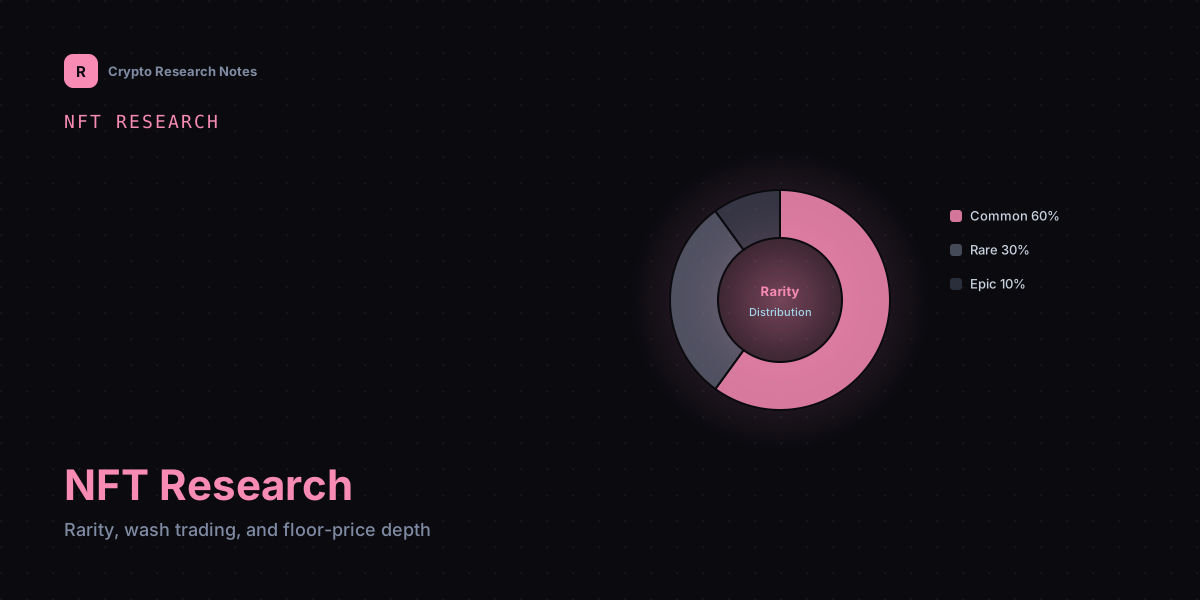
A marketplace's displayed rarity rank is a convenient shortcut, not a verified fact. Rarity scores are typically built by counting how often each trait value appears across a collection and combining those frequencies into a per-item score, but platforms disagree on the formula. "Statistical rarity" simply multiplies the inverse frequency of each trait an item holds, so items with several uncommon traits score very high even if one of those traits barely affects visual distinctiveness. "Trait-normalized" scoring instead weights each trait category so no single attribute (say, background color, which usually has few possible values) dominates the score. The same item can rank very differently depending on which method a given platform uses — and platforms rarely publish their exact formula.
A researcher's job is to treat the displayed rank as one input, not the answer, and to recompute a rough ranking independently from the collection's own metadata — whether that metadata lives in an off-chain JSON file referenced by the token URI or is stored fully on-chain. Pulling every item's trait list, tabulating frequency per trait value, and applying a chosen scoring method lets a researcher see whether an item's marketplace-advertised rank survives a second calculation, or whether it only looks rare under one specific formula.
- Pull trait data directly from the collection's metadata source rather than trusting a rendered rarity badge.
- Recompute frequency-based scores using at least two different weighting methods and compare the resulting ranks.
- Treat a large gap between methods as a flag to investigate the trait schema, not as noise to ignore.
As an illustration only: suppose item #4821 in a hypothetical collection ranks 12th rarest by statistical rarity but 340th by trait-normalized scoring — this figure is invented purely to illustrate the methodology, and the gap simply shows how much a rarity rank depends on the formula behind it.
3. Detecting Wash Trading Through Wallet Clustering
Wash trading in an NFT context means an address, or a small group of linked addresses, buying and selling the same item back and forth to manufacture volume or push up its apparent last-sale price, rather than any genuine change of ownership taking place. Because a single wallet trading with itself would be too obvious, wash trading usually runs through a cluster of addresses that look independent on the surface but share funding sources, creation timing, or transaction patterns.
The detection method here directly echoes the wallet-clustering approach from our earlier airdrop/Sybil-detection article: group addresses by shared funding origin and behavioral similarity, then look for repeated transfers of the same token ID circulating only within that cluster rather than reaching genuinely external buyers. A real market shows an item moving to new, unrelated wallets over time; a washed item tends to loop.
- Map the token ID's full transfer history, not just its most recent sale.
- Check whether buyer and seller wallets in a sequence trace back to a common funding wallet or were created within a short window of each other.
- Flag tight, closed loops — the same handful of wallets repeatedly re-acquiring the same item — as a wash-trading signal rather than organic demand.
As a purely illustrative example: imagine token #77 in a fictional collection changing hands four times in three days, each time among only three wallets that were all funded from the same source address 48 hours before the first trade — this figure is invented purely to illustrate the methodology. That circular pattern, not the headline sale price it generated, is the signal worth investigating.
4. Floor Price and Real Liquidity Depth
A collection's headline floor price is usually just the price of the single cheapest active listing at that moment — it is not an average, not a volume-weighted figure, and not a guarantee that a second or third item could be bought anywhere near that price. If the listings just above the floor are sparse or priced far higher, the floor can be swept with a surprisingly small amount of capital, after which the "floor" simply resets several times higher, or a seller can relist to walk it back down. Either way, the single-item floor price is a weak proxy for how liquid the collection actually is.
This is the same depth-verification logic our earlier DEX-liquidity article applied to token pools: a headline price only means something once you check what sits behind it. For NFTs that means pulling the full order book (or listing depth) rather than reading the floor in isolation — how many listings exist within, say, 10% of the floor, and how thin or clustered that depth is.
- Always check the number and price spread of listings near the floor, not just the single lowest one.
- Watch for floor prices that move sharply on very few transactions — a sign of thin depth rather than genuine repricing.
- Treat "floor price" as a snapshot of the cheapest ask, not as an executable price for any meaningful quantity.
Purely as illustration: a fictional collection might show a floor of 2.0 (unit omitted intentionally), but only one listing exists below 2.6, meaning a buyer with modest capital could clear the floor and reset the displayed price by roughly 30% — this figure is invented purely to illustrate the methodology.
5. Royalty Enforcement and Marketplace Policy Differences
Creator royalties on secondary sales are not a universal, contract-enforced guarantee — they depend entirely on what a given marketplace's smart contracts and order-matching logic actually do. Some marketplace protocols enforce royalty payment at the settlement-contract level, making it effectively unavoidable for trades executed through that venue. Others treat the royalty field as optional metadata that a buyer, seller, or aggregator can simply set to zero when constructing an order, regardless of what the collection's creator originally specified.
Because of this split, a researcher should never assume a creator-stated royalty percentage is actually being paid across the board. The only reliable check is to look at the specific marketplace or aggregator being used for a given transaction — whether its settlement logic reads and enforces the royalty registry standard the collection published, whether it allows royalty overrides in the order parameters, and whether aggregators routing trades across several venues preserve or strip that field in the process.
- Identify which marketplace or aggregator actually executed a given sale, not just which platform's listing page it was viewed on.
- Check whether that venue's contracts enforce royalties on-chain or leave the rate as an optional order parameter.
- Where possible, compare the royalty amount actually transferred on-chain against the rate publicly stated for the collection, rather than assuming the two always match.
The practical takeaway is that "royalty rate" is a per-marketplace enforcement question, not a fixed property of the collection itself — the same collection can pay full royalties on one venue and effectively zero on another.
6. Common Misconceptions and Conclusion
A few recurring misconceptions are worth naming directly. First, treating a single marketplace's displayed rarity rank as ground truth, when it is really one formula's output among several plausible ones. Second, treating floor price as a liquid, executable price for any quantity, when it typically reflects one thin listing that may not survive contact with real buying pressure. Third, assuming a creator's stated royalty percentage is honored on every venue, when enforcement is a marketplace-level policy choice that varies considerably and can be bypassed entirely on some platforms.
Pulling the four layers together: rarity/metadata verification, wash-trading detection, floor-price/liquidity depth checks, and royalty-enforcement review address four distinct failure modes that don't overlap with the fungible-token methods covered earlier in this series. Rarity and metadata checks guard against trusting a single displayed rank; wallet-clustering analysis (echoing the Sybil-detection approach) guards against manufactured volume; liquidity-depth checks (echoing the DEX-liquidity approach) guard against mistaking a thin listing for a real market; and royalty-policy review guards against assuming stated terms are always enforced.
- Misconception: a marketplace's rarity badge is authoritative — it is one formula's output, not a verified fact.
- Misconception: floor price is a tradable price for any volume — it is usually one listing, not a market depth.
- Misconception: creator royalty rates are always paid — enforcement depends on the specific marketplace's contract logic.
As with the rest of this series, everything above describes abstract methodology and uses invented figures solely to illustrate calculation logic. None of it evaluates, ranks, or makes claims about any real NFT collection, marketplace, or creator, and none of it constitutes investment advice.