
1. Stablecoin Basics: Where the "Stable" in USDT Actually Comes From
Let's get the concept straight. USDT is a "fiat-collateralized stablecoin." Its design goal isn't to appreciate but to stay as close to one dollar as possible. Think of it as an "IOU for a dollar, on-chain": the issuer claims that for every USDT in circulation, there is roughly one dollar of real assets held as reserves. So the first thing stablecoin basics should teach you is this — USDT's value doesn't come from the blockchain itself, but from the promise that "the money exists off-chain."
This is fundamentally different from Bitcoin or Ethereum, whose prices are set by supply and demand and swing with sentiment and consensus. USDT stays glued to a dollar because of a whole "peg–reserves–redemption" machine working behind the scenes. Understand that machine and you've actually crossed the threshold of stablecoin basics, instead of merely "knowing it's worth a buck."
- USDT is a fiat-collateralized stablecoin aiming to equal $1, not to appreciate.
- Its value rests on the promise of off-chain reserves, not on blockchain tech.
- The heart of stablecoin basics is grasping why the peg holds, not just the price.
2. The Peg Mechanism: How the Anchor Is Held in Place
Many newcomers assume the price is "set" by the issuer. It isn't — no one can order the market to trade at exactly a dollar. What actually holds the price is a redeemable promise combined with arbitrage. The issuer's core commitment is: a verified user can redeem 1 USDT for 1 dollar at a 1:1 rate, and mint 1 USDT with 1 dollar. That "always convertible back to dollars" channel is the bedrock of the anchor.
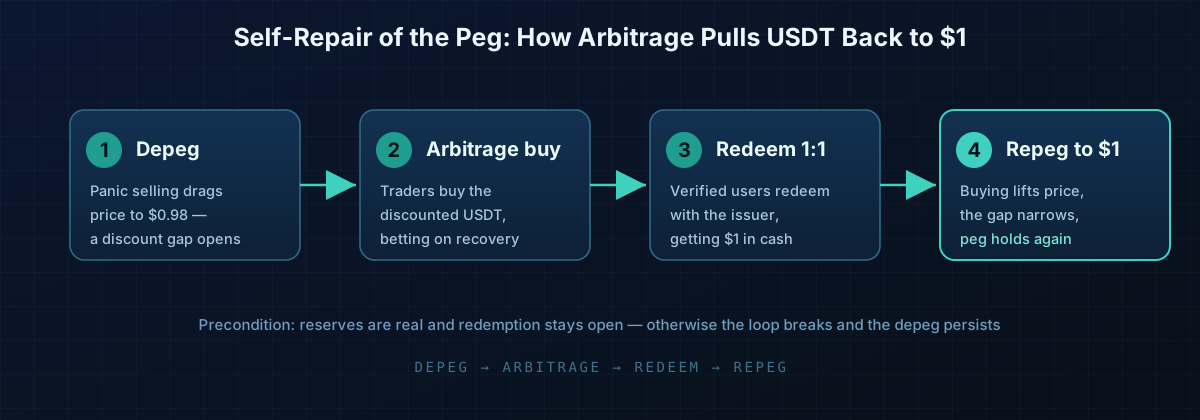
With that channel in place, even a brief price deviation gets pulled back by arbitrage. When the price is above a dollar, people mint new coins and sell them for the spread, and the added supply pushes the price down. When it's below a dollar, people buy cheap and redeem for dollars, and the added demand lifts it back up. The key piece of stablecoin basics, plainly put: the peg isn't maintained by decree, but by profitable arbitrage keeping a dynamic balance.
- The anchor's bedrock is a two-way "redeem/mint at 1:1" channel.
- When price deviates, arbitrageurs' profit-seeking pulls it back to $1.
- The peg is a dynamic balance, not something the issuer unilaterally "sets."
3. Reserves: The Money Behind It, and Why Quality Decides Everything
The arbitrage loop above has an implicit precondition — the issuer can actually produce those dollars. That leads to the most sensitive part of stablecoin basics: reserves. Reserves are the assets backing every USDT; their size decides whether redemption is possible, and their quality decides how reliable it is. If reserves are all cash and short-term U.S. Treasuries, liquidity is excellent and they can be converted almost anytime. But if they include commercial paper, corporate bonds, or even related-party loans, they may not sell at a good price during a run.
So looking at reserves isn't just about "is it 100%?" but "what is it made of?" That's why reserve transparency matters so much: issuers periodically disclose reserve composition and audit/attestation reports so the market believes the backing is both sufficient and high-quality. As a researcher, build the habit of reading "circulating supply" against "disclosed reserves," rather than relaxing at a vague "we hold ample reserves." Get reserves wrong and the elegant peg mechanism above is a castle in the air.
- Reserves are the physical basis of USDT's redemption ability — size for sufficiency, composition for quality.
- Cash and short-term Treasuries are the most liquid; low-liquidity assets can drag during a run.
- Reserve transparency rests on periodic disclosures and attestations — cross-check against supply.
4. Depeg: The Conditions Under Which the Anchor Loosens
Understand how the anchor holds, and you can work backward to when it loosens. A depeg means the market price clearly deviates from a dollar and doesn't come back. It's usually not one cause but several stacking up. First is a confidence shock: the market suspects reserves are unreal or low-quality, panic selling hits, and the price plunges — here, arbitrage appetite alone isn't enough, because what everyone fears is precisely "not being able to redeem."
Second is a blocked redemption channel: if redemption is paused, capped, or too slow, the arbitrage chain in step 3 breaks and the price naturally can't return to a dollar. Third is a liquidity crunch: in extreme conditions, thin exchange depth and congested bridges can cause a temporary supply-demand imbalance that knocks the price off for a while. Put the three together and a depeg is essentially "the arbitrage-repair loop being interrupted" — if reserves are questionable or dollars can't be redeemed, the self-healing loop simply stops turning. So to judge whether a stablecoin is stable, don't just watch today's price; ask whether its redemption channel is open and whether its reserves hold up to scrutiny.
- A depeg is a clear, persistent deviation from $1, usually from stacked causes.
- Three triggers: confidence shock, blocked redemption, liquidity crunch in extreme markets.
- At its core, the arbitrage-repair loop is interrupted — reserves and redemption are the key variables.
5. Practical Verification for Everyday Users, and Tooling Costs
To put stablecoin basics into daily practice, follow a few rules. First, confirm the contract address: a same-named "USDT" has different official contracts on different chains, so before transferring or approving, verify the official address on a block explorer and don't get fooled by counterfeit tokens. Second, don't put all eggs in one basket: parking all funds in a single stablecoin means betting all your credit risk on one issuer. Third, watch the reserve-disclosure cadence: treat the issuer's periodic disclosures like a routine checkup, which beats panicking after the market breaks.
A practical aside — this kind of research and on-chain work often means subscribing to a stack of tools that bill monthly and only take overseas cards: market terminals, on-chain data platforms, stablecoin monitoring and alerts. Many people pay for these with a virtual credit card: fast to open, controllable limits, and a separate card per platform so your main card isn't authorized everywhere. If you're looking for a reliable virtual card issuing platform, options like RDVCC that support Visa virtual cards for subscriptions are worth a look, just to smooth out the "how do I pay for tools" step. To be clear, this is only payment convenience and has nothing to do with whether a given stablecoin is stable or its reserves are real — don't conflate the two.
- Verify the official contract address on a block explorer before transferring or approving.
- Don't put all funds in one stablecoin; diversification dilutes single-issuer credit risk.
- Treat periodic reserve disclosures as checkups; a virtual credit card is payment convenience only, unrelated to a coin's safety.
6. Wrap-Up: Take "Worth $1" Apart
Back to the opening question — what makes one USDT worth a dollar? The answer is now clear: not the blockchain, not the issuer's word, but three pillars holding it up together — a redeemable promise, arbitrage repair, and real reserves. When all three are solid, the anchor holds; if any one falters, the price can loosen or break away. That's the underlying logic stablecoin basics are really about.
So next time someone tells you "USDT is totally safe, always equals a dollar," ask a follow-up: what are its reserves made of, is the redemption channel open, is disclosure transparent? Think those through and your understanding of stablecoins upgrades from "using it" to "seeing through it." This whole piece discusses abstract mechanisms and research methods only; it does not target or evaluate any real project or product and is not investment advice. Reserve structures and compliance status can change at any time, so always rely on the latest official and on-chain information and own your decisions.
- "Worth $1" rests on three pillars: redeemable promise, arbitrage repair, real reserves.
- If any pillar falters, the anchor can loosen or break.
- This is a methodology discussion, names no real project, and is not investment advice.