
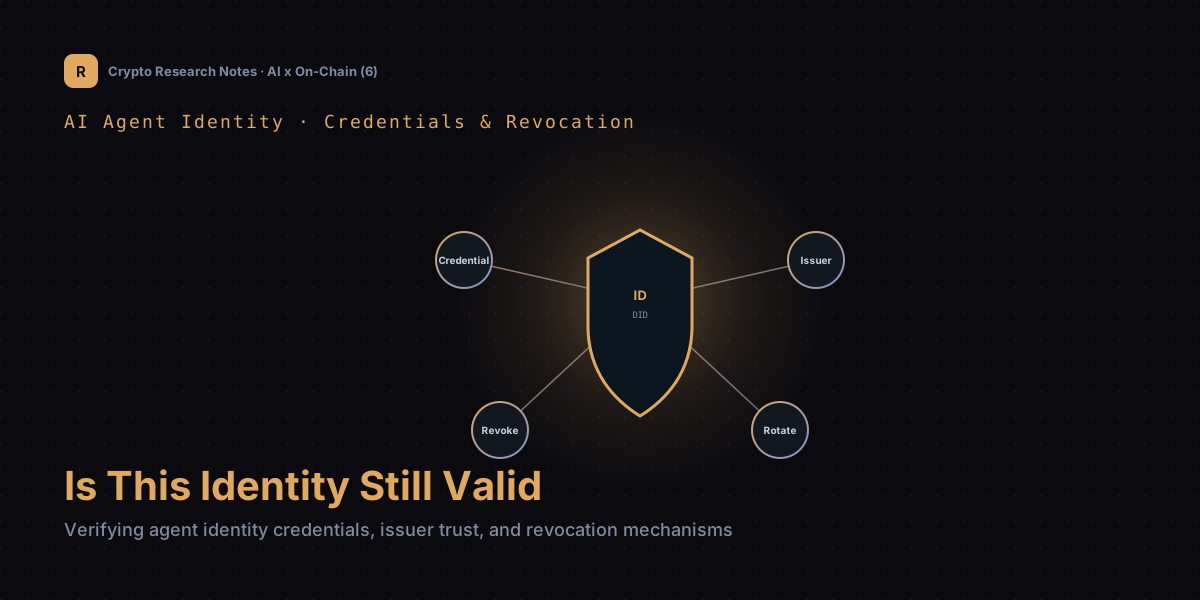
1. Identity Is Not an Address: Where Decentralized Identifier Trust Actually Comes From
In the simplest on-chain scenario, "identity" is often reduced to an address: as long as a transaction's signature passes elliptic-curve verification, we say the transaction "was sent by this address." But that only answers "who signed it," not "is the entity behind the signature trustworthy." As the agent economy grows to need distinctions like "is this the official agent of a particular service provider" or "is this agent authorized to act on behalf of an organization," an address alone is not enough. This usually calls for some form of decentralized identifier (DID) and verifiable credential system - the identifier itself is just an anchor point for verifying signature ownership; the actual trust is carried by a set of claims bound to that identifier, and whether those claims are trustworthy depends on whether the issuer is credible.
A common misconception here is equating "decentralized" with "trustless." In reality, most usable identity and credential systems still rely on some issuer backing the truthfulness of a claim - the "decentralized" part usually only refers to the registration and resolution of the identifier not depending on a single central authority. Whether "what this credential claims is actually true" ultimately converges to the credibility of one issuer, or a set of issuers. After obtaining an agent's identity claim, the first step for a verifier should be to establish: through what mechanism is the control of the public key/identity resolved and updated; who backs the truthfulness of the claims; and at what layer the entire trust chain collapses if the issuer itself is compromised or acts maliciously.
- The identifier itself is only an anchor for signature verification; real trust comes from the claims bound to it and their issuer.
- "Decentralized" usually only decentralizes identifier registration/resolution; claim truthfulness still converges to issuer credibility.
- Starting point: the identifier's control-change mechanism, who issues the claims, and where trust collapses if the issuer is compromised.
2. Credential Issuer Credibility: Who Gets to Say "I Certify This Agent"
The value of a verifiable credential depends entirely on the issuer's credibility and the rigor of its issuance process. If anyone can deploy an issuance service and grant "certified" credentials to any agent, the credential is functionally no different from a self-declaration wrapped in extra technical packaging. A meaningfully useful credential system requires the issuer itself to have passed some independent qualification check, with that process and its results auditable - for example, whether the issuer publicly discloses its admission criteria, whether it discloses which credentials it has revoked and why, and whether multiple independent issuers exist that can cross-verify the same agent's qualifications.
Another often-overlooked risk is issuer conflict of interest: if a marketplace platform both runs the matching business and serves as the credential issuer for agents on that platform, it has an incentive to relax review standards for the agents it favors and tighten them for competitors. This "referee and player at once" structural conflict is hard to eliminate through technical means alone and can only be mitigated through disclosure and external audit. Verifiers should ask: are the issuer's admission and review standards public; does an independent third-party issuer exist outside any single marketplace or platform; does the credential record the issuer's own identity for accountability purposes; and is the credential's validity period reasonable - an overly long validity window lets a one-time qualification check underwrite a reality that may have already changed.
- A credential's value hinges entirely on issuer credibility; a barrier-free self-issued "certification" is functionally a self-declaration.
- A platform acting as both matcher and issuer has a structural conflict of interest that only disclosure and external audit can mitigate, not technical fixes.
- Verification angles: whether admission criteria are public, whether independent third-party issuers exist, whether validity periods are reasonable.
3. Key Rotation and Revocation: An "Invalid" Credential May Still Be Treated as Valid
The most fragile part of an identity and credential system is often not the moment of issuance but the long lifecycle afterward: an agent's control may change hands (e.g., its operator switches custody arrangements), a credential may be actively revoked for misbehavior, or keys may need rotation on suspicion of compromise. Whether the system can promptly inform every downstream party that "this credential is no longer valid" after such changes directly determines whether the revocation mechanism is real or merely nominal. A common trap on-chain is that revocation records are publicly queryable on-chain, but downstream verifiers may not actually query the latest revocation status before every interaction - they may instead rely on a cached "valid" result from an earlier check. If a verifier skips the real-time query for convenience, an already-revoked credential can still be accepted as valid in an actual interaction.
The design of the revocation mechanism itself involves trade-offs: a fully decentralized revocation list may suffer propagation delay, creating a window where a revocation has been submitted but not yet propagated network-wide, during which the credential could still be abused; relying on a centralized revocation-lookup service reintroduces a single point of availability dependence - if that service goes down, the system may fall into a dangerous default of "treat as valid when revocation status cannot be confirmed." Verifiers should ask: is a revocation-status query mandatory before every critical interaction, or can it be cached and skipped; how long is the lag window between a revocation being submitted and being network-wide queryable; and when the revocation service is unavailable, does the system default to conservative denial or permissive acceptance - this default choice determines whether the system leans toward safety or availability in the worst case.
- Whether revocation is real or nominal depends on whether downstream verifiers actually query the latest status before every interaction.
- Decentralized revocation lists have propagation lag; centralized lookup services have single-point availability risk - each carries a trade-off.
- Verification focus: whether revocation queries are mandatory, the lag window length, and the default behavior on query failure.
4. Spoofing and Impersonation: When Attackers Don't Need to Break Cryptography, Just Look Convincing
The first three sections discuss trust boundaries when an identity and credential system is "working as intended." Real-world attacks, however, often bypass cryptography entirely and strike at the social-engineering or presentation layer. A common attack pattern is "similar-identity confusion": an attacker registers an identifier that closely resembles a well-known agent's name (differing by only subtle characters) and configures metadata that looks compliant, betting that downstream users or other agents will mistake it for the real one during a quick check. If the verification flow only performs fuzzy matching rather than exact identifier comparison, this attack's success rate rises significantly. A more subtle tactic is hijacking a formerly legitimate but now-abandoned agent identity - if the original operator loses control without promptly revoking the credential, an attacker who acquires residual control can continue impersonating with a credential that is "technically still valid."
Defending against these attacks does not depend on stronger cryptography but on whether the verification flow has cultivated the habit of "exact matching plus proactively querying the latest status," and whether the identity system has designed some form of proactive expiry or re-verification requirement for long-inactive agents, rather than treating a credential as forever valid so long as it hasn't been actively revoked. When evaluating any agent identity system, researchers should ask: does the system flag or distinguish similar-looking identifiers; are long-inactive identities required to re-verify before continued use; and if an identity's control changes unexpectedly (e.g., a suspected private-key leak followed by unauthorized use), how quickly can anomalous behavior patterns be detected and escalated for manual review.
- Similar-identity confusion exploits fuzzy/visual matching gaps in verification, not cryptographic weaknesses; exact identifier comparison is the baseline defense.
- Long-inactive identities that haven't been actively revoked are a real attack surface for hijacking and impersonation.
- Verification angles: whether similar-identifier warnings exist, whether inactive identities require re-verification, and detection speed for anomalous control changes.
5. Verification Checklist and Summary
Condensing the previous four sections into a reusable checklist, any system claiming to support "AI agent identity authentication" can be evaluated against: first, trust basis - what mechanism governs control changes for the identifier's resolution, and who issues the claims? Second, issuer credibility - are admission criteria public, do independent multi-party issuers exist, and is there a self-certification conflict of interest? Third, revocation timeliness - is a revocation query mandatory before critical interactions, how long is the lag window, and does query failure default to safety or availability? Fourth, spoofing and impersonation defense - is exact identifier matching performed, are long-inactive identities required to re-verify, and how fast are anomalous control changes detected?
Looking back across the six pieces in the "AI x On-Chain" series - from a single agent's permission boundaries, to an oracle's source of truth, to a proof system's capability limits, to the credit chain between agents, to the mechanism design of an open marketplace, and finally to this piece's discussion of identity and credential infrastructure - this is almost a path from "specific scenarios" gradually converging toward "the underlying foundation." And this piece reveals a conclusion easy to overlook: if the identity and credential foundation itself has revocation lag or issuer trust gaps, every verification method discussed in earlier pieces, no matter how rigorously designed, may be a castle built on an identity that can be forged or impersonated. This piece discusses only abstract mechanism categories and verification methods, names no real products or protocols, and is not investment advice in any form. As the sixth piece in the "AI x On-Chain" series, we will continue tracking mechanism developments in this space - subscribe via RSS for future updates.
- Four-question checklist: identity trust basis, issuer credibility, revocation mechanism timeliness, spoofing/impersonation defense.
- What's distinct about this piece: it pulls the lens back to the underlying identity and credential infrastructure that supports all five earlier pieces' verification methods.
- This is a discussion of mechanism categories and methodology only, naming no real products, not investment advice; the series will keep tracking mechanism evolution in the agent economy.