
1. From "aggregated price" to "model conclusion": where trust moves
To understand what AI oracles change, first look at the trust model of a traditional oracle. A typical price oracle collects prices from several exchanges or on-chain markets, aggregates them by some rule (median, weighted average), and writes the result on-chain. The defining feature of this process is that it is recomputable — any researcher who obtains the same raw quotes and aggregation rule can run the numbers again and check whether the feed's value is reasonable. Trust here rests mainly on "is the data source manipulated" and "is the aggregation logic transparent," and both can be traced through on-chain or public market data.
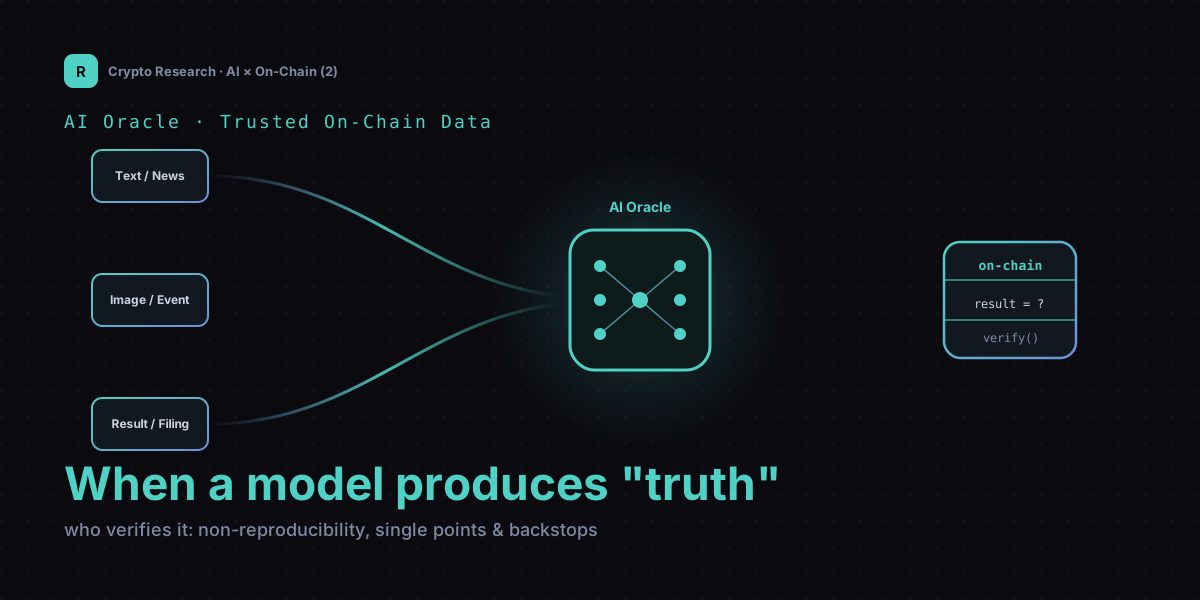
AI oracles change exactly that recomputable premise. What they process is often not an already-numeric price but a vague, unstructured input: whether a news text is true, the final result of a sports match, an inventory reading of oil tanks from a satellite image, whether an off-chain contract was fulfilled. The model "understands" these inputs into a conclusion a contract can consume — yes or no, pay or don't pay, some value. The problem is that this conclusion no longer comes from a formula anyone can recompute, but from one inference under a specific model, specific weights, specific inputs. Trust thus shifts from "data and formula" as a whole to a new object: the model itself, its training data, its inference environment, and whether the party running it is honest. Verifying an AI oracle begins with recognizing this shift — you are no longer just assessing "is the data right," but "why does this conclusion-producing model, and the person running it, deserve trust."
- A traditional oracle's core trait is recomputability: with the same quotes and aggregation rule, anyone can independently verify the feed.
- AI oracles process unstructured inputs and generate conclusions via model inference, breaking the "anyone can recompute" premise.
- Trust moves from "data and formula" to "the model, its training data, its inference environment, and whether the operator is honest" — the starting point of verification.
2. Non-reproducibility: why model inference is hard to recompute
A traditional oracle is verifiable because every step can be replayed; the trickiest thing about an AI oracle is precisely that its conclusion is inherently hard to reproduce independently. This non-reproducibility comes from several stacked layers. First, the model's own opacity — if the weights are not public, an outside researcher simply cannot rerun the same input and can only passively accept the output; even with public weights, large-model inference is often affected by floating-point ordering, hardware differences, sampling temperature and random seeds, so the same input need not yield a bit-identical output. Second, the input leaves no trace — if the raw material the model judged (that text, that image) was not recorded completely and tamper-evidently, there is no way to check afterward "what exactly did it see."
This creates a verification dilemma quite different from a traditional oracle: when an AI oracle produces a disputed conclusion and you try to recheck it, you find there is almost nothing to grab onto. You don't know which model version it used, you don't know whether the input was preprocessed or cropped, and you cannot guarantee your own rerun gets the same result. So "verification" easily degrades into "trust the operator's self-attestation" — it says the model judged this way, and you can only believe it. Researchers facing an AI oracle should treat non-reproducibility as an explicit risk dimension to interrogate: is the model version pinned and its hash published? Are key inputs fully attested (for example, hashing the input on-chain)? Is there a mechanism that lets a third party at least verify after the fact that the "input-model-output" chain was not swapped midway? If none of this exists, then the word "objective" for this oracle rests, in essence, on unconditional trust in the operator.
- Non-reproducibility is multi-layered: weights not public, inference affected by hardware and randomness, input material not tamper-evidently recorded.
- The result: verification degrades to "trust the operator's self-attestation" — it says the model judged so, and outsiders can hardly refute it.
- What to check: is the model version pinned and hash-published, are key inputs attested on-chain, can one verify after the fact that "input-model-output" was not swapped.
3. Single-model feeds: a new single point of manipulation
In earlier discussions of oracle manipulation, this site repeatedly stressed one principle: a single data source is a single point of failure. AI oracles carry this problem into a new dimension — if a series of on-chain contracts all depend on the same model, the same operator's conclusions, then that model becomes a highly concentrated manipulation surface, and one whose manipulation is subtler than a traditional feed's. Manipulating a traditional feed usually requires moving a price in a real market (e.g., a flash-loan pump), which leaves traces on-chain; manipulating a model conclusion can happen where you cannot see: biased data fed in during training, carefully crafted adversarial input at inference time that makes the model misjudge, or the operator simply tampering at the output stage while claiming "that's just what the model concluded."
More worrying is incentive misalignment. If an AI oracle's operator simultaneously holds positions in the markets it feeds, it has a motive to make the model "happen to" produce a conclusion in its own favor at a critical moment — and because of the non-reproducibility of Section 2, such manipulation is extremely hard to prove from the outside. Verifiers need to treat "who runs this model, do they have a conflict of interest, how many independent parties provide the same kind of conclusion" as core questions. A healthy design should not let a single model's single output directly decide the liquidation or payout of a large sum; at minimum there should be cross-checking across multiple independent models or operators, a challenge window for anomalous conclusions, and fallback logic when results diverge. If the entire system's "truth" is decided by one black-box model, then no matter how accurate it usually is, it is a single point that can be exploited at any time.
- An AI oracle relying on a single model/operator is a manipulation surface subtler than a traditional feed.
- Manipulation can occur unseen — in training (biased data), inference (adversarial input) or output (the operator tampering directly).
- The most dangerous case is incentive misalignment: an operator holding positions in the fed markets has a motive to make the model "happen to" favor itself.
4. Multi-source cross-checking and dispute resolution: who backstops the model's conclusion
Since a single model is untrustworthy, the sensible direction is to let no single conclusion be final. In traditional oracles this corresponds to "multi-source aggregation"; in AI oracles it is more complex, because a model's conclusion is often a discrete judgment (yes/no, pay/don't pay), not a price you can simply take the median of. What is worth verifying here is whether the system has a clear dispute-resolution mechanism: when multiple models or operators disagree, what does the system do? Simple majority, human arbitration, an optimistic challenge period, or a fallback to a more conservative default? In discussing prediction-market resolution, this site raised a similar "propose-challenge-final-ruling" structure — AI oracles must likewise answer "who ultimately holds final authority."
A well-designed system usually positions the AI model as an "efficient preliminary judge" rather than an "irreversible final court": the model gives a conclusion first, but a challenge window is kept, and anyone can stake to challenge within it, triggering a higher-cost, more transparent review (e.g., decentralized human voting or multi-model re-adjudication). This way, even if a single model errs or is manipulated, there is an economic and procedural backstop. Verifiers should ask: is this AI oracle's conclusion "instantly final" or "challengeable"? Is the cost and path of a challenge feasible for ordinary participants, or so high as to be a dead letter? Who ultimately adjudicates a dispute, and is that adjudicator itself a new centralized single point? Pressing these questions is how you judge whether the system is "an AI-accelerated extra layer" or "an AI black box that replaced an otherwise verifiable process."
- The sensible direction is to let no single conclusion be final; but model conclusions are mostly discrete judgments, not prices you can median.
- The key is the dispute-resolution mechanism: on disagreement, majority, human arbitration, optimistic challenge, or conservative fallback.
- Healthy designs treat the model as a "preliminary judge," not a "final court," keeping a feasible challenge window as an economic and procedural backstop.
5. Trusted execution environments (TEE): what they can and cannot prove
Against the model's non-reproducibility, a common technical response is the trusted execution environment (TEE) — running the model inside a hardware-level "safe," where the chip produces a remote attestation claiming "this code really ran in an untampered environment, with the specified input, and produced this output." This is a valuable tool, but its boundaries are often overstated, and verifiers must distinguish what it can and cannot prove.
What a TEE can prove is "execution integrity": ideally, it lets you believe the operator did not secretly swap the model, did not tamper with the inference, and that the output really came from the claimed code and input. But it cannot prove "the input itself is correct" — if the raw data fed to the model (that image, that text) was forged or cherry-picked to begin with, the TEE will faithfully wrap the inference of a bad input into a "trusted" output: garbage in, garbage out. It also cannot prove "the model's judgment is right" — the model may run meticulously inside the TEE and produce a wrong conclusion or one misled by an adversarial sample, while the attestation only guarantees "it really ran this way," not "it ran correctly." Moreover, the TEE itself depends on the hardware vendor's root of trust, and side-channel attacks have appeared historically. So the pragmatic stance is: treat a TEE's remote attestation as evidence that "execution was not tampered with," not evidence that "the conclusion is trustworthy"; it addresses part of Section 2's "input-model-output was not swapped," but in no way replaces the multi-source cross-checking and dispute resolution of Sections 3 and 4. A genuinely robust system usually stacks TEE, multi-source cross-checking and challengeable adjudication together, rather than expecting any single technology to be a one-shot fix.
- A TEE can prove "execution integrity": the model and inference were not tampered with; the output came from the specified code and input.
- A TEE cannot prove "the input is real" nor "the judgment is right" — garbage in, garbage out is still wrapped as a "trusted" output.
- Pragmatic framing: a TEE is evidence "execution was not tampered with," to be stacked with multi-source cross-checking and challengeable adjudication, not a cure-all.
6. Checklist and summary
Condensing the five sections into a reusable checklist, you can run through it against any oracle or data service claiming to "use AI to bring off-chain facts on-chain": First, where does trust land — does the conclusion come from a recomputable formula, or some model's inference? If the latter, is the model version pinned and its hash public? Second, how is reproducibility — are key inputs fully attested (e.g., input hashes on-chain), and can a third party verify after the fact that the "input-model-output" chain was not swapped? Third, is it a single point — does it depend on a single model or operator, and does the operator have a conflict of interest in the markets it feeds? Fourth, is there a backstop — how are disagreements among multiple independent conclusions adjudicated, and is there a cost-feasible challenge window and conservative fallback? Fifth, are the boundaries of the technical proof honestly labeled — if a TEE is used, it proves execution integrity, but has the operator packaged it as "the conclusion is trustworthy" to mislead users?
It bears repeating: AI oracles make "turning complex off-chain facts into on-chain conclusions" efficient, but the price of efficiency is reduced verifiability — a process anyone could recompute is replaced by a black box requiring trust in the model and its operator. This is not necessarily bad, but the researcher's job is to put that layer of trust explicitly on the table, rather than let it be waved away by phrases like "AI is more objective" or "hardware-level trust." The most pragmatic principle is: the more significant and irreversible the on-chain action (large liquidations, final payouts, result adjudication), the less it should be decided directly by a single model's single output, and the more it needs a multi-source, challengeable, fallback-equipped structure as a backstop. This entire piece discusses abstract mechanism categories and verification methods only — it does not name or evaluate any real product or protocol, and does not constitute any form of investment advice. As the second article in the "AI × On-Chain" series, the next piece plans to push further into trusted execution and verification of on-chain models — when we want not only to know "the model ran" but to prove cheaply on-chain that "the model ran correctly," what new possibilities and new pitfalls do directions like zero-knowledge machine learning (zkML) bring.
- Five checklist questions: where trust lands, reproducibility, whether it is a single point, dispute backstop, and honest labeling of the technical proof's boundaries.
- Pragmatic principle: the more significant and irreversible the on-chain action, the less it should be decided by a single model's single output.
- The piece is a discussion of mechanism categories and methodology, names no real product, and is not investment advice; the next in the series turns to zkML and trusted execution of on-chain models.