
1. The Basic Structure of the Agent Economy: From "Single-Agent Execution" to "Multi-Agent Transactions"
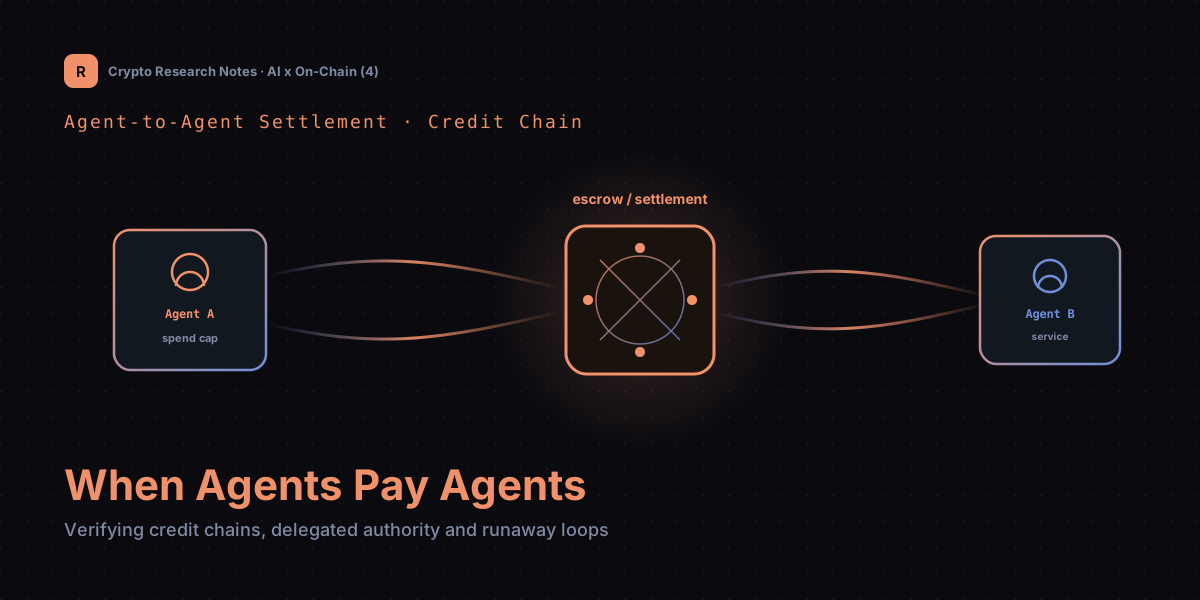
The AI agent discussed in the first piece of this series followed a relatively simple one-to-one model: a user authorizes an agent, and the agent executes on-chain actions within a spending limit. But as agents become more specialized and better at particular sub-tasks, a more complex structure naturally emerges — a "primary agent" completing a user's overall task may need to temporarily hire other agents to handle parts it isn't good at: calling a data-retrieval specialist to verify a fact, calling a pricing specialist for a quote, calling an execution specialist to complete a swap. These calls are often accompanied by instant, automated micro-settlements — the primary agent transfers funds directly to the called agent's address in exchange for the service, with no human in the loop.
The value proposition of this "agent economy" is straightforward: breaking a complex task into pieces handled by specialized agents should, in theory, be more efficient. But it also introduces a dimension absent from the single-agent model — funds no longer flow only from "user" to "agent," they start flowing "agent to agent," and often at a scale and granularity the user never sees, potentially dozens of tiny agent-to-agent settlements within a single task. The first step in verifying such a system is mapping the topology of this fund flow: how many layers of agents does a task's spending authorization pass through? Does each layer keep an independent, auditable record of its spending, or are all agent-to-agent settlements bundled into a black box where the user only sees a final total afterward?
- The agent economy breaks complex tasks into pieces for specialized sub-agents, who coordinate through automated micro-settlements between themselves.
- Fund flow shifts from a single "user to agent" layer to a multi-layer "agent to agent" structure, often at a granularity invisible to the user.
- The starting point for verification is mapping the fund-flow topology: how many agent layers does the authorization pass through, and does each layer keep an independent, auditable spending record.
2. The Cascade of Delegated Authority: Is the Limit Copied, or Re-Derived
The first piece in this series stressed that the core of single-agent verification is a "hard, on-chain-enforced spending cap" — a limit that should be enforced by smart contract or wallet-layer rules, not the agent's own self-restraint. This principle needs refinement in the multi-agent setting, because the limit now has to be "passed along": once the primary agent receives a user's authorization and delegates a sub-task to a sub-agent, is that payment deducted from the primary agent's own limit, or does the sub-agent get issued a brand-new authorization that might be decoupled from the original limit entirely?
The key risk here is "limit duplication" rather than "limit derivation." A sound delegation model should guarantee that no matter how many layers of sub-agents a task chain delegates through, every sub-agent's spending is traceably deducted from the same original user-granted pool, and no single layer can exceed that shared total. But if the system's actual implementation has the primary agent issue a fresh, independent spending permission each time it delegates to a sub-agent — and that new permission isn't hard-bound to the original limit, just set to some number the primary agent judged "reasonable" — then in theory, with enough layers of delegation each opening a new allowance, total actual spending could far exceed the user's original cap. This isn't cheating by any single actor; it's a structural gap in the limit-propagation mechanism itself. Verifiers should ask directly: does multi-layer delegated spending share the same hard-constrained fund pool, or can every layer draft a fresh authorization decoupled from the original?
- In a multi-agent setting, a spending limit is no longer a simple one-time cap — it must be propagated through a delegation chain, and the distinction between "limit duplication" and "limit derivation" is critical.
- Sound model: every sub-agent's spending is traceably deducted from the same original user-granted pool, forming a shared hard-constrained fund pool.
- Risky model: each delegation layer issues an independent new authorization; if decoupled from the original limit, more delegation layers can push total spending far beyond the user's intended cap.
3. Runaway Call Loops and Uncontrolled Spending: A Deadlock No One Designed
A more subtle class of risk than authorization-propagation gaps is the calling relationship between agents itself forming a loop or unexpectedly amplifying. Consider a scenario: Agent A delegates to Agent B to finish a task, Agent B decides it needs more data support and delegates to Agent C, and Agent C happens to call back into some sub-service that Agent A itself provides — without an explicit call-depth limit or loop-detection mechanism, this chain could in theory continue indefinitely, with every hop producing a real, automated on-chain transfer, until some layer's authorization is exhausted. This requires no malicious attacker at all; each agent acting on its own locally rational judgment ("delegating here is worth it") is enough to produce a runaway spending loop at the system level.
An even more realistic risk comes from misaligned pricing incentives: if a sub-agent's fee scales with task complexity or call count, it has an economic incentive to make a task "appear" to need more calls — repeatedly claiming the data is incomplete, repeatedly requesting more verification — each round generating a new settlement. This behavior is hard to classify as an "attack," since it may simply be a natural evolution of agent strategy under a particular incentive structure, but for the user footing the final bill, the outcome is indistinguishable from being attacked. Verifiers should ask whether the system enforces a call-depth cap, a total-call-count cap, or a hard rate limit on spending per unit time, and whether there's monitoring capable of detecting "abnormally rising spend rate" signals and triggering a pause — rather than letting agents drain the authorization while staying entirely within normal protocol rules.
- Without a call-depth limit or loop detection, purely locally-rational delegation decisions by each agent can, in aggregate, produce a runaway spending loop.
- When fees scale with call count or task complexity, a delegated agent has an economic incentive to make a task "appear" to need more calls — producing attack-like effects through otherwise normal behavior.
- Verification direction: is there a call-depth cap, a hard spend-rate limit, and monitoring that can detect abnormal spending and trigger a pause?
4. Agent Identity and Reputation: Who Exactly Did You Delegate To
In the single-agent model, the user at least knows which agent they trust. In the agent economy, though, which sub-agent the primary agent chooses to delegate to is often an automated decision made through some discovery mechanism — a service registry, a bidding auction, a reputation score — that the user has essentially no visibility into, let alone the chance to vet in advance. This introduces a new verification dimension: is that sub-agent's "identity" stable and verifiable — does it have a persistent on-chain address and history, or can it simply reappear under a new address and wipe its bad track record clean? If the reputation mechanism itself can be cheaply forged (for example, by self-trading to manufacture fake transaction history), then the primary agent's delegation decisions based on that reputation are effectively no better than a blind pick.
Another easily overlooked issue is whether the sub-agent's service quality has actually been verified at the moment settlement occurs, or whether it's pay-first-deliver-later on pure trust. If settlement happens before service delivery, with no escrow or installment mechanism as a buffer, then a malicious or simply unreliable sub-agent can take payment and never deliver the promised service, leaving the primary agent — and ultimately the user footing the bill — with no recourse. Verifiers should ask whether the system has a credible identity-registration and reputation-tracking mechanism, whether reputation data can be independently verified rather than self-reported, and whether payment and delivery are decoupled in time and logic — via escrow, installment payment, or after-the-fact arbitration — to reduce the risk of "take the money and don't deliver."
- The user typically has no visibility into how or which sub-agent the primary agent chooses to delegate to, making sub-agent identity stability and reputation credibility new verification targets.
- If reputation can be cheaply forged (e.g. via self-trading), a delegation decision based on that reputation is effectively equivalent to a blind pick.
- Without a time/logic decoupling buffer between payment and delivery (escrow, installments), the risk of "take payment, don't deliver" falls on the primary agent and the user.
5. Final Say at the Settlement Layer: Can the Money Be Clawed Back When Something Goes Wrong
Stacking up the risks from the previous sections reveals a common landing point: whether it's an authorization-propagation gap, a runaway loop, or a non-delivery caused by fake reputation, all of it eventually surfaces as one or a series of on-chain transfers that "already happened, but shouldn't have." What actually determines whether such a system is robust is whether the settlement layer has a mechanism for handling disputes — not whether upfront prevention was flawless, because the complexity of multi-agent systems makes it nearly unrealistic to plug every gap in advance. Verifiers should focus on: is this kind of automated agent-to-agent transfer instant and final with no recourse, or is there a feasible dispute window that lets a user or the primary agent request a rollback or arbitration after spotting an anomaly?
If settlement is based purely on native on-chain transfers with no escrow layer at all, the answer is usually "once the money moves, it's gone for good" — meaning the entire system's security rests entirely on the preventive mechanisms covered in the previous four sections, and once any gap is triggered, the loss is already final. A more robust design will typically introduce some form of delayed settlement, an escrow account, or an on-chain arbitrable dispute-resolution protocol on the critical agent-to-agent settlement paths — even if it sacrifices some of the automation's instant-finality, it provides a stop-loss and correction window for failure modes the designers never anticipated. When evaluating any agent-economy product, researchers should treat "is settlement reversible, who arbitrates disputes, and is the cost of arbitration realistic" as verification dimensions every bit as important as spending caps and loop detection — rather than resting all trust on the self-declaration that "our architecture was designed rigorously."
- All of these risk categories eventually surface as transfers that already happened; system robustness depends on having a mechanism for handling disputes after the fact, not solely on the completeness of upfront prevention.
- Settlement based purely on native on-chain transfers with no escrow layer is irreversible once executed, putting the entire burden of safety on preventive mechanisms — a single failure becomes a permanent loss.
- More robust designs introduce delayed settlement, escrow accounts, or arbitrable protocols, trading some instant-finality for a stop-loss and correction window when the unexpected happens.
6. Verification Checklist and Summary
Consolidating the previous five sections into a reusable checklist, here is what to run through for any system or protocol that claims to support "AI agents automatically paying other agents": First, fund-flow topology — how many layers of agents does a task's spending authorization pass through, does each layer keep an independent auditable spending record, or is it bundled into a black box the user can't see? Second, how authority propagates — does multi-layer delegated spending share the same hard-constrained pool tied to the user's original authorization, or can each layer draft a fresh, decoupled authorization? Third, loop and amplification risk — is there a call-depth cap, a hard spend-rate limit, and monitoring that can detect abnormal spending patterns and trigger a pause? Fourth, identity and reputation credibility — is a sub-agent's identity stable and verifiable, and can its reputation data be independently checked rather than self-reported? Fifth, settlement reversibility — are agent-to-agent transfers instant and final, or is there an escrow, delayed-settlement, or arbitrable dispute window?
Looking back across these four "AI x On-Chain" pieces, the methodological throughline has stayed consistent: every time a new layer of automation gets introduced on-chain — whether it's an agent's autonomous execution, a model's generation of "facts," a zero-knowledge proof's computational verification, or, in this piece, automated agent-to-agent settlement — the efficiency gains almost always come at the cost of some ceded verifiability. What's distinct about this piece is that the risk is no longer confined to a single agent and its user; it propagates and amplifies along a delegation chain, involving multiple agent actors who don't know each other and share no direct basis for trust. A researcher's job remains the same: pull that propagation path apart and ask whether the spending cap is really a hard constraint, whether loops are really bounded, whether settlement is really recoverable — rather than letting descriptive efficiency narratives like "multi-agent collaboration" or "automated economy" carry the argument. The entire piece discusses abstract mechanism categories only, names no real product or protocol, and is not investment advice of any kind. As the fourth entry in the "AI x On-Chain" series, we'll keep following how these mechanisms evolve — subscribe via RSS for future updates.
- Five-question checklist: fund-flow topology, how authority propagates, loop and amplification risk, identity and reputation credibility, settlement reversibility.
- What's distinct here: risk is no longer confined to a single agent and its user, but propagates and amplifies along a delegation chain among multiple unrelated agent actors.
- The entire piece is a discussion of abstract mechanism categories and methodology, names no real product, and is not investment advice; the series will keep tracking how the agent economy evolves.