
1. From Point-to-Point Delegation to an Open Market: A Third Organizational Form for Agent Services
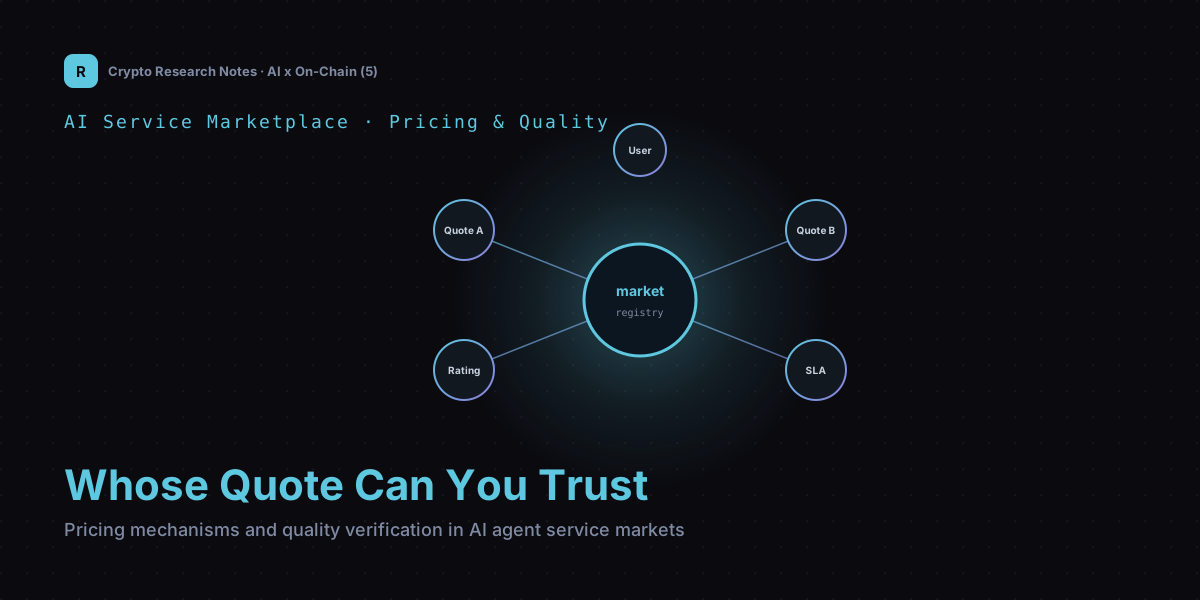
The agent-to-agent settlement discussed in the fourth piece of this series assumed the primary agent already knew exactly which sub-agent to delegate to — some connection had already been established between them, whether a hardcoded address or a one-off discovery step. But as the agent economy develops further, an organizational form closer to a traditional marketplace starts to emerge: many agents offering similar services (data retrieval, price verification, content generation, compute rental) stop existing as scattered individuals and instead register into a public service registry or marketplace protocol. Any primary agent needing that kind of service can broadcast a request to the marketplace, receive quotes from multiple bidders, and select a winner according to some rule. The efficiency promise is compelling: competition should drive prices down and quality up, with the market mechanism automatically doing the price-comparison work that would otherwise require a human.
But handing "comparison shopping" entirely to an automated market mechanism also means the human verification step gets systematically skipped. A human shopping online, even in an open marketplace, instinctively checks seller ratings, review history, and verification badges — those actions compensate for information asymmetry. When the decision-maker is an AI agent instead, whether it has an equivalent or stronger ability to verify, or whether it simply picks based on the lowest price number, determines whether this whole marketplace mechanism ends up rewarding quality or rewarding whoever games the numbers best. The starting point for verifying such a system is figuring out exactly what signals it actually surfaces to agents for decision-making — price alone, or price plus historical fulfillment record, or price plus historical record plus third-party audit flags?
- An open marketplace upgrades point-to-point delegation into one-to-many bidding and matching, theoretically driving down price and up quality through competition.
- Handing comparison-shopping entirely to automated agents means the instinctive human verification of information asymmetry gets systematically skipped.
- The starting point for verification is what decision signals the marketplace actually surfaces to agents: price alone, or price plus fulfillment history and third-party audit information.
2. Manipulation Surfaces in Quoting and Bidding: The Lowest Number Is Not the Lowest Cost
The most obvious risk in an automated bidding marketplace is that the quote itself can be strategically distorted. The most common tactic is "bait pricing": a provider submits a quote well below actual cost to win the job, then recoups the difference through hidden fees, added terms, or degraded service quality at delivery time — if the primary agent's decision logic only looks at the quoted number, and the marketplace protocol has no enforcement that the quote must match the final settled amount, this strategy will persist and dominate the game over time. A subtler form of manipulation is collusion among bidders: several accounts, even under different addresses, might actually be run by the same operator, coordinating quotes to manufacture the appearance of "healthy competition" while keeping prices propped up.
Another easily overlooked manipulation surface is the timing dimension of bidding: if the marketplace protocol lets a bidder revise its quote after seeing other participants' bids (similar to front-running issues common in on-chain MEV scenarios), then what actually determines the winner may not be "who offers the best value" but "who has an information advantage in the asymmetry." Verifiers should ask: is bidding sealed (participants cannot see each other's quotes, preventing front-running and collusion probing), is there an on-chain-enforceable consistency constraint between the quoted price and the final settled amount, and is there any mechanism — or at minimum disclosed caveat — for detecting multiple bidding accounts actually controlled by the same entity.
- Bait pricing (win low, then upcharge or degrade delivery) dominates the game in a marketplace with no consistency enforcement between quote and settlement.
- Colluding bidding accounts manufacturing a false appearance of competition can keep prices propped up well above real cost for a long time.
- Verification direction: is bidding sealed, is there an on-chain consistency constraint between quote and settlement, and is there any collusion-account detection.
3. Service Quality and SLAs: Who Verifies "It Was Actually Done" After Delivery
Even with a perfectly fair and transparent bidding stage, the marketplace mechanism still faces a more fundamental problem: whether the service itself can be verified. On-chain payment is easy to check (did the transfer happen, was the amount correct), but service quality is often subjective, context-dependent, and hard to reduce to a single clean metric — a data-retrieval agent claims it fetched "the latest" data, a content-generation agent claims its output "meets requirements" — these claims are inherently difficult to verify automatically and cheaply. Without an accompanying acceptance process, the practical outcome tends to be "whoever declares delivery first is treated as having delivered," with acceptance authority effectively ceded to the provider itself.
More structured marketplace designs typically introduce some form of service-level agreement (SLA) that breaks "quality" down into measurable, automatable indicators: is response latency within the promised range, does output conform to a required schema, is the data source traceable, has a preset dispute-trigger condition been hit. The value of an SLA isn't eliminating all subjectivity — it's pulling out whatever can be verified automatically to shrink the gray zone of pure trust. Verifiers should ask: does the marketplace define quantifiable SLA metrics, is there a third party or on-chain logic independent of both transacting parties to verify whether metrics were met, is the refund or compensation mechanism for an SLA miss automatic or does it require manual appeal, and how practical and costly is that appeal process in reality.
- The subjectivity of service quality makes it harder to verify than payment, effectively ceding acceptance authority to the provider's own self-declaration.
- A structured SLA breaks quality into measurable, automatable indicators, shrinking the gray zone of pure trust.
- Verification direction: are SLA metrics quantifiable and verifiable, is there an independent party checking whether they were met, and is compensation for a miss automatic.
4. Reputation Score Credibility: How Much Trust Can One Number Carry
Most marketplace mechanisms end up relying on some form of reputation score as the core signal — a composite of transaction count, positive-review rate, and average response time. Its appeal is compressing complex history into a single number easy for agents to act on, but that compression means information loss, and information loss is exactly the space a manipulator can exploit. The most direct manipulation is self-trading: shuffling funds between different wallets to manufacture a large volume of seemingly genuine transactions and positive reviews, quickly inflating a new account's score. If the marketplace has no mechanism for detecting whether transacting parties are actually linked (e.g., a shared source of funds), the marginal cost of farming a score can be close to negligible.
A subtler issue is decay and weighting in the scoring design: a provider that accumulated a large amount of genuine positive history and then declined sharply in quality can keep misleading new principals for a long time if the scoring algorithm doesn't weight recent performance heavily enough. When evaluating any agent service marketplace, researchers should treat "how expensive is it, in practice, to defeat this reputation system" as the core question — not "does a reputation mechanism exist," but how much capital, how many transactions, and how much time it takes to forge a high score, and whether the algorithm reacts quickly to recent negative signals or lets accumulated historical scores provide a long-running backstop.
- Reputation scores compress complex history into a single number; the information loss from that compression is exactly the space a manipulator can exploit.
- Self-trading in a marketplace with no linked-account detection can have negligible marginal cost while quickly inflating a new account's score.
- The right question isn't whether a reputation system exists, but the actual cost of forging a high score and how fast the algorithm responds to recent negative performance.
5. Neutrality of Matching Rules: Is the Ranking Algorithm Just Another Paid Placement
Even after controlling for the risks above, one last and easily overlooked layer of risk remains: whether the marketplace's own matching and ranking rules are neutral. When a primary agent broadcasts a request, the order of the candidate list returned, and the default recommended winner, are typically governed by a ranking algorithm the marketplace operator controls — and the specific weighting of that algorithm, whether paid placement exists, and whether providers affiliated with the marketplace operator itself receive implicit preference, are all extremely hard for an outside observer to verify. This is structurally the same self-preferencing problem seen on traditional internet platforms — except in an on-chain context, where both sides of a transaction leave publicly auditable traces, it's easy to mistake that for proof the transparency problem has already been solved by the technology. But the matching logic itself typically runs off-chain, and on-chain traces only prove a transaction happened, not that it was brokered under genuinely neutral rules.
Verifiers should ask: is the marketplace's ranking or recommendation algorithm publicly auditable, or a complete black box; does the marketplace operator itself also operate or hold a stake in some of the service providers, and if so, is there any conflict-of-interest disclosure or isolation mechanism; is there any way for an independent third-party researcher to reproduce and verify whether, given identical quotes and identical reputation histories, different providers actually receive equal exposure and win probability. If a marketplace protocol can't give a convincing answer here, its claim to let "the best-fit agent win the job" may really just be another way of saying "the agent most willing to pay for exposure, or with the best relationship to the operator, wins the job."
- The weighting of the matching/ranking algorithm and the existence of paid placement or self-preferencing are risks that on-chain transaction traces alone cannot prove or rule out.
- Verification focus: is the ranking algorithm publicly auditable, and does the operator have undisclosed ties to any service providers.
- Without an independent way to reproduce and verify outcomes, a marketplace's "best agent wins" narrative deserves real scrutiny.
6. Verification Checklist and Summary
Consolidating the previous five sections into a reusable checklist, here is what to run through for any protocol claiming to support "open bidding and automated matching for AI agents": First, decision signals — does the marketplace surface only price to agents, or does it layer in fulfillment history and third-party audit information? Second, bidding mechanism — is bidding sealed, is there an on-chain consistency constraint between quote and settlement, and is there any collusion-account detection? Third, service quality verification — are quantifiable SLA metrics defined, and is there an independent party verifying whether they were met? Fourth, reputation credibility — how expensive is it in practice to forge a high score, and how fast does the algorithm respond to recent negative performance? Fifth, matching neutrality — is the ranking algorithm publicly auditable, and does the operator have undisclosed ties to service providers?
Looking back across all five pieces in the "AI x On-Chain" series, each one really examines the same underlying theme in a different setting: as automation increases and manual verification steps get systematically skipped, efficiency gains almost always come at the cost of some ceded verifiability. The first four pieces focused on single-agent authority, a model's role as a source of truth, the limits of proof techniques, and the credit chain between agents; this piece pulls the camera back to the design of the marketplace mechanism itself — because once agent-to-agent collaboration reaches enough scale, even rigorous verification of individual agents can't stop a structural bias at the market level from pulling the entire system's output away from its "best agent wins" promise. The entire piece discusses abstract mechanism categories and methodology only, names no real product or protocol, and is not investment advice of any kind. As the fifth entry in the "AI x On-Chain" series, we'll keep following how these mechanisms evolve — subscribe via RSS for future updates.
- Five-question checklist: completeness of decision signals, bidding mechanism resistance to manipulation, service quality verifiability, reputation credibility, matching neutrality.
- What's distinct here: the lens widens from a single agent or single transaction to the structural design of the marketplace mechanism itself.
- The entire piece is a discussion of abstract mechanism categories and methodology, names no real product, and is not investment advice; the series will keep tracking how the agent economy evolves.