
1. Why Layer2/Rollup Research Needs Its Own Line of Inquiry
Two earlier articles in this series already built durable methodology around trust verification: the bridge-security piece taught researchers to trace custody contracts and validator sets rather than trust a "secured by multi-sig" label, and the contract-security-audit piece taught researchers to identify who actually holds upgrade and admin privileges rather than trust an audit's conclusions. It would be tempting to assume a rollup is simply "a bridge plus a smart contract" and that those two methodologies already cover it. They do not. A rollup introduces trust-assumption layers that neither article was built to examine: who orders transactions before they ever reach the base chain, which cryptographic or economic mechanism actually proves a batch is valid, and how quickly (or slowly) a user can exit if that ordering or proving layer misbehaves.
This article treats those three layers — sequencing, proof system, and exit/upgrade permissions — as the rollup-specific research object. Where a check genuinely reduces to prior methodology, we say so briefly rather than re-deriving it: verifying an emergency exit path reuses the same on-chain custody-tracing habit taught in the bridge article, and verifying who controls an upgrade key reuses the same permission-mapping habit taught in the contract-security article. Everything else here — sequencer censorship resistance, challenge-period enforcement, proof verification location — has no direct precedent earlier in the series and is treated as new ground.
As with every article in this series, the scope here is strictly methodological. We describe abstract categories of rollup design and the general questions a researcher should ask of any one of them; we do not name, identify, or evaluate any specific real rollup, sequencer operator, or proving system. Any numeric figure that appears below — a challenge-period length, a delay window, a signer count — is explicitly invented purely to illustrate the methodology and does not describe any real deployed system. Nothing here is investment advice, and nothing here should be read as an accusation against any named or identifiable project.
2. Sequencer Centralization Risk: Who Actually Orders Your Transactions
Most rollups in production today rely on a single sequencer — frequently operated by the core team itself — that receives user transactions, orders them, and periodically batches that ordering to the base layer. This is a meaningful centralization point that has nothing to do with bridge custody or contract permissions: the sequencer does not hold user funds and is not (usually) an upgrade-key holder, yet it still has real power over a user's experience. A sequencer that orders transactions could, in principle, delay a specific transaction, reorder transactions ahead of a user's own (a form of MEV extraction distinct from the DEX-level MEV covered elsewhere in this series), or simply refuse to include a transaction at all.
The standard mitigation is a "forced inclusion" mechanism: a fallback path, enforced by the base-layer contract itself, that lets a user submit a transaction directly to the base chain if the sequencer will not process it, guaranteeing inclusion after some fixed delay. A researcher's job is not to take the existence of this mechanism on faith. It should be checked concretely: does the rollup's core contract actually expose a forced-inclusion function callable by any address, or does documentation merely describe the concept without a corresponding on-chain entry point? What is the enforced delay before a forced transaction is guaranteed processing — for illustration only, a design might specify something like a 24-hour window, a figure invented purely to demonstrate the check, not a real parameter? And critically, has this path ever actually been exercised on-chain, even once, or does it exist only as unused code? A mechanism that has never been triggered is not proven to work; it is only proven to have been written.
- Identify the sequencer operator and whether sequencing is single-party, rotating, or genuinely permissionless today (not on a roadmap)
- Locate the forced-inclusion function in the base-layer contract, if one is claimed to exist
- Check the enforced delay parameter and whether it is fixed on-chain or adjustable by an admin key
- Search on-chain history for any actual use of the forced-inclusion path, not just its presence in code
3. Fraud Proofs vs. Validity Proofs: Verifying the Two Security Models
Rollups broadly split into two abstract security models, and a researcher needs to know which one a given design uses before any other check makes sense. An optimistic rollup assumes each batch it posts is valid by default and finalizes it only after a challenge period elapses without a successful fraud-proof submission — security here rests on the assumption that at least one honest, capable party is watching every batch and is economically willing to challenge a bad one. A validity-proof (ZK) rollup instead requires a cryptographic proof to be generated and verified before a batch is accepted at all; in principle, no one needs to be "watching," because invalid batches cannot pass verification in the first place.
Each model demands a different verification checklist. For an optimistic design, a researcher should confirm the actual length of the challenge window written into the contract — for illustration only, a design might specify something like seven days, an invented figure — and separately check whether that window has ever actually been used to successfully challenge and reverse a batch, since an unused fraud-proof path proves the incentive design has never been stress-tested. For a validity-proof design, the check shifts to verifying that proof verification genuinely happens on-chain (as opposed to an off-chain attestation the contract merely trusts) and that submitting a valid proof is permissionless — callable by any address, not gated behind an operator-only function.
- Determine which model a given rollup actually uses before applying either checklist
- For optimistic designs: read the challenge-period length directly from the contract, not from marketing copy
- For optimistic designs: search for any historical instance where a fraud proof was actually submitted and succeeded
- For validity-proof designs: confirm the verifier contract executes on-chain and accepts proofs from any caller
4. Withdrawal Delay and Forced-Exit Mechanisms
Ordinary withdrawal timing differs by model and is itself worth documenting: an optimistic rollup withdrawal typically must wait out the same challenge period described above before base-layer finality is reached, while a validity-proof rollup's delay is mostly a function of proof-generation latency rather than a fixed waiting window. Neither of these is the interesting case for a security researcher, though — the interesting case is what happens if the rollup's operator disappears, stalls the sequencer indefinitely, or actively censors withdrawals. That scenario is what a "forced exit" or emergency withdrawal mechanism is meant to solve: a path that lets a user prove their balance and exit funds directly through the base layer, bypassing the normal operator-mediated withdrawal flow entirely.
This is exactly the kind of claim the bridge-security article trained researchers to treat skeptically — in the same way that a bridge's "secured by multi-sig" label had to be broken down into an actual custody contract and signer list, a rollup's "users can always self-exit" claim has to be broken down into an actual contract function, an actual proof format users would need to submit, and confirmation that this path has been used at least once rather than existing only in documentation. A forced-exit mechanism that has never processed a real withdrawal carries meaningfully less assurance than one with a demonstrated on-chain history, regardless of how the whitepaper describes it.
- Distinguish ordinary withdrawal delay (challenge period or proof latency) from emergency forced-exit
- Locate the actual forced-exit contract function, not just its description in documentation
- Check whether the forced-exit path has ever processed a real, on-chain withdrawal
- Note who, if anyone, could disable or gate this emergency path via admin privilege
5. Verifying Upgrade Permissions and Emergency Override Powers
The contract-security-audit article in this series established the core habit of mapping out exactly who holds an upgrade key for a given contract — single key, multisig, or DAO-governed timelock — rather than trusting a project's self-description of its governance. That same mapping exercise applies directly to a rollup's core contracts: the sequencer contract, the proof-verifier contract, and the bridge/exit contract are all, in most current designs, upgradeable, and a researcher should identify concretely which address or governance process can push a new implementation. A single externally-owned key with upgrade rights is a materially different trust assumption than a multisig requiring several independent signers, which is again different from a timelocked DAO vote that gives the community advance notice before any change takes effect.
A second, rollup-specific wrinkle is the "security council": many designs grant a designated group emergency power to bypass the normal challenge window or force through an upgrade faster than the standard governance path, justified as a response to a critical bug or an active attack. This is worth documenting precisely because it is a deliberate, designed centralization point layered on top of an otherwise more decentralized system — the fact that it is rarely or never invoked does not make it disappear as a trust assumption; it only means the assumption has not yet been tested under pressure. A thorough researcher records who sits on any such council, what threshold of members must agree to invoke emergency power, and whether that power has ever actually been exercised.
- Identify the upgrade-key holder for each core rollup contract: single key, multisig, or timelocked DAO
- Check whether a security council exists with power to bypass the normal challenge window
- Record the council's membership and the threshold required to invoke emergency power
- Note whether emergency power has ever actually been used, not just whether it is documented
6. Common Misconceptions and Conclusion
A first misconception is treating "it's a rollup" as a single, uniform security guarantee equivalent to the base layer, regardless of which proof system backs it. An optimistic design and a validity-proof design carry genuinely different trust assumptions, and neither is automatically equivalent to base-layer security merely by virtue of posting data there. A second misconception is conflating a documented mechanism with a tested one: a forced-inclusion path, a fraud-proof window, or a forced-exit function that exists in a contract's code but has never actually been triggered on-chain tells a researcher only that the code was written, not that it works as intended under real adversarial conditions. A third misconception is assuming decentralized sequencing is already live because it appears on a project's roadmap; a roadmap item is a stated intention, not an on-chain fact, and should be checked against the sequencer's actual current operating structure.
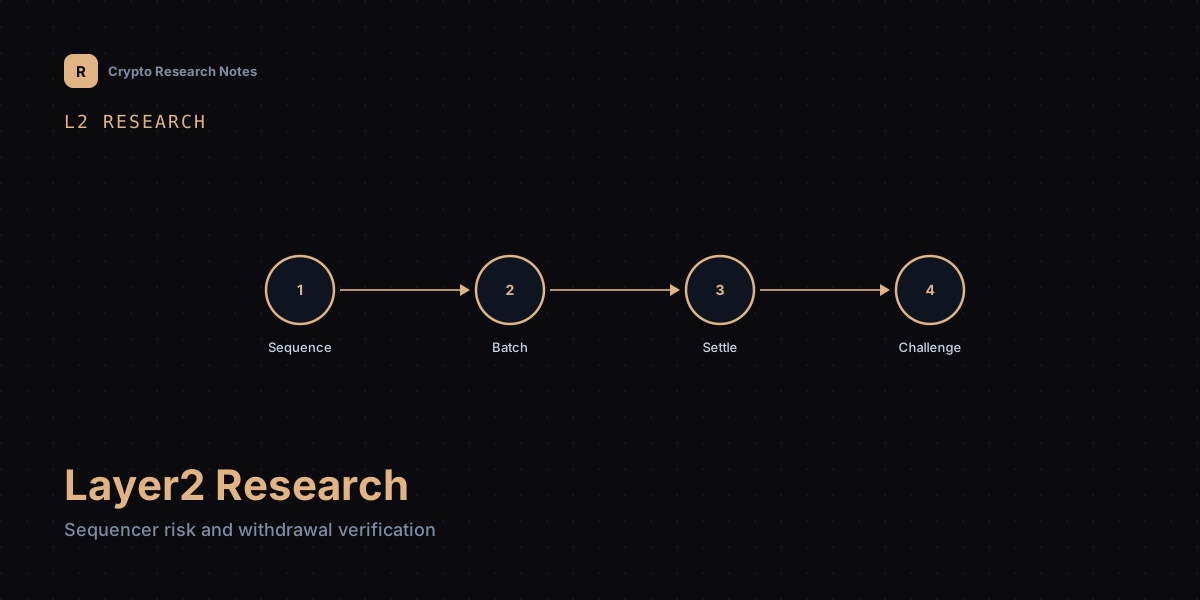
Pulling the four layers together: sequencing determines who can delay or reorder a user's transaction day-to-day; the proof system determines what actually stands behind a batch's claimed validity; the withdrawal and forced-exit path determines whether a user has a real, tested way out if the operator misbehaves; and upgrade permissions — including any emergency-council override — determine who could change all of the above unilaterally. None of these four checks substitute for one another, and none of them substitute for the bridge-custody or contract-permission verification already taught earlier in this series; they extend that same underlying discipline to rollup-specific structures. As throughout this series, everything above describes abstract mechanism categories and general verification questions only, illustrated with invented figures — it does not evaluate any real, named rollup, and it is not investment advice.