
1. A Different Kind of Oracle Problem
A price-feed oracle answers a question that is, in principle, mechanical: what is the current spot price of an asset across a set of venues? The value exists continuously, is observable by anyone with market data access, and converges across sources within a narrow tolerance. Verification reduces to checking aggregation methodology, update latency, and source diversity — the underlying fact is not in dispute, only its faithful reporting. A prediction market resolver faces a categorically different task: it must determine whether a discrete real-world event occurred, often based on incomplete, delayed, or contested information, with no continuously-observable ground truth to check against.
This distinction matters because the entire verification playbook built for price oracles — redundant data sources, deviation thresholds, heartbeat updates — does not transfer cleanly to event resolution. There is no median of five news outlets that resolves whether an ambiguous contract clause was breached, or whether a contested election outcome is final. The resolver is not reporting a number; it is rendering a judgment, and judgment is where subjectivity, delay, and manipulation incentives enter. Any framework for evaluating a prediction market must therefore start by asking not 'how accurate is the data feed' but 'who is making this judgment call, and what constrains them.'
- Price oracles report an observable number; event resolvers render a judgment — the verification methods are not interchangeable.
- Ambiguous or contested real-world events have no objective ground truth to check a resolver's output against.
- Evaluating a prediction market starts with identifying who makes the resolution judgment and what constrains them, not with data-feed accuracy.
2. The Propose-and-Dispute Mechanism
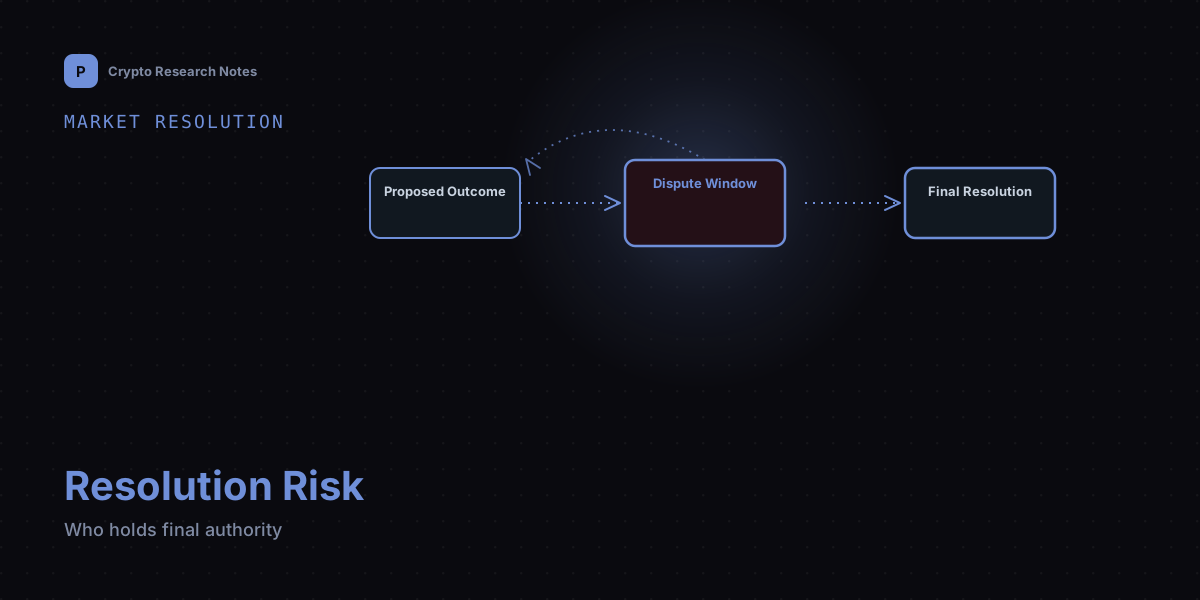
Most decentralized prediction markets resolve outcomes through a propose-then-challenge flow rather than a single authoritative report. A party — sometimes anyone willing to post a bond, sometimes a designated reporter role — submits a proposed outcome once the underlying event has concluded. This opens a challenge window: a fixed period during which any observer who disagrees can post a dispute bond, triggering escalation to a higher-authority adjudication step. If no one challenges within the window, the proposed outcome finalizes automatically and funds settle accordingly. The design assumes that economically rational disputers will police incorrect proposals, making silence during the window a proxy for correctness.
That assumption only holds if challenging is actually accessible and worthwhile. Three parameters determine this: the length of the challenge window, the size of the bond required to dispute, and the value at stake in the market. A short window gives observers little time to notice and organize a challenge, especially across time zones or for events resolved outside normal business hours. A large bond requirement — even one nominally set to deter frivolous disputes — can simultaneously price out the ordinary users most likely to notice a wrong proposal, leaving only large, well-capitalized actors with practical standing to dispute. Reading these three parameters together, rather than in isolation, is the first concrete check.
- Propose-and-dispute relies on someone finding it worthwhile to challenge a wrong outcome during a fixed window.
- Challenge window length and dispute bond size jointly determine who can realistically police a bad proposal.
- A bond set to deter spam can also deter the legitimate disputers the mechanism depends on.
3. Who Holds Final Adjudication Authority
When a dispute escalates past the initial challenge window, some final backstop must render a binding decision, and its structure varies widely across designs: an on-chain vote weighted by governance-token holdings, a small centralized arbitration committee, or a dedicated decentralized arbitration protocol built specifically for cross-application dispute resolution. Each model carries a different trust assumption. A token-weighted vote assumes large holders act as neutral arbiters; a committee assumes a small set of named or pseudonymous individuals are both competent and disinterested; a dedicated arbitration layer assumes its own incentive design (staking, slashing, cross-case reputation) is sound and hasn't itself been captured.
The verification question that matters is not which category is used but whether the adjudicator's incentives track truth-finding independent of the outcome. This breaks down when the same large token holders who vote on disputes are also sizable traders in the market under dispute — a structural conflict where ruling in one's own favor is a rational, undetectable action rather than an aberration. It also breaks down when a committee's membership overlaps with a protocol's founding team or investors who have a stake in a particular resolution outcome for reasons unrelated to the facts. Checking for these overlaps, not just confirming that a mechanism exists, is the actual due-diligence step.
- Final adjudication takes different forms — token vote, committee, dedicated arbitration protocol — each with distinct trust assumptions.
- The real question is incentive alignment with truth-finding, not merely which adjudication category is used.
- Overlap between adjudicators and market participants creates a structural conflict of interest that is easy to overlook.
4. Verifying the Transparency of Evidence
A resolution is only as trustworthy as the evidence a resolver cites in support of it. The first check is traceability: does the proposed outcome point to a specific, checkable source — an official results page, a named news report, a timestamped announcement — or does it rest on an unsubstantiated assertion of the resolver's personal judgment with nothing an outside observer can independently verify? Traceable evidence lets a disputer contest the resolution on its merits within the challenge window; an assertion without a citable source effectively forces disputers to argue against a black box, which discourages exactly the challenges the mechanism depends on to catch errors.
The second check applies specifically to genuinely ambiguous events — a sports result later overturned on review, an election result subject to recount or legal challenge, an economic data point subsequently revised. Does the protocol have pre-specified rules for handling these cases (for example, a defined cutoff time after which later corrections are ignored, or an explicit reference to a single canonical source of record), or is the treatment of ambiguity left entirely to whatever the resolver decides in the moment it happens to propose? Pre-specified rules constrain discretion before anyone has a financial stake in a particular outcome; ad hoc discretion invites post hoc rationalization once the stakes are known.
- Traceable, citable evidence lets disputers evaluate a proposed outcome; bare assertions of judgment do not.
- Pre-specified rules for ambiguous events constrain discretion before financial stakes are known.
- Discretion exercised after outcomes and money are already at stake is far more vulnerable to bias.
5. Stress-Testing Manipulation Cost: A Fictional Example
Consider an entirely fictional, illustrative market with no correspondence to any real protocol: $5,000,000 in total volume, a proposed-outcome challenge window of 48 hours, and a dispute bond of $20,000. A large trader holding a position that benefits from a false proposed outcome faces a straightforward calculation — post the (comparatively small) proposal cost, and the only way to be stopped is if some other party notices within 48 hours and is willing to risk $20,000 to dispute. If the true outcome is genuinely ambiguous or slow to become publicly evident, the 48-hour window may simply elapse before enough outside observers even become aware a market needs checking, let alone organize a challenge.
In this fictional scenario, the manipulation cost is not the $20,000 bond itself — a proposer who is confident no one will dispute never pays it — but the expected cost of the bond multiplied by the probability of being challenged and losing. If the trader's position gain from the false outcome exceeds that expected cost, pushing the false proposal through is rational. This shows why market size, bond size, and window length must be read jointly: a $20,000 bond is a meaningful deterrent against a $50,000 position but negligible against a multi-million-dollar one, and a 48-hour window that is generous for a domestic sports score may be inadequate for a contested cross-border event report. All figures here are illustrative only.
- Manipulation cost is the expected cost of the dispute bond weighted by the probability of a challenge, not the bond amount alone.
- The same bond and window can be an effective deterrent at one market size and negligible at another.
- All figures in this section are fictional and illustrate a method, not a claim about any real market.
6. Common Misconceptions and Summary
Three errors recur when evaluating decentralized prediction markets. First, treating outcome resolution as an objective, automated process analogous to a price oracle, when real-world event adjudication inherently carries subjectivity, interpretation, and dispute risk that no amount of aggregation eliminates. Second, taking language such as 'decentralized resolution' or 'community governance vote' at face value as a guarantee of fairness, without checking whether the identities of final adjudicators overlap with large market participants in ways that create a direct incentive to rule in their own favor. Third, skipping the evidentiary check entirely — never asking whether the sources behind a resolution are traceable, or whether the protocol has pre-specified rules for handling genuinely ambiguous or contested events rather than leaving it to a resolver's in-the-moment discretion.
The throughline across this article is that resolution mechanics — who proposes, who can dispute and at what cost, how long the window runs, and who holds final authority — determine a prediction market's real risk profile far more than its trading interface or liquidity design ever will, and most of this structure is invisible unless a user goes looking for it. This article discusses abstract categories of resolution mechanism only; it does not name, evaluate, or endorse any real protocol, and the numeric example in Section 5 is a fictional illustration of a method, not a description of any actual market. Nothing here constitutes investment advice.
- Event resolution is inherently subjective and dispute-prone; treating it as an automated oracle process is the core misconception.
- Decentralization or governance-vote language does not by itself rule out adjudicator-participant conflicts of interest.
- This article covers abstract mechanism categories only, uses fictional figures, names no real protocol, and offers no investment advice.