
1. Why a Liquid Staking Token Is a Claim on a Validator, Not an Instantly Redeemable Asset
A liquid staking token is often described, informally, as "the same asset, just liquid." That framing skips over what the token actually represents. When a holder deposits the underlying asset into a liquid staking protocol, the deposit does not sit in a vault waiting to be handed back on demand. It is delegated to a validator or a set of validators, bonded into the base-layer consensus process, and put to work producing blocks and attestations. The liquid staking token minted in return is a receipt representing a proportional claim on that bonded principal plus whatever staking rewards accrue to it over time — not a redeemable balance held in reserve.
This distinction matters because two very different things can both be true at once: the token itself can be freely transferable and instantly tradable on a secondary market the moment it is minted, while the underlying claim it represents remains subject to the base-layer protocol's own rules for how staked assets are unbonded and returned. Those rules typically include a validator exit process and an unbonding or withdrawal period measured in days, not seconds. A researcher evaluating a liquid staking design should treat "the token trades" and "the underlying is redeemable right now" as two separate facts, verified separately, rather than assuming the first implies the second.
A useful mental model is to separate the token's two identities: as a tradable instrument, it behaves like any other liquid asset on a secondary market; as a claim, it behaves like a position in a queue governed by validator-set mechanics the holder does not directly control. Everything that follows in this article — pricing behavior, slashing exposure, operator concentration, and stress scenarios — flows from keeping those two identities distinct rather than collapsing them into one.
- A liquid staking token is a receipt for bonded principal plus accrued rewards, not a stored balance.
- Tradability on a secondary market is independent from redeemability of the underlying at the protocol level.
- Treat "the token trades freely" and "the underlying is redeemable now" as separately verified claims.
2. Why the Price Deviates From 1:1: Instant Secondary-Market Liquidity vs. the Native Redemption Queue's Speed
The stablecoin peg article in this series established a method for a different asset class: verify that the arbitrage loop tying a market price back to $1 actually works at the speed and scale a real stress event would demand, not merely on paper. Liquid staking tokens carry a structurally similar gap, even though nothing here is pegged to a fiat unit — the reference point is the underlying staked asset's redemption value rather than a dollar.
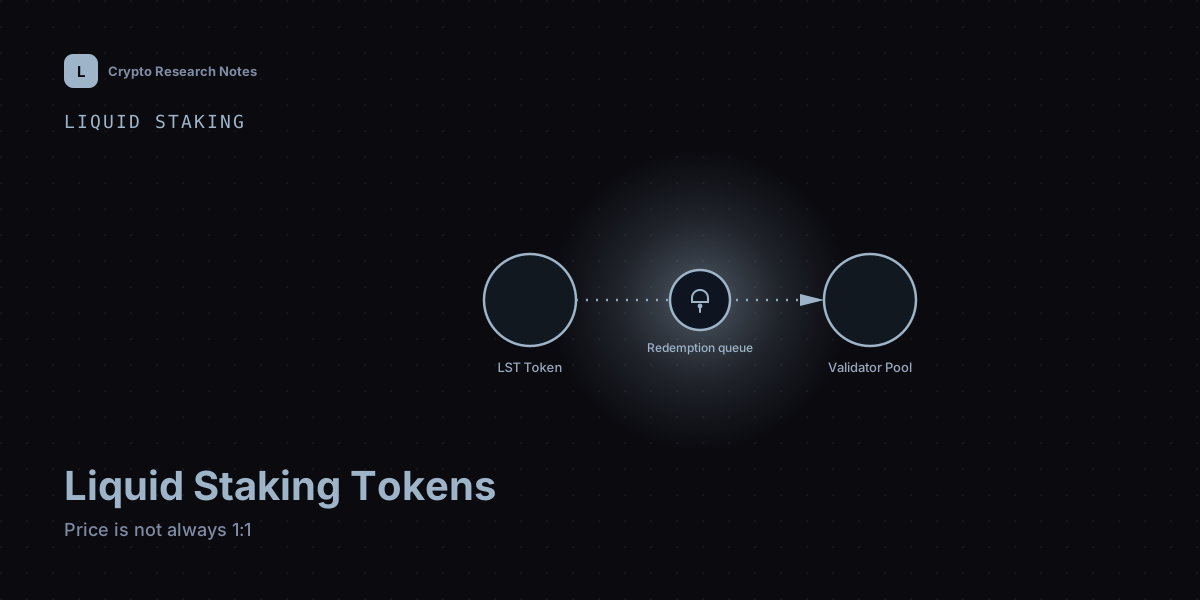
Two exit paths exist for a liquid staking token holder, and they move at very different speeds. The first is the secondary market: selling the token instantly into an AMM pool or order book, at whatever price the pool currently supports. The second is the native path: initiating an unstake through the protocol itself, which typically requires the underlying position to work through a validator exit queue and an unbonding period before the underlying asset is returned. Under normal conditions, arbitrageurs keep the secondary-market price close to the redemption value precisely because the native path, while slower, is reliably available — anyone can buy the token below its redemption value and eventually redeem it for a small profit, and that activity narrows the gap.
That arbitrage relationship breaks down exactly when it is needed most. If a large share of holders want out at once, secondary-market sell pressure hits AMM pool depth immediately, while the native redemption path's queue length is fixed by validator-exit throughput and does not accelerate to match demand. The result is a widening discount: the token trades below its redemption value not because the underlying claim has changed, but because instant liquidity is scarce relative to a queue that cannot be rushed. A researcher should check both the current discount and how AMM pool depth compares to the size of positions that could plausibly want to exit together.
- Two exit paths exist — instant secondary-market sale and the slower native unstaking queue — and they move at different speeds.
- Under calm conditions, arbitrage between the two paths keeps the secondary-market price close to redemption value.
- Under stress, AMM depth is exhausted quickly while the native queue's throughput is fixed, widening the discount.
3. How Slashing Risk Propagates: Does One Validator's Failure Get Shared Proportionally Across All Holders
The restaking article in this series covered a related but distinct question: how many independent slashing conditions sit behind a single restaked position once it is committed to multiple services at once. Liquid staking raises a narrower version of the same underlying concern — not how many slashing conditions exist, but how a loss from any one of them is distributed once it occurs.
Most liquid staking designs pool deposits across many validators and express a holder's claim as a proportional share of the total pool, typically reflected through an exchange rate between the liquid staking token and the underlying asset rather than a fixed 1:1 redemption. When a single validator in that pool is slashed for downtime, equivocation, or another protocol-defined fault, the loss is usually not isolated to whichever depositor happened to be delegated to that specific validator. Instead it reduces the pool's total backing, which is typically reflected as a small downward adjustment to the exchange rate applied to every holder proportionally — socialized loss rather than isolated loss.
That socialization is a design choice with real consequences a researcher should verify rather than assume. Key questions: is proportional loss-sharing actually disclosed in the protocol's own documentation, or only inferable from contract code; does the protocol maintain an insurance fund, treasury buffer, or operator-posted collateral meant to absorb small slashing events before they touch the exchange rate at all; and, when a past slashing event did occur, can the resulting exchange-rate adjustment actually be traced on-chain, or does the protocol simply state that it happened. A protocol able to show a slashing event's exact effect on the exchange rate, block by block, offers meaningfully stronger evidence than one that asserts loss-sharing works without a traceable instance.
- Slashing losses are typically socialized proportionally across all holders via the exchange rate, not isolated to one validator's depositors.
- Check whether proportional loss-sharing is explicitly disclosed, not just inferable from contract code.
- Check for an insurance fund or operator-posted buffer, and whether any past slashing event's exchange-rate impact is traceable on-chain.
4. Verifying Operator/Validator Concentration: Who Actually Controls the Staked Assets
The restaking article's operator-concentration check applied to entities running infrastructure across multiple services at once. The same lens applies to liquid staking directly, without the multi-service layer: a liquid staking protocol still has to decide which validators actually receive delegated stake, and that decision is made by a relatively small governance or operational process on behalf of every depositor, not by each depositor individually.
Concentration here creates two related but separable risks. The first is censorship resistance at the base layer: if a small number of node operators end up running validators that collectively control a large share of a network's total stake — whether through one liquid staking protocol's own concentration or through the combined footprint of several protocols delegating to overlapping operators — that concentration can approach thresholds where coordinated censorship or chain-level influence becomes theoretically possible, independent of any single protocol's own intentions. The second is correlated slashing risk: operators frequently run standardized client software and infrastructure across the validators they control, so a single software bug, misconfiguration, or infrastructure outage can trigger simultaneous faults across every validator that operator runs, rather than one isolated failure.
A researcher should look for concrete disclosure rather than a general claim of decentralization. That includes the actual distribution of delegated stake across operators, expressed as a share held by the largest handful; the process by which new operators are admitted or existing ones are removed, and how much discretion sits with a governance body versus an open permissionless process; and client and infrastructure diversity — whether operators are meaningfully spread across different validator client software and hosting environments, or concentrated on the same stack, which would let a single bug affect the entire delegated set at once.
- Check delegated-stake concentration among the top operators, not just the protocol's total validator count.
- Check the operator admission/removal process and how much discretion sits with governance versus an open process.
- Check client and infrastructure diversity — shared software or hosting stacks turn one bug into a correlated fault.
5. Stress-Testing Mass Redemption: What Instant Secondary-Market Tradability Conceals
The pieces covered so far — the redemption-speed mismatch, socialized slashing, operator concentration — combine most visibly during a mass-exit event, which a researcher should explicitly model rather than treat as too remote to bother with. The mechanism is straightforward: a shock — a slashing incident, a governance controversy, or a broader market panic — pushes a large share of holders toward the exits simultaneously, and the two exit paths described earlier absorb that demand very differently.
Consider a purely fictional scenario, with every figure invented solely to illustrate the method and not drawn from any real protocol. A liquid staking token has 500 million units outstanding, backed by an underlying redemption value of 1.00 per unit. Its main AMM pool holds the equivalent of 15 million units of two-sided depth. A slashing incident affecting a handful of operators triggers exit demand equal to 8% of outstanding supply — 40 million units — within a short window. Holders selling into the AMM exhaust its depth several times over; the pool's pricing curve pushes the trade price down sharply, and by the time the initial wave is absorbed, the secondary-market price sits well below the 1.00 redemption value, invented here as a roughly 6% discount. Holders who instead queue for native redemption face a different constraint: validator exit throughput caps how much stake can be unbonded per unit time, so even though their claim is, in principle, fully backed, an invented queue length of roughly two weeks becomes the real limiting factor on when they actually receive the underlying asset.
The instructive point is that the two prices — secondary-market and "fair" redemption value — can diverge substantially even when the protocol remains fully solvent on paper. A researcher stress-testing a liquid staking design should explicitly model AMM depth against plausible exit-demand sizes, and separately estimate native queue length under a comparable stress scenario, rather than relying on the calm-market discount as representative of stressed conditions.
- Model AMM pool depth against a plausible mass-exit demand size, not just current trading volume.
- Recognize that native redemption remaining "fully backed" does not mean it remains fast — queue length is the real constraint under stress.
- All figures above are invented for methodology illustration only and describe no real protocol.
6. Common Misconceptions and Conclusion
A few recurring misreadings are worth naming directly. First, treating a liquid staking token's current secondary-market price as proof of accurate 1:1 backing — as the earlier sections showed, the market price and the underlying redemption value can diverge meaningfully under stress even when the protocol's accounting is entirely correct. A calm-market price close to 1:1 mainly reflects that no one has recently tested the AMM's depth, not that the peg is structurally guaranteed. Second, treating a completed smart-contract audit as equivalent to an absence of economic or liquidity risk. An audit can verify that the contract code executes as written; it says nothing about whether AMM depth is sufficient for a mass exit, whether operator concentration is high, or whether slashing loss-sharing is disclosed honestly — security and economic soundness are different questions requiring different evidence. Third, dismissing operator concentration because a protocol is "decentralized in theory" — a permissionless operator-admission process on paper does not guarantee a diversified operator set in practice, and the actual distribution of delegated stake, not the theoretical openness of the process, is what determines correlated-slashing and censorship risk.
Taken together, liquid staking token research applies the same discipline used elsewhere in this series: the redemption-speed mismatch borrows directly from the peg-verification method used for stablecoins, and the operator-concentration and slashing questions extend the concentration and risk-aggregation checks introduced for restaking. A liquid staking token is a claim on a validator set's performance, mediated by an exchange rate and a redemption queue, not a risk-free liquid twin of the underlying asset. Verifying it means checking AMM depth against plausible exit demand, confirming how slashing losses are actually distributed and buffered, and mapping operator concentration directly rather than accepting a decentralization claim at face value. As with the rest of this series, this article discusses abstract mechanism categories only, names no real liquid staking protocol, token, or operator, and every figure used in illustrative examples above is invented for methodology purposes. Nothing here constitutes investment advice.
- Misconception: secondary-market price near 1:1 proves accurate backing rather than merely reflecting untested AMM depth.
- Misconception: a smart-contract audit substitutes for evidence about economic and liquidity risk.
- Misconception: theoretical decentralization of the operator-admission process guarantees an actually diversified operator set.