
1. Why Restaking Is a Distinct Research Question
This series has already covered two adjacent yield mechanisms. The liquidity-mining article covered decomposing a headline APY into real fee income versus token-emission subsidy, and spotting mercenary capital that only shows up for the rewards. The vote-market article covered lock-based governance mechanisms and the tendency for voting power — and the aggregator platforms that intermediate it — to concentrate among a small number of addresses. Restaking is a different mechanism from both, and it deserves its own line of research rather than being treated as a variant of either.
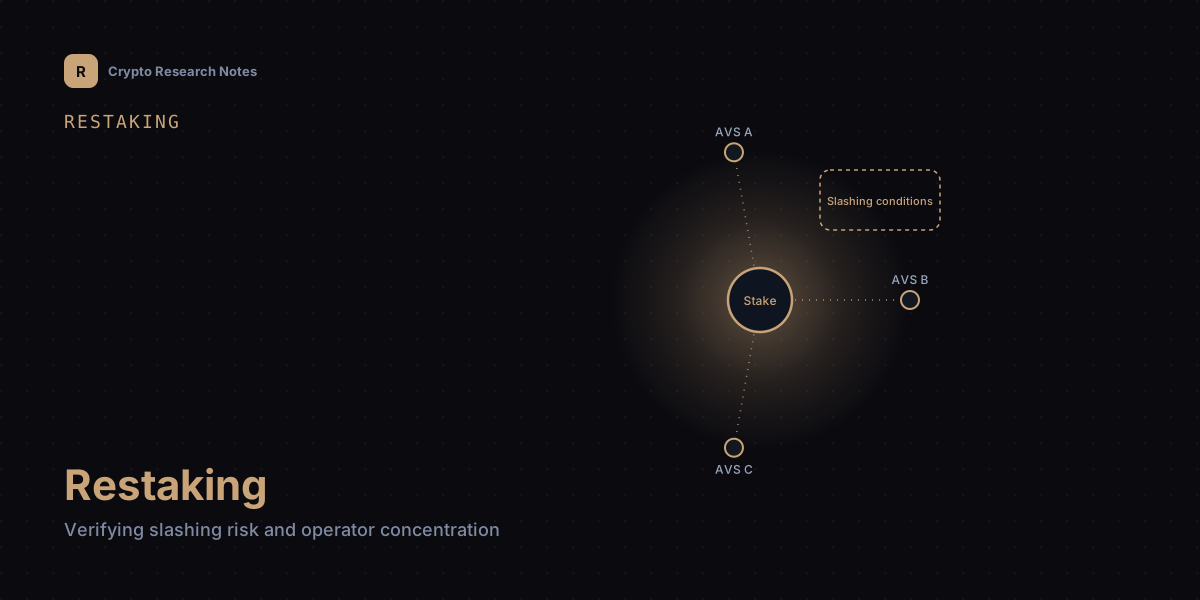
The basic idea: a researcher takes an asset that is already staked to secure a base-layer network, and locks that same staked position again to additionally secure one or more other services — commonly grouped under the abstract label "actively validated services," or AVS, used here purely as a category, not a reference to any real protocol. In exchange, the position earns additional yield on top of its base staking return. This is neither a governance-lock question (nothing is being voted on) nor a pure LP-yield question (there is no pooled asset pair or price divergence). It is a question about re-pledging the same collateral to multiple, independent commitments at once, which introduces its own composition and risk profile.
- Scope boundary: every mechanism, figure, and example below is invented purely to illustrate a category — "a given restaking protocol," "a given AVS" — not a claim about any real project.
- Distinct from vote-locking: no governance power is being exercised or aggregated.
- Distinct from LP yield: no pooled asset pair, no impermanent loss dynamic.
2. Decomposing Restaking Yield: Base Layer Plus Stacked AVS Rewards
A restaking position's yield is typically presented as a single blended APY, but it is actually a stack of separable layers. At the bottom sits the base staking yield — the relatively stable return earned for securing the underlying network, largely independent of restaking activity. On top of that sit one or more AVS reward layers, each paid by a different service in exchange for that service borrowing the same staked collateral's security guarantee.
The same decomposition discipline from the liquidity-mining article applies here: each AVS reward layer needs to be independently verified as either real economic activity — genuine fee revenue the AVS generates from the service it provides — or a token-emission subsidy funded by inflating that AVS's own token, which says nothing about durable demand. A researcher who only reads the combined number cannot tell which layers are load-bearing and which evaporate once emissions taper.
Consider a purely fictional example, invented only to illustrate the method: a position advertises a "blended APY of 9.2%." Decomposed, that might be 3.5% base staking yield, 2.1% from an AVS reward layer tied to a fee-generating oracle-style service, and 3.6% from a second AVS layer paid entirely in that AVS's own newly issued token. Only the first two components reflect verifiable, ongoing economic activity; the third is a subsidy that persists only as long as the emission schedule and token price hold up.
- Base staking yield: stable, tied to the underlying network, largely independent of restaking.
- AVS reward layer: verify per-layer whether it is fee revenue or token emission.
- A single blended APY hides which layers are durable and which are subsidized.
3. Verifying Slashing Risk Aggregation: More Yield Layers, More Ways to Lose Principal
This is the risk that restaking introduces and that neither vote-locking nor LP yield share: the same underlying stake now simultaneously backs multiple, independent slashing conditions. Each AVS a position opts into defines its own rules for what counts as a fault — downtime, incorrect attestations, equivocation, or service-specific misbehavior — and each of those rules can trigger a slash against the same collateral, not against some separate pool set aside for that AVS.
The consequence is that stacking reward layers also stacks independent failure modes on top of one principal. A fault in any single AVS, even one contributing a small slice of the blended yield, can slash the underlying stake in full or in part — the loss is not capped at forfeiting that AVS's own reward layer. A researcher evaluating a restaking position should therefore count the number of independent slashing conditions the position is actually exposed to, not just read the combined headline yield. A position secured by one AVS carries one slashing surface; the same position opted into five AVS carries five, each governed by different code, different operational requirements, and different failure histories.
- Slashing conditions are per-AVS but apply to the same shared collateral.
- A fault in any one AVS can slash the full position, not just that AVS's reward layer.
- Verification step: enumerate independent slashing conditions per position, not just the summed APY.
4. Liquid Restaking Tokens and the Discount-to-Redemption Check
Because a restaking position is otherwise locked, many implementations issue a liquid restaking token (LRT) — a receipt token representing a claim on the underlying restaked position and its accrued yield — so the holder can trade or deploy it elsewhere while the underlying stays locked and slashing-exposed. Official documentation often frames the LRT as effectively pegged 1:1 to its underlying redemption value, but that framing describes an accounting entitlement, not a market guarantee.
A researcher should instead check the LRT's actual secondary-market trading price against the redemption value it represents. When an LRT trades at a persistent discount, that gap is frequently the market pricing in exactly the risks covered above: aggregated slashing exposure across multiple AVS, uncertainty about operator behavior, or simply thin secondary-market liquidity for exiting the position quickly. A purely illustrative example: an LRT with a stated redemption value of 1.00 unit of the underlying asset trading at 0.97 on the open market reflects a roughly 3% liquidity/trust discount — a signal worth investigating, not a rounding error to ignore. Widening discounts over time, especially around AVS-specific incidents, are a more informative signal than the discount level at any single moment.
- LRT = receipt token for a restaked position, not a separate risk-free asset.
- Check actual market price against redemption value, not the assumed 1:1 peg.
- A persistent or widening discount often prices in slashing and operator risk.
5. Operator Concentration and the Shared Attack Surface
The vote-market article flagged a hidden centralization risk in aggregator platforms that intermediate voting power for a large share of participants. Restaking has a structural echo of that pattern, but the concentrated resource is operational infrastructure rather than voting power. Actual node operation — running the software that performs AVS tasks and stays within each service's slashing conditions — is delegated to a relatively small set of entities usually called "operators." A restaked position's holder chooses which operator secures their stake, but in practice a small number of operators end up running infrastructure for a large majority of restaked value across many AVS at once.
That concentration matters because it converts an operational failure into a cross-AVS event. If one operator running infrastructure for several unrelated AVS suffers downtime, a software bug, or a compromise, every AVS it services can trigger its own slashing condition against every position delegated to that operator, simultaneously. A purely illustrative example, invented for this discussion only: the top five operators in a given restaking ecosystem running roughly 60% of restaked node infrastructure network-wide. A researcher should check operator distribution the same way the vote-market article checked aggregator concentration — as a proxy for how much shared risk sits behind a seemingly diversified set of AVS.
- Operators run the actual infrastructure; delegation choice concentrates real operational risk.
- One operator's failure can cascade slashing events across every AVS it services.
- Check top-operator share of restaked value, echoing the vote-aggregator concentration check.
6. Common Misconceptions and Conclusion
A few recurring misreadings are worth naming directly. First, treating a stacked, blended APY as simply "more yield for free" — every additional AVS reward layer accepted is also an additional, independent slashing condition accepted against the same principal, not a costless add-on. Second, assuming an LRT is always redeemable at a clean 1:1 peg because a project's documentation says so; the secondary market, not the documentation, is the honest source for what the position is currently worth. Third, overlooking operator concentration as a source of correlated risk — a portfolio that looks diversified across many AVS can still be running on a handful of shared operators, meaning a single operational failure can slash across all of them at once.
Put together, restaking research means applying the yield-decomposition discipline from the liquidity-mining article to each AVS reward layer individually, applying the concentration-verification instinct from the vote-market article to operator distribution, and — specific to this mechanism — explicitly counting how many independent slashing conditions now sit behind one pool of collateral. As with the rest of this series, everything above is a methodology framework built on invented figures and abstract categories; it is not an evaluation of, or claim about, any real restaking protocol, AVS, or operator, and nothing here is investment advice.
- Misconception: a stacked APY is risk-free extra yield rather than more slashing surface.
- Misconception: an LRT is always worth exactly its stated redemption value.
- Misconception: many AVS automatically means diversified risk, regardless of shared operators.