
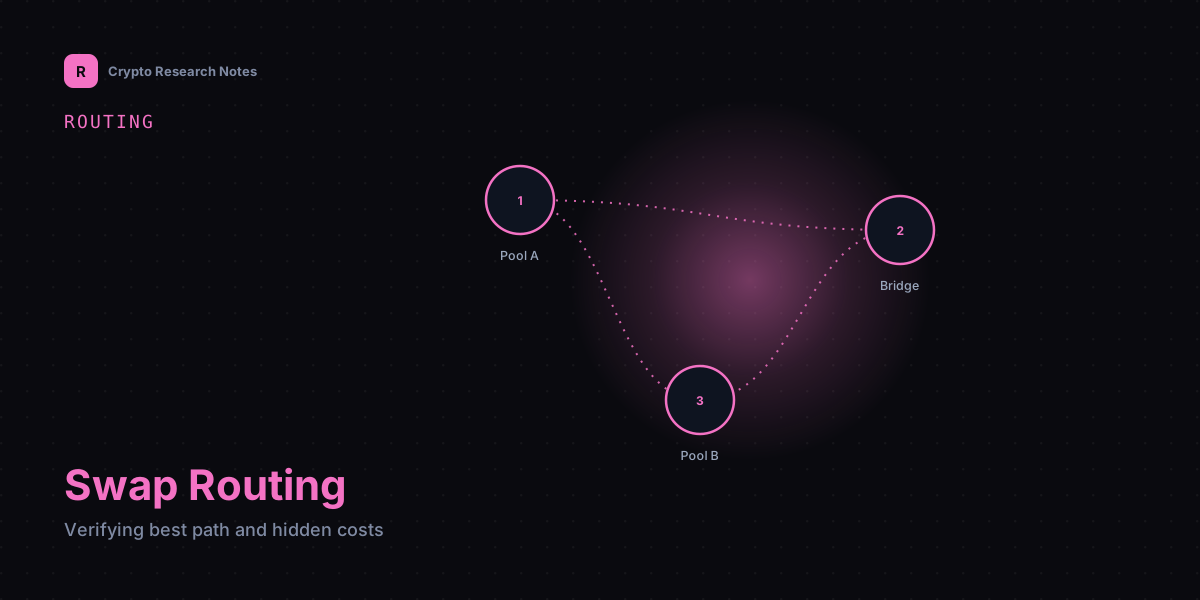
1. Why Routing and Aggregation Need Their Own Research Lens
Two earlier pieces in this series each looked at one layer of a swap. The DEX liquidity article examined how price impact and slippage behave inside a single pool, and how a researcher verifies depth before trusting a quoted price. The bridge security article examined how a single bridge custodies funds in transit and how its validator or multisig trust model can be checked. Neither question, on its own, answers what happens when a trade cannot be filled by one pool or one bridge and must instead be split, sequenced, or routed across several of them to reach a destination asset or chain.
That is the layer this article covers: aggregation and routing. When a swap aggregator claims to have found the "best path" across dozens of pools and several chains, a researcher needs a way to check that claim rather than accept it as given. This involves understanding how a routing engine actually compares candidate paths, how the real cost of a multi-step route differs from its headline quote, and how the aggregator itself — as a piece of software with its own permissions and incentives — fits into the trust picture.
The scope here is strictly methodological. All figures, route structures, and aggregator behaviors described below are abstract and invented purely to illustrate a category of verification technique; no real aggregator, bridge, or protocol is named or implied. The goal is a repeatable checklist a researcher can apply to any aggregator, not an evaluation of any specific one. Three questions anchor the rest of this piece:
- How does a routing engine choose between a direct swap and a multi-hop path?
- What is the true net cost of a route once slippage, bridge fees, and gas are all accounted for?
- What trust does the aggregator itself hold over funds while a route is executing?
2. How an Aggregator Computes a "Best Path"
A routing engine's core job is comparing candidate paths for a given trade and ranking them by expected output. The simplest candidate is a single-hop direct swap: moving straight from asset A to asset B through one pool. If that pool has thin depth for the requested size, the nominal price the trade would receive there can be worse than splitting the same trade across multiple pools, or routing it through an intermediate asset, or crossing to another chain entirely where deeper liquidity exists for that pair. Multi-hop routing exists precisely to work around single-pool depth limits — a problem the DEX liquidity article already framed as verifying depth within one pool; aggregation is what happens when no single pool has enough of it.
Consider a purely fictional example, invented only to illustrate the mechanism. A researcher wants to swap 1,000 units of Asset A for Asset C. A direct A-to-C pool exists but is shallow, and a full-size trade there would move the price substantially. An aggregator instead splits the order: 600 units route through a deeper A-to-B pool on the same chain, then B-to-C on a separate pool, while the remaining 400 units route directly through the thin A-to-C pool up to the point where its price impact becomes unfavorable. In principle this split can produce a better blended nominal rate than sending the full 1,000 through either path alone.
- Single-hop: fewer moving parts, but capped by one pool's depth.
- Multi-hop: can access deeper liquidity elsewhere, at the cost of additional steps.
- Cross-chain multi-hop: may also require an underlying bridge leg, adding another cost and trust layer.
The next section addresses why that better nominal rate is not the same thing as a better net amount actually received.
3. Verifying the Hidden Costs Behind the Quoted "You Receive" Number
An aggregator's interface typically displays a single "estimated receive" figure before a trade is submitted. This number is a theoretical quote calculated at request time, and a researcher should treat it as a starting point rather than a promise. Three separate cost components sit between that quote and the amount actually settled in the destination wallet: the route's realized slippage as it executes against live pool states, any fee charged by the underlying bridge for the cross-chain leg, and gas that must be reserved to complete remaining execution steps on the destination chain — the aggregator's own routing fee, if disclosed separately, is a fourth. A researcher who only reads the headline figure is not seeing the full cost stack.
A purely fictional example illustrates the decomposition. Suppose a route quotes 100 units of receive value for a given trade. By the time the trade executes, realized slippage across the hops accounts for roughly 2 units, an underlying bridge charges a 0.3% fee on the transferred value, and the destination chain requires a small reserve of the receive asset (or a separate gas token) to finalize the last step, worth perhaps another 0.7 units in this example. Summed together, the actual net receipt lands closer to 97 units rather than the 100 originally quoted — a gap of roughly 3%, invented purely to illustrate the exercise, not a claim about any real route.
- Realized slippage: the difference between quoted and executed price across all hops.
- Underlying bridge fee: whatever the cross-chain leg itself charges, separate from the aggregator's fee.
- Destination gas reserve: value withheld or required to complete final settlement.
A researcher should ask an aggregator, or independently reconstruct, all three figures before treating any quote as final.
4. The Hop-Count Tradeoff: More Hops Is Not Automatically Better
Because a routing engine ranks candidate paths by nominal expected output, it can be drawn toward routes with more hops if those routes show a marginally better headline number. But each additional pool or bridge crossed adds its own fee, its own slippage exposure, and its own execution risk. A four-hop route that looks best on paper can still net less than a two-hop route once every intermediate cost is totaled, and it carries a higher chance that one leg fails, stalls, or settles at a worse price than expected partway through — a risk that does not show up in a single quoted percentage at all.
A researcher evaluating two candidate routes should compare them on net proceeds and execution risk together, not on the aggregator's displayed nominal-price ranking alone. A route quoting a fractionally better rate through five hops across three pools and a bridge crossing may be strictly worse, once costs and failure risk are counted, than a simpler route through two pools that quotes a slightly lower nominal price but completes reliably in one or two steps. Partial execution is a particular concern in multi-hop cross-chain routes: if a later leg fails after an earlier leg has already settled, funds can be left in an intermediate asset or on an intermediate chain, requiring manual recovery.
- Compare net proceeds after all fees, not just the nominal quoted rate.
- Weigh execution risk: more hops means more points where a route can partially fail.
- Treat "more complex route, better quote" as a tradeoff to evaluate, not a default win.
This mirrors, at a routing level, the same discipline the bridge security article applied to a single crossing: verifying claims rather than trusting them by default.
5. The Aggregator's Own Trust Surface
Evaluating a route also means evaluating the aggregator itself, which is a distinct question from evaluating any single underlying bridge it happens to route through — that bridge-level custody and validator analysis is the subject the bridge security article already covers in depth. Here the question is narrower: what does the aggregator's own routing contract do with user funds while a multi-step trade is in flight, and how transparent is the logic it uses to pick which underlying bridge or pool handles a given hop.
Many routing contracts briefly hold custody of funds between hops — receiving an intermediate asset from one pool before forwarding it into the next step or across a bridge. A researcher should check the actual permission scope of that contract: can it only forward funds along a pre-committed route, or does it retain broader authority that could, in principle, redirect funds elsewhere. Equally important is the transparency of bridge selection. When multiple underlying bridges could carry a given cross-chain leg, is the aggregator's choice driven purely by an algorithmic best-execution comparison, or could it reflect an undisclosed business relationship that is not visible in the interface. A researcher cannot answer this from the quoted price alone; it requires checking the aggregator's own documentation, contract permissions, and, where possible, a sample of past routing decisions.
- Check the routing contract's permission scope: forwarding-only versus broader custody authority.
- Check whether bridge-selection logic is disclosed as purely algorithmic or left unexplained.
- Sample historical routes to see whether selection patterns match the aggregator's stated "best path" claim.
This trust-surface check sits above both single-pool and single-bridge analysis, and applies to the aggregator layer specifically.
6. Common Misconceptions and Conclusion
A few recurring misconceptions are worth naming directly. First, treating the aggregator's quoted "estimated receive" figure as the actual amount that will arrive — as shown above, realized slippage, underlying bridge fees, and destination-chain gas reserves can meaningfully separate the quote from the settlement. Second, assuming that a route with more hops or a better nominal exchange rate is automatically the better choice; cumulative fees and added execution risk can make a simpler route net more value even when its headline rate looks slightly worse. Third, assuming that using an aggregator at all removes the need to separately evaluate the underlying pools and bridges it routes through — an aggregator is a coordination layer, not a substitute for the pool-depth verification covered in the DEX liquidity article or the bridge custody verification covered in the bridge security article.
Taken together, researching cross-chain routing and aggregation means checking three layers rather than one: whether the aggregator's path-selection logic is actually comparing routes soundly, whether the full cost stack behind any quoted figure has been decomposed rather than assumed, and whether the aggregator's own contract permissions and bridge-selection transparency hold up to scrutiny. None of this is a judgment on any particular aggregator's honesty or any particular bridge's safety — it is a methodology for asking the right questions before treating a routing claim as fact. As with every piece in this series, the aim is a repeatable research process, not a verdict on any named protocol.
- Quoted receive figures are theoretical, not final.
- More hops or a better nominal rate is not automatically a better net outcome.
- An aggregator adds its own trust surface; it does not remove the need to check what it routes through.